
Credit card charges India cardholders pay are rarely visible at the time of swiping, yet interest, late fees, cash advance fees and GST can add thousands of rupees a year. This page compares the main credit card charges India banks levy in 2026, with a dated source for every table. Rates are set by each issuer and can change, so confirm the figure for your exact card with the bank and the Reserve Bank of India guidelines before acting.
Credit Card Charges India 2026: The Short Version
Most issuers charge 3.5% to 3.99% a month (42% to 47.88% a year) on unpaid balances. Late fees now run on slabs based on the amount due, interest-free periods last up to 50 days, and cash advances attract a fee of 2.5% to 3% plus interest from day one. All fees attract 18% GST on top.
Credit Card Interest Rates in India by Bank
Credit card interest rates by issuer, October 2026
| Issuer | Monthly interest | Annual rate (APR) |
|---|---|---|
| SBI Card | Up to 3.75% (some sources show 3.50%) | Up to 45% |
| HDFC Bank | 1.99% to 3.75% | 23.88% to 45% |
| ICICI Bank | 3.75% | 45% |
| Axis Bank | 1% to 3.75% | 12.68% to 55.55% |
| IndusInd Bank | 1.79% to 3.95% | 21.48% to 47.40% |
| Kotak Mahindra Bank | 3.50% to 3.75% | 42% to 45% |
| RBL Bank | Up to 3.99% | Up to 47.88% |
| Yes Bank | 2.49% to 3.99% | 29.88% to 47.88% |
| IDFC FIRST Bank | 0.71% to 3.99% | 8.5% to 47.88% |
| Equitas Small Finance Bank | 3.75% | 45% |
Source: Paisabazaar credit card interest comparison, accessed 7 Oct 2026. The lower end of each range usually applies only to premium or special variants.
Lowest-interest premium cards
| Card | Monthly interest |
|---|---|
| IDFC FIRST Private | 0.75% |
| Axis Burgundy Private | 1.50% |
| IndusInd Indulge | 1.79% |
| HDFC Diners Black | 1.99% |
| HDFC Infinia Metal | 1.99% |
Source: Paisabazaar, accessed 7 Oct 2026. These cards carry high joining or annual fees and invite-only eligibility, so the lower interest rate rarely makes them cheaper overall for a revolving balance.
Credit Card Late Payment Fees by Bank
Late fee slabs for the five largest issuers were reported on 24 Sep 2026 (FREED). Fees below are before 18% GST and apply to the total amount due.
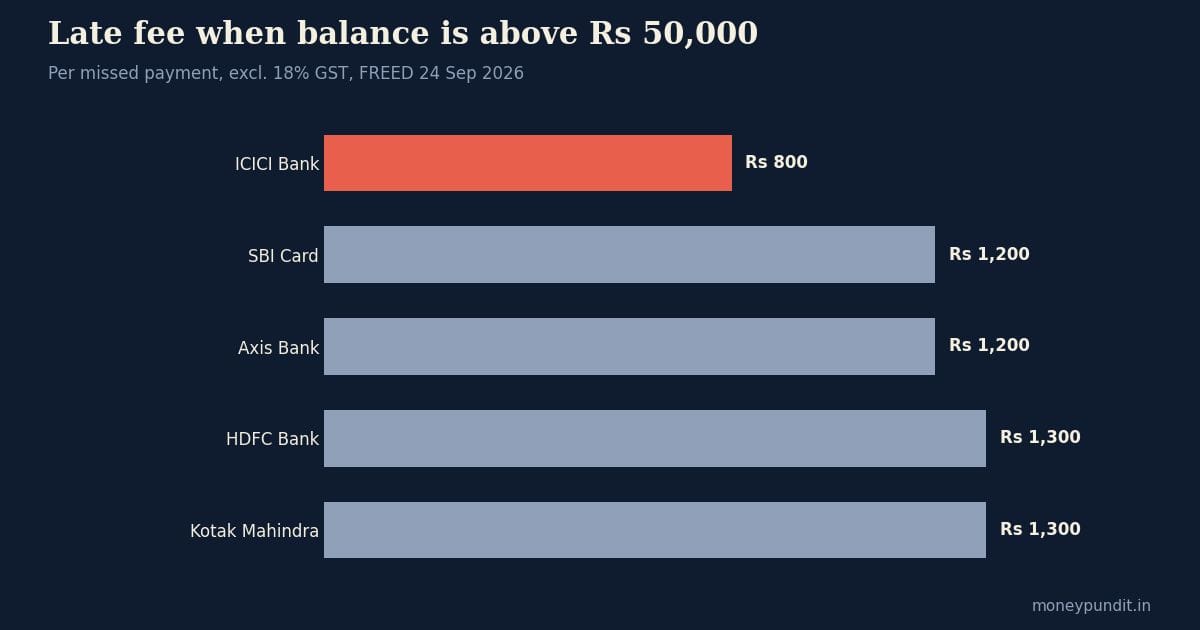
Late payment fee by amount due, before GST
| Amount due | HDFC | SBI | ICICI | Axis | Kotak |
|---|---|---|---|---|---|
| Below Rs 100 | Nil | Nil | Nil | Nil | Nil |
| Rs 100 to 500 | Rs 100 | Nil | Rs 100 | Rs 100 | Rs 100 |
| Rs 501 to 5,000 | Rs 500 | Rs 400 | Rs 400 | Rs 400 | Rs 500 |
| Rs 5,001 to 10,000 | Rs 500 | Rs 400 | Rs 500 | Rs 400 | Rs 500 |
| Rs 10,001 to 25,000 | Rs 750 | Rs 750 | Rs 600 | Rs 750 | Rs 750 |
| Rs 25,001 to 50,000 | Rs 1,000 | Rs 1,000 | Rs 700 | Rs 1,000 | Rs 1,000 |
| Above Rs 50,000 | Rs 1,300 | Rs 1,200 | Rs 800 | Rs 1,200 | Rs 1,300 |
Source: FREED late fee comparison, 24 Sep 2026. SBI Card adds Rs 100 if the minimum due is missed in two consecutive cycles. Axis Burgundy cards are exempt from late fees.
Other Credit Card Charges India Cardholders Should Know
Interest-free period, cash advance and GST
| Charge | What to expect | Source and date |
|---|---|---|
| Interest-free period | HDFC up to 50 days, SBI 50, ICICI 48, Axis 50, Kotak 48 to 50 | FREED, 24 Sep 2026 |
| Cash advance fee | Typically 2.5% to 3% with a minimum of Rs 250 to 500 | Paisabazaar, 7 Oct 2026 |
| Interest on cash advance | Charged from day one, no interest-free period | Paisabazaar, 7 Oct 2026 |
| GST | 18% on interest, fees and charges | GST rules, current |
The interest-free period only applies when the previous bill was paid in full. Carry any balance and new purchases start accruing interest from the transaction date.
Worked Example: What One Missed Payment Costs
Suppose Rs 20,000 is outstanding and the bill is paid 10 days late. The late fee is Rs 750 plus Rs 135 GST, and the illustration in the source puts interest at about Rs 1,000 because interest runs from the purchase date once the interest-free period is lost. The total is roughly Rs 1,885, close to 9.4% of the bill for a short delay. Use the credit card billing cycle guide to time payments so this never happens.
How to Reduce Credit Card Charges India Users Pay
Pay the full statement amount, not the minimum, every month. Set an auto-debit for at least the minimum due so one forgotten date never triggers a fee. Avoid ATM cash withdrawals on cards. If you already carry a balance, compare a credit card balance transfer or a personal loan, where the rate is far lower: see the personal loan interest rate comparison. For annual fees, read our credit card annual fee waiver tips and the shortlist in best credit cards in India.
How Credit Card Interest Is Calculated
Understanding how credit card charges India issuers apply makes the tables above easier to use. Interest is charged on the unpaid amount at the monthly rate, usually worked out on the daily outstanding balance. If you pay only the minimum due, the rest of the statement balance carries forward and every new purchase also starts accruing interest from its transaction date, because the interest-free period is lost. A 3.75% monthly rate compounds to roughly 45% a year, which is far above most personal loan rates, so revolving a balance is almost always the most expensive way to borrow.
Minimum due versus total due
The minimum due is a small slice of the bill (usually a few percent of the outstanding amount plus any fees, EMIs and taxes). Paying it avoids the late payment fee but not interest. Only paying the total due keeps the interest-free period alive on the next cycle. For the cycle dates, grace days and cut-off timing, see our guide on the credit card billing cycle and interest charges.
Other Fees That Add to Credit Card Charges India Cardholders Face
Beyond interest and late fees, issuers can levy an over-limit fee when spending crosses the sanctioned limit, a cheque or auto-debit dishonour fee when a payment fails, a charge for duplicate statements, and a card replacement fee. Reward redemption can also carry a small fee at some banks. These vary by card variant and change through the year, so the schedule of charges in your card’s most important terms and conditions document is the only reliable reference. Every one of these fees attracts 18% GST, which is easy to miss when comparing.
Late payment and your credit score
A late payment is reported to credit bureaus once it is overdue by 30 days or more, and repeated delays lower your credit score, which then raises the interest rate offered on future loans. Paying even a few days late costs money immediately, but a payment 30 or more days overdue can cost far more through a lower score.
Checklist Before You Compare Credit Card Charges India Banks Quote
Check the monthly and annual interest rate for your specific variant, not the headline range. Look up the late fee slab for your typical bill size. Confirm the interest-free period and how it is counted from the statement date. Ask about cash advance fees if you ever withdraw from an ATM. Review the annual fee and the spend needed to waive it. Finally, note that all of these figures are subject to change, and any change should be communicated by the issuer in advance under RBI rules.
What This Comparison Does Not Cover
This page is not exhaustive. Late fee slabs are available here for only five issuers (HDFC, SBI, ICICI, Axis, Kotak). Interest rates cover ten issuers. Public sector issuers such as Bank of Baroda Card and PNB, and others such as Standard Chartered, HSBC, AU Small Finance Bank and Federal Bank, are not covered because no dated source was available. Annual and joining fees vary by variant and are covered by card in our best credit cards guide. Forex markup is being compared in a separate page. Always check the bank’s most important terms and conditions document for your card.
FAQs on Credit Card Charges India
What are the main credit card charges India banks levy?
The main credit card charges India issuers apply are interest on unpaid balances (about 3.5% to 3.99% a month), late payment fees, cash advance fees, annual fees, over-limit fees and 18% GST on all of these.
What is the late payment fee on a credit card in India?
It depends on the amount due. For a due amount between Rs 10,001 and Rs 25,000, HDFC, SBI, Axis and Kotak charge Rs 750 and ICICI charges Rs 600, before GST.
How long is the interest-free period on a credit card?
Up to about 48 to 50 days at the large issuers (HDFC, SBI, Axis, ICICI, Kotak), provided the previous statement was paid in full.
Is there interest on credit card cash withdrawals?
Yes. Cash advances carry a fee of typically 2.5% to 3% (minimum Rs 250 to 500) and interest starts from the withdrawal date with no grace period.
Which credit card has the lowest interest rate?
Among the cards in our source, IDFC FIRST Private at 0.75% a month is the lowest, followed by Axis Burgundy Private at 1.50%. Premium eligibility and annual fees apply.
Related Resources
Compare home loan interest rates, the car loan interest rate comparison and the education loan interest rate comparison. Also see credit card vs debit card and credit card fraud protection tips.
Compare: debit card charges India 2026: annual fees, ATM fees and minimum balance penalties by bank for the debit side of card fees.
Compare: forex markup India 2026: credit card and forex card charges compared for foreign transaction fees.
Related guide: Read our guide on how to close a credit card in India.