
Car loan India interest rates can differ by 2-3 percentage points between banks and NBFCs for the same credit profile, and a longer tenure that lowers your EMI can still cost you significantly more in total interest. Here’s how current rates, eligibility, and EMI calculation actually work.
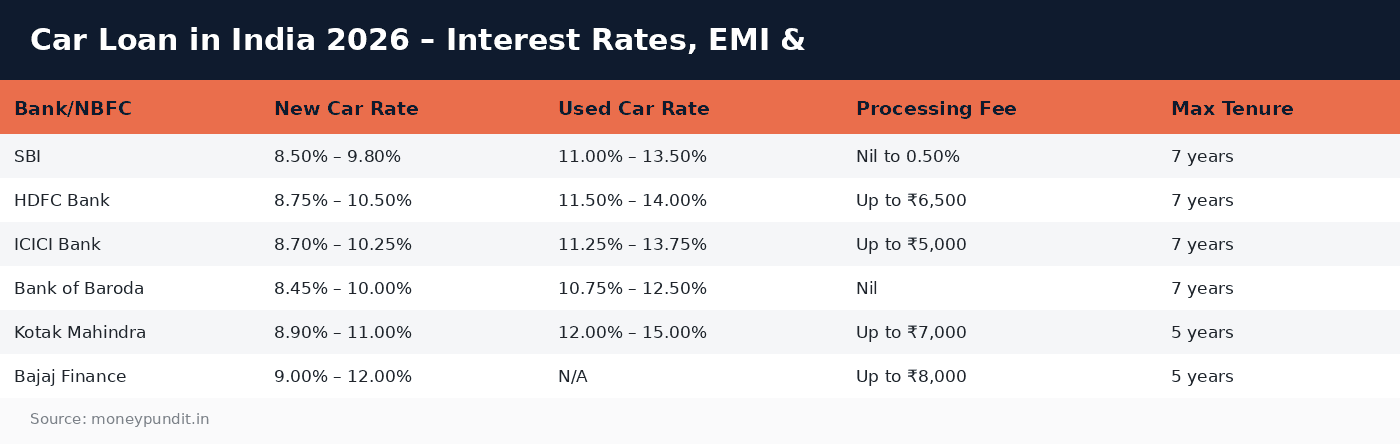
Everything you need to know about car loans in india in 2026 in brief: Car Loan India Interest Rates 2026: Bank-Wise Comparison These car loan India interest rates compare 25+ banks using two dated sources.
Car Loan India Interest Rates 2026: Bank-Wise Comparison
These car loan India interest rates compare 25+ banks using two dated sources. The first table shows the lowest advertised starting rate (some are for electric cars or top credit scores); the second shows the typical rate range for new cars. All figures predate the RBI repo rate hike to 5.50% on 7 October 2026, so lenders may reprice soon (RBI).
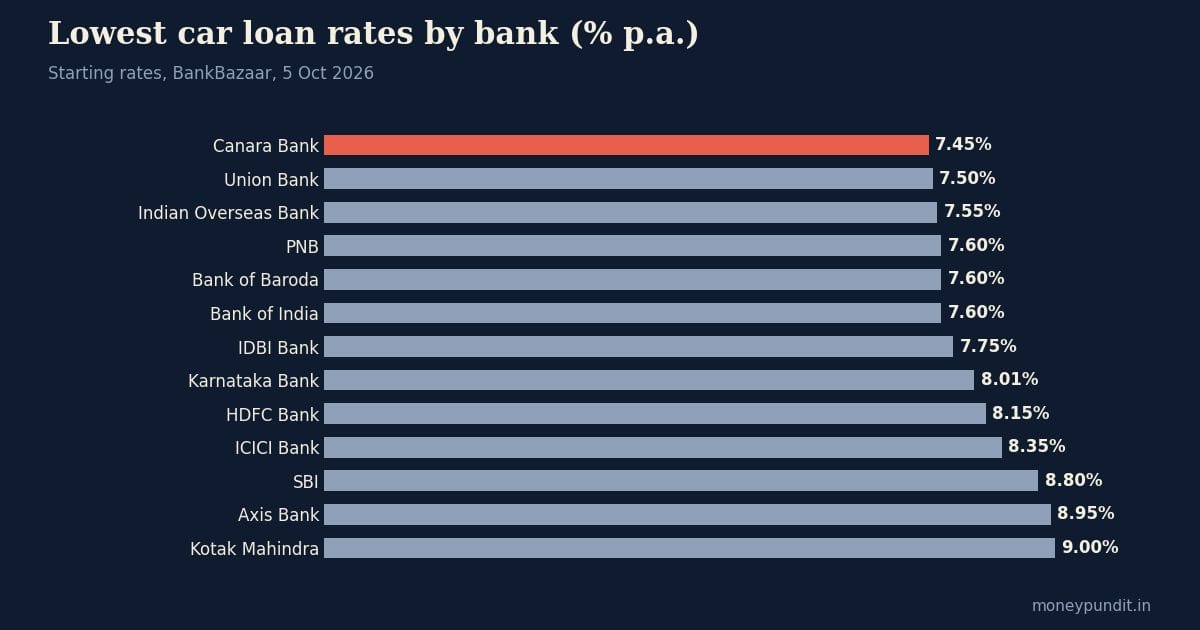
Lowest starting car loan India interest rates by bank
| Bank | Starting rate (p.a.) | EMI per ₹1 lakh, 7 years |
|---|---|---|
| Canara Bank | 7.45% onwards | ₹1,531 |
| Union Bank of India | 7.50% onwards | ₹1,534 |
| Indian Overseas Bank | 7.55% onwards | ₹1,536 |
| Punjab National Bank | 7.60% (floating), 8.60% (fixed) | ₹1,539 |
| Bank of Baroda | 7.60% (floating), 8.50% (fixed) | ₹1,539 |
| Bank of India | 7.60% onwards | ₹1,539 |
| IDBI Bank | 7.75% (floating), 8.65% (fixed) | ₹1,546 |
| Karnataka Bank | 8.01% onwards | ₹1,559 |
| HDFC Bank | 8.15% onwards | ₹1,569 |
| ICICI Bank | 8.35% onwards | ₹1,576 |
| State Bank of India | 8.80% onwards | ₹1,599 |
| Axis Bank | 8.95% onwards | ₹1,606 |
| Kotak Mahindra Bank | 9.00% onwards | ₹1,609 |
| Federal Bank | Not verified (source figures inconsistent) | n/a |
| Jammu & Kashmir Bank | RLLR + 0.75% (floating) | Ask the bank |
| South Indian Bank | Ask the bank | Ask the bank |
| Yes Bank | Ask the bank | Ask the bank |
Source: BankBazaar, updated 5 October 2026. Gap: Punjab & Sind Bank and Bank of Maharashtra are not covered in this table.
New car loan rate range by bank
| Bank | Rate range (p.a.) |
|---|---|
| State Bank of India | 8.65% – 9.70% |
| Bank of Baroda | 8.70% – 11.10% |
| Indian Bank | 8.60% – 12.90% |
| IDBI Bank | 8.75% – 9.55% |
| Bank of India | 8.75% – 11.25% |
| Punjab National Bank | 8.80% – 9.60% |
| Canara Bank | 8.80% – 11.95% |
| Bank of Maharashtra | 8.80% – 13.00% |
| Union Bank of India | 8.85% – 13.00% |
| UCO Bank | 8.90% – 10.55% |
| HDFC Bank | 8.95% – 11.00% |
| ICICI Bank | 8.95% – 11.25% |
| Axis Bank | 9.15% – 13.80% |
| Central Bank of India | 9.25% – 10.15% |
| Kotak Mahindra Bank | 8.25% – 13.00% |
Source: Deal4loans, updated 6 October 2026. Gap: Punjab & Sind Bank and Indian Overseas Bank are not covered in this table. Federal Bank and other private banks beyond HDFC, ICICI, Axis and Kotak are not listed, so check them directly.
How to read these car loan interest rates
The two sources differ because one lists the lowest “onwards” rate and the other lists the usual range, so quote the range when budgeting. Public sector banks lead on price, with Canara, Union Bank and Indian Overseas Bank starting under 7.60%, while Axis and Kotak start near 9%. A CIBIL score of 750 or above typically unlocks the lowest tier, and a down payment of 20% or more can cut the rate further. Women applicants at several banks get a concession of 0.05% to 0.25%. Fixed rates run roughly 0.9 to 1 percentage point above floating at PNB, Bank of Baroda and IDBI. Test your EMI with the EMI calculator before you apply.
Compare with personal loan interest rates, home loan interest rates and gold loan rates to pick the cheapest way to borrow.
Car Loan Eligibility
When exploring car loan in india 2026 options, it is important to compare interest rates, processing fees, and EMI structures across different banks.
Salaried individuals typically need a minimum monthly income of ₹15,000-₹25,000, age between 21-65 years, and a CIBIL score of 700 or above. Self-employed individuals need at least 2-3 years of business vintage and regular ITR filings. Banks generally finance 80-90% of the on-road price for new cars and 60-80% for used cars, meaning you need a 10-20% down payment.
How to Calculate Your Car Loan EMI
For a ₹8 lakh car loan at 9% interest for 5 years, the monthly EMI would be approximately ₹16,607, and you would pay ₹1.96 lakh as total interest over the loan tenure. For the same loan at 7 years, the EMI drops to ₹12,826, but total interest rises to ₹2.77 lakh, an additional ₹81,000 in interest charges for the extended tenure. This illustrates why choosing the shortest affordable tenure is critical for car loans.
New Car vs Used Car Loan
| Parameter | New Car Loan | Used Car Loan |
|---|---|---|
| Interest Rate | 8.5-12% | 11-16% |
| LTV (Loan-to-Value) | Up to 90-100% | Up to 60-80% |
| Max Tenure | 7 years | 3-5 years |
| Processing Fee | Lower | Higher |
| Documentation | Standard | Additional vehicle verification |
Used car loans come with higher interest rates because the collateral (the car) depreciates faster. The car’s age also limits the maximum loan tenure, most banks require the loan tenure plus the car’s age to not exceed 10 years. A 5-year-old used car may only qualify for a 4-5 year loan.
Tips to Get the Best Car Loan Deal
Negotiate the Interest Rate
Car loan rates are negotiable, unlike home loans which are largely standardised. Dealers often have tie-ups with specific banks and may quote higher rates to earn a commission. Get quotes from 3-4 banks directly before visiting the dealership. Armed with competing offers, you can negotiate a better rate at the dealer or with your preferred bank.
Make a Larger Down Payment
A 30-40% down payment significantly reduces your interest burden and often qualifies you for a lower interest rate. For a ₹10 lakh car, a 40% down payment means you borrow only ₹6 lakh. At 9% for 5 years, you save approximately ₹54,000 in interest compared to financing ₹9 lakh with a 10% down payment.
Choose the Shortest Possible Tenure
Your EMI should not exceed 15-20% of your monthly take-home income. Within this constraint, choose the shortest possible tenure. A ₹7 lakh loan at 9% costs ₹1.37 lakh in interest over 3 years but ₹2.43 lakh over 7 years. Since cars depreciate rapidly (losing 15-20% value in the first year alone), you want to avoid being in a situation where you owe more than the car is worth.
Car Loan Tax Benefits
Unlike home loans, there are no tax benefits on car loans for personal use. However, if you use the car for business purposes (self-employed or business owners), the interest paid on the car loan can be claimed as a business expense under Section 37. The depreciation on the vehicle can also be claimed for tax purposes. Salaried individuals who receive a car allowance may have some indirect tax benefits through their employer’s compensation structure.
Should You Buy or Lease?
Car leasing has gained popularity in India, especially in metro cities. Under a lease arrangement, you pay a monthly rental (typically 1.5-2% of the car’s on-road price) without owning the vehicle. Leasing works well if you change cars every 3-4 years, want lower monthly outflows, and don’t want the hassle of resale. Buying is better if you keep cars for 7-10 years, drive extensively (leases have mileage limits), and want an asset in your name.
Frequently Asked Questions
Can I prepay my car loan without charges?
As per RBI guidelines, banks cannot charge prepayment penalties on floating-rate vehicle loans. Since most car loans are now floating-rate, you can prepay without charges. Fixed-rate car loans (mainly from NBFCs) may carry prepayment charges of 2-5%. Always verify the loan type before signing.
Should I take a car loan from the dealer or my bank?
Compare both. Dealers sometimes offer manufacturer-subsidised zero or low interest schemes during festive seasons, which can be cheaper than bank loans. However, dealer-arranged bank loans may have inflated rates. The best practice is to get a pre-approved car loan from your bank and compare it with the dealer’s offering before finalising.
Is car insurance mandatory for a car loan?
Yes, comprehensive car insurance is mandatory for the entire loan tenure. The bank is listed as the hypothecation holder on the insurance policy. Most banks require you to maintain comprehensive insurance (not just third-party) and may insist on renewal through their partner insurers. You have the right to buy insurance from any insurer, so compare premiums instead of automatically accepting the bank’s partner offer.
What happens if I default on a car loan?
Car loans are secured against the vehicle. If you miss 3-6 consecutive EMIs, the bank can seize and auction the car to recover the outstanding loan amount. A default also severely damages your CIBIL score, making it difficult to get any credit in the future. If you foresee repayment difficulties, contact your bank immediately to discuss restructuring options before missing payments.
If you are comparing a car loan in India 2026 with other borrowing options, check our detailed guide on loan EMI calculation to understand how monthly instalments work. Whether you choose a car loan in India 2026 from a public sector bank or a private lender, always compare the total interest outgo before signing the agreement. A well-planned car loan in India 2026 can save you thousands in interest costs over the tenure.
References: Rbi.org.in
Need unsecured credit instead? Compare personal loan India interest rates across 30+ banks and NBFCs.
What is the lowest car loan interest rate in India in 2026?
Canara Bank starts at 7.45% (BankBazaar, 5 October 2026), followed by Union Bank of India at 7.50% and Indian Overseas Bank at 7.55%. These car loan India interest rates are best-case figures, and some apply only to electric cars or borrowers with a CIBIL score of 750 or more.
How will the RBI repo hike change car loan India interest rates?
The RBI raised the repo rate to 5.50% on 7 October 2026. Floating-rate car loans linked to repo-based benchmarks can reprice upward, while fixed-rate loans stay unchanged for existing borrowers. The rates above predate the hike.
Is a fixed or floating car loan rate cheaper?
Floating rates usually start lower: at Punjab National Bank 7.60% floating against 8.60% fixed, and at Bank of Baroda 7.60% against 8.50%. Fixed rates keep your EMI constant, which suits short tenures.
Which banks offer the cheapest new car loan range?
Indian Bank (8.60% to 12.90%), State Bank of India (8.65% to 9.70%), Bank of Baroda (8.70% to 11.10%) and IDBI Bank (8.75% to 9.55%) lead on the typical range, per Deal4loans on 6 October 2026.
Funding a course? Compare education loan India interest rates across 25+ lenders.
Related guide: Read our guide on how to close a car loan account in India.