
Education loan India interest rates start near 6.85% at public sector banks, and an education loan up to ₹7.5 lakh for studying in India doesn’t require any collateral under RBI’s model scheme, a fact many families don’t know, so they either avoid education loans entirely or pledge property unnecessarily. Here’s current interest rates, loan types, tax benefits, and repayment rules.
An education loan is one of the most impactful financial decisions for students and parents in India. With the cost of quality education rising sharply, IIM fees now exceed ₹25 lakh, engineering colleges charge ₹10-20 lakh, and overseas education costs ₹30-80 lakh, education loans bridge the gap between aspirations and affordability. The added benefit of Section 80E tax deduction on interest makes this one of the most tax-friendly borrowing options available.
Education Loan India Interest Rates 2026: Bank-Wise Comparison
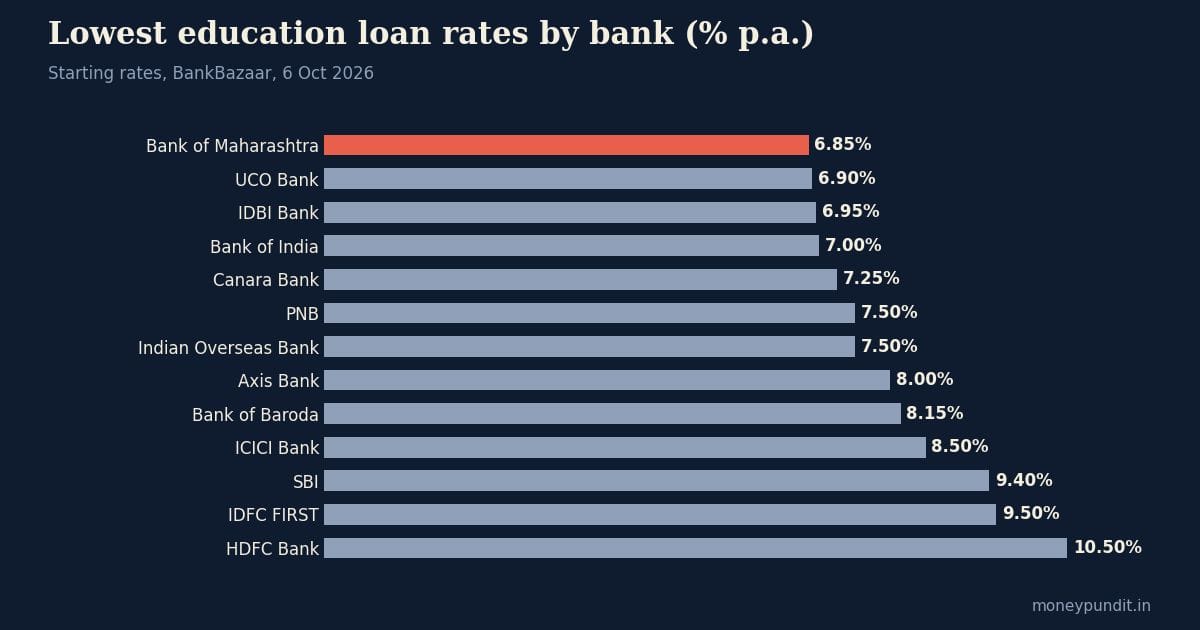
These education loan India interest rates cover 26 lenders: banks, regional rural banks and NBFCs. Public sector banks are cheapest, especially up to ₹7.5 lakh; private banks and NBFCs charge more and add processing fees. Women borrowers get a 0.5% concession at SBI and Canara Bank. All figures predate the RBI repo rate hike to 5.50% on 7 October 2026, so lenders may reprice soon (RBI).
Banks: education loan India interest rates and fees
| Bank | Interest rate (p.a.) | Processing fee |
|---|---|---|
| Bank of Maharashtra | 6.85% – 10.05% | Nil |
| UCO Bank | 6.90% – 10.50% | Nil (0.50% on UCO Aspire, max ₹10,000) |
| IDBI Bank | 6.95% – 10.40% | Nil |
| Bank of India | 7.00% – 9.80% | Nil |
| Canara Bank | 7.25% – 10.10% | Nil or minimal |
| Punjab National Bank | 7.50% onwards | Nil |
| Indian Overseas Bank | 7.50% – 11.75% | Contact the bank |
| Axis Bank | 8.00% – 16.00% | Up to 2% + GST |
| Bank of Baroda | 8.15% onwards | Nil |
| ICICI Bank | 8.50% – 13.00% | Up to 2% + GST |
| State Bank of India | 9.40% – 9.90% | Nil up to ₹7.5 lakh |
| IDFC FIRST Bank | 9.50% onwards | Up to 1.5% |
| Karnataka Bank | 9.81% onwards | Nil in India; ₹10,000 + GST abroad |
| HDFC Bank | 10.50% onwards | Nil up to ₹7.5 lakh; 1% above |
| Karur Vysya Bank | 10.75% – 13.25% | ₹5,000 + GST above ₹7.5 lakh |
| Federal Bank | 10.50% – 13.50% | Contact the bank |
| Tamilnad Mercantile Bank | 11.30% – 14.15% | Nil in India; 1% abroad |
| Kotak Mahindra Bank | Up to 16% | Nil |
Source: BankBazaar, updated 6 October 2026. Gap: Union Bank of India, Indian Bank, Central Bank of India and Punjab & Sind Bank are not in the source table, so check them directly.
Regional rural banks: education loan India interest rates
| Bank | Interest rate (p.a.) |
|---|---|
| Maharashtra Gramin Bank | 9.25% |
| Kerala Gramin Bank | 9.80% onwards |
| Assam Gramin Vikash Bank | 9.85% onwards |
| J&K Grameen Bank | 9.95% – 10.45% |
| Gujarat Gramin Bank | 10.50% – 12.00% |
| Karnataka Gramin Bank | 10.50% – 11.50% |
Source: BankBazaar, updated 6 October 2026. RRB loans may qualify for the Central Sector Interest Subsidy (CSIS).
NBFCs: education loan India interest rates
| Lender | Interest rate (p.a.) | Processing fee |
|---|---|---|
| Bajaj Finance | 11.00% – 16.00% | Up to 3.54% |
| Tata Capital | 11.30% – 15.25% | Up to 2% + taxes |
Source: BankBazaar, updated 6 October 2026. NBFCs approve faster and with fewer collateral demands, but cost more.
How to read education loan India interest rates
The range shown depends on your course, institute, loan size and collateral: top institutes such as IITs and IIMs, a strong co-applicant and collateral above ₹7.5 lakh all push you toward the low end. Bank of Maharashtra, UCO Bank, IDBI Bank and Bank of India start below 7.05%, while HDFC and private lenders start above 10%. Interest paid is deductible under Section 80E for up to 8 years with no upper limit. Compare education loan India interest rates on all-in cost, then check the EMI on a ₹10 lakh loan at 9% over 10 years (about ₹12,668) with the EMI calculator.
Compare with personal loan interest rates, car loan rates and home loan rates before choosing how to fund a course; education loan India interest rates are usually the lowest of the four.
Types of Education Loans
Based on Loan Amount
Education loans up to ₹4 lakh typically require no collateral or third-party guarantee. Loans between ₹4-7.5 lakh require a third-party guarantee but no collateral. Loans above ₹7.5 lakh require collateral. This can be property, fixed deposits, LIC policies, or gold. These thresholds may vary slightly between banks but follow the Indian Banks’ Association (IBA) guidelines.
Domestic vs International
Loans for domestic education cover tuition fees, hostel charges, examination fees, books, equipment, and reasonable living expenses at recognised Indian institutions. International education loans additionally cover travel expenses, visa fees, health insurance, and cost of living abroad. Interest rates for overseas education are typically 0.5-1% higher than domestic loans.
Eligibility and Documentation
The student must be an Indian citizen with confirmed admission to a recognised institution. There is no minimum academic percentage requirement from banks, but top-tier institution admissions (IITs, IIMs, AIIMS, top 100 global universities) attract lower interest rates and faster approvals. A co-applicant (parent, guardian, or spouse) is mandatory for all education loans. Key documents include admission letter, fee structure, academic records, co-applicant’s income proof, and collateral documents (for larger loans).
Repayment Structure
Moratorium Period
Education loans come with a moratorium period: the course duration plus 6-12 months after course completion or 6 months after getting a job, whichever is earlier. During this period, no EMI payment is required. However, interest continues to accrue during the moratorium. Many experts recommend paying at least the interest portion during the study period to prevent the principal from ballooning due to compounding interest.
Repayment Tenure
After the moratorium, the loan must be repaid in EMIs over 5-15 years depending on the loan amount and lender. Larger loans for premium programs typically get longer tenures. Some lenders offer step-up EMI structures where initial EMIs are smaller and increase over time as the borrower’s earning capacity grows.
Section 80E Tax Benefit
The interest paid on education loans is fully deductible under Section 80E of the Income Tax Act, with no upper limit on the deduction amount. This benefit is available for 8 years from the year you start repaying the loan, or until the interest is fully paid, whichever is earlier. The deduction is available only to the individual who repays the loan, so if a parent is repaying, they claim the deduction.
For example, if you pay ₹2.5 lakh in interest in a financial year and are in the 30% tax bracket, you save ₹75,000 in taxes that year. Over the repayment period, the total tax savings can be ₹3-5 lakh for a large education loan, significantly reducing the effective cost of borrowing.
Education Loan for Abroad Studies – Special Considerations
Loan Disbursement in Foreign Currency
Some lenders disburse the loan directly to the foreign university in the local currency (USD, GBP, EUR), while others convert to foreign currency and remit. Direct disbursement avoids exchange rate fluctuations between sanction and payment. Check with your lender about the disbursement mode and any forex markup charges.
Choosing Between Indian and Foreign Lenders
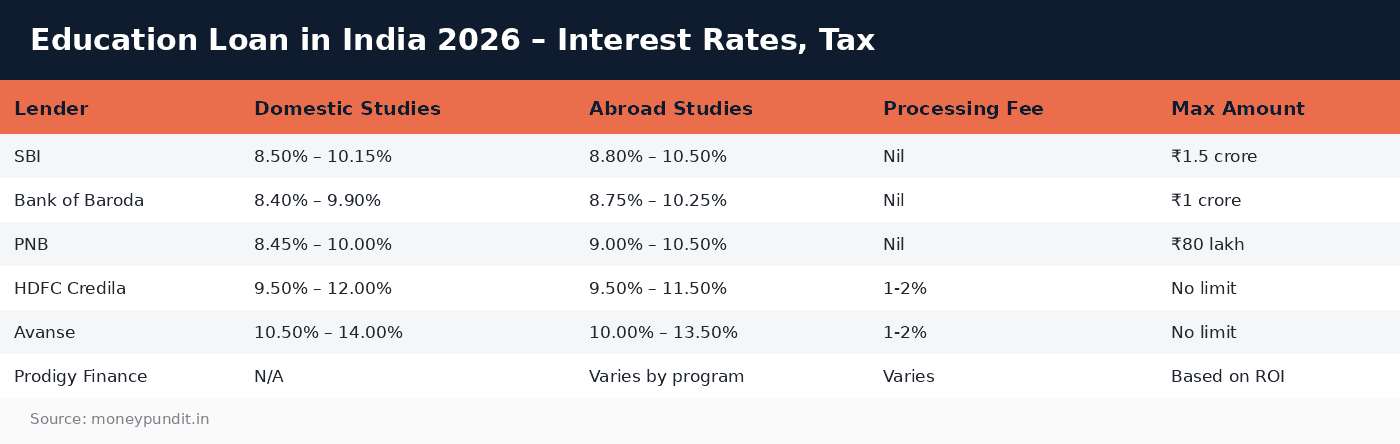
Indian banks offer lower interest rates (8.5-12%) but require collateral for larger amounts and have extensive documentation. Foreign lenders like Prodigy Finance and MPower offer unsecured loans based on the expected return on investment of your program but at higher interest rates (10-15%). The choice depends on your collateral availability and the specific program’s reputation with lenders.
Tips to Reduce Your Education Loan Burden
Pay Interest During the Moratorium
On a ₹20 lakh loan at 9.5% interest, the monthly simple interest is approximately ₹15,833. If you let this accumulate over a 2-year course plus 6-month moratorium (30 months), approximately ₹4.75 lakh gets added to your principal. By paying just the interest during studies, you save significantly on total repayment.
Prepay When Possible
Most banks do not charge prepayment penalties on education loans. Use bonuses, tax refunds, or any windfalls to make partial prepayments. Even small prepayments in the early years reduce the principal significantly and save substantial interest over the remaining tenure.
Explore Scholarships and Assistantships
Many universities, especially abroad, offer teaching assistantships, research assistantships, and need-based scholarships that can cover 20-100% of tuition. Apply aggressively for these opportunities to reduce the loan amount needed. Every ₹1 lakh reduction in the loan saves approximately ₹50,000-₹80,000 in interest over the repayment period.
Frequently Asked Questions
Can I get an education loan without collateral?
Yes, loans up to ₹4-7.5 lakh from PSU banks do not require collateral. Private lenders like HDFC Credila and Avanse offer unsecured loans up to ₹20-40 lakh for admissions to top-ranked institutions, though at higher interest rates. The institution’s ranking and the student’s academic profile play a crucial role in unsecured loan approval.
What if I cannot find a job after completing my course?
Banks generally provide flexibility during genuine financial hardship. You can request EMI restructuring or an extended moratorium period. However, the loan obligation does not disappear. Interest continues to accumulate. The co-applicant (usually a parent) becomes liable for repayment if the student cannot pay. It is essential to have a realistic assessment of job prospects before taking a large education loan.
Can my parents claim the 80E deduction?
Yes, if your parents are repaying the education loan, they can claim the Section 80E interest deduction on their income tax return. However, the deduction is available only to individuals (not companies or HUFs), and only for loans taken from recognised financial institutions or approved charitable organisations, not from relatives or friends.
Is education loan interest rate fixed or floating?
Most education loans from PSU banks are on a floating rate basis, linked to the MCLR or external benchmark rate. This means the interest rate can change during the repayment period. Some private lenders offer fixed-rate options, which provide EMI certainty but may start at a slightly higher rate. In a falling interest rate environment, floating rates benefit borrowers, while fixed rates protect against rate increases.
What is the lowest education loan interest rate in India in 2026?
Bank of Maharashtra starts at 6.85%, followed by UCO Bank at 6.90% and IDBI Bank at 6.95% (BankBazaar, 6 October 2026). These education loan India interest rates are starting figures; your rate depends on the course, institute and collateral.
How will the RBI repo hike change education loan India interest rates?
The RBI raised the repo rate to 5.50% on 7 October 2026. Floating-rate education loans linked to repo-based benchmarks can reprice upward, while fixed-rate loans stay unchanged. The rates above predate the hike.
Which banks charge no processing fee on education loans?
Bank of Maharashtra, IDBI Bank, Bank of India, Punjab National Bank, Bank of Baroda and Kotak Mahindra Bank list nil fees, and SBI and HDFC charge none up to ₹7.5 lakh. Axis Bank and ICICI Bank charge up to 2% plus GST.
Are NBFC education loans costlier than bank loans?
Yes. Bajaj Finance charges 11% to 16% with fees up to 3.54%, and Tata Capital 11.30% to 15.25%, against under 8% starting rates at several public sector banks.
Related guide: Read our guide on how to close an education loan account in India.