
Freelancer tax in brief: Under this scheme, 50% of your gross receipts are deemed as profit.
A freelancer earning ₹15 lakh a year can legally pay tax on just 50% of that income under Section 44ADA’s presumptive taxation scheme, a provision most self-employed professionals in India don’t fully use. Here’s how freelancer taxation, GST, and deductions actually work.
Freelancer Income Tax Basics
| Aspect | Details |
|---|---|
| Income Classification | Business or Professional Income (under PGBP head) |
| ITR Form | ITR-3 (regular) or ITR-4 (presumptive taxation) |
| Tax Rate | Normal slab rates (same as salaried) |
| Advance Tax | Must pay quarterly if tax liability > ₹10,000/year |
| GST Registration | Required if turnover exceeds ₹20 lakh (₹10 lakh special states) |
| TDS by Clients | 10% under Section 194J (professional fees) |
Presumptive Taxation (Section 44ADA) – The Simpler Route
If your gross receipts are below ₹75 lakh per year (with digital receipts being 95%+ of total), you can opt for presumptive taxation under Section 44ADA. Under this scheme, 50% of your gross receipts are deemed as profit. You pay tax on this 50% and don’t need to maintain detailed books of accounts or get an audit done.
For example, if you earn ₹30 lakh as a freelancer, 50% (₹15 lakh) is your deemed profit. After standard deductions (80C, 80D, etc.), your taxable income and tax liability are calculated on this amount. The beauty is that even if your actual expenses are only 20% of revenue (common for IT freelancers), you still get to declare 50% as expenses. No books, no audit, simple ITR-4 filing.
Deductible Business Expenses
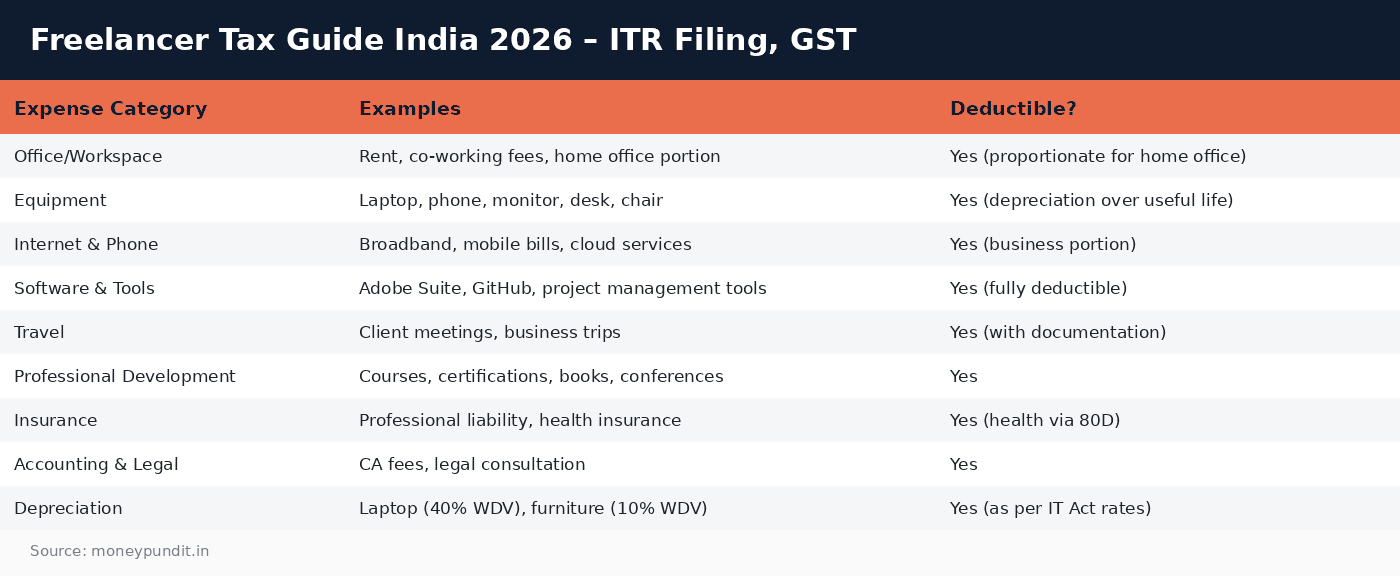
If you opt for regular taxation (ITR-3) instead of presumptive, you can deduct all legitimate business expenses from your income. Common deductions include:
| Expense Category | Examples | Deductible? |
|---|---|---|
| Office/Workspace | Rent, co-working fees, home office portion | Yes (proportionate for home office) |
| Equipment | Laptop, phone, monitor, desk, chair | Yes (depreciation over useful life) |
| Internet & Phone | Broadband, mobile bills, cloud services | Yes (business portion) |
| Software & Tools | Adobe Suite, GitHub, project management tools | Yes (fully deductible) |
| Travel | Client meetings, business trips | Yes (with documentation) |
| Professional Development | Courses, certifications, books, conferences | Yes |
| Insurance | Professional liability, health insurance | Yes (health via 80D) |
| Accounting & Legal | CA fees, legal consultation | Yes |
| Depreciation | Laptop (40% WDV), furniture (10% WDV) | Yes (as per IT Act rates) |
Advance Tax: Quarterly Payments
If your estimated tax liability for the year exceeds ₹10,000, you must pay advance tax in quarterly instalments. Missing advance tax deadlines attracts interest under Section 234B and 234C.
| Due Date | Cumulative Tax Due |
|---|---|
| June 15 | 15% of annual tax |
| September 15 | 45% of annual tax |
| December 15 | 75% of annual tax |
| March 15 | 100% of annual tax |
Estimate your annual income at the start of the year, calculate approximate tax, and pay 15% by June 15. Revise estimates each quarter as actual income becomes clearer. If you opt for presumptive taxation (44ADA), you can pay the entire advance tax by March 15 in a single instalment.
GST for Freelancers
When to Register
GST registration is mandatory when your annual turnover crosses ₹20 lakh (₹10 lakh in special category states). If you provide services to clients outside India (export of services), you may want to register voluntarily to claim GST refunds on your input purchases even if below the threshold.
GST Rate on Services
Most professional and freelance services attract 18% GST. Export of services (to clients outside India where payment is received in foreign currency) is zero-rated. You charge 0% GST but can claim refund on input GST paid. This makes GST registration beneficial for freelancers with international clients.
Simplified Compliance
Freelancers below ₹1.5 crore turnover can opt for the QRMP scheme (Quarterly Return Monthly Payment), file GSTR-1 and GSTR-3B quarterly instead of monthly. This reduces compliance burden from 24 returns per year to 8. If eligible, the composition scheme (6% flat rate for service providers below ₹50 lakh turnover) simplifies even further but you cannot claim ITC or issue GST invoices.
TDS on Freelancer Income
Indian clients paying professional fees are required to deduct 10% TDS under Section 194J before paying you. This means if your invoice is ₹1 lakh, the client pays ₹90,000 to you and deposits ₹10,000 as TDS with the government. This TDS appears in your Form 26AS and can be claimed as credit against your total tax liability. If the TDS deducted exceeds your actual tax, you can claim a refund through your ITR.
Tax-Saving Strategies for Freelancers
Maximise Section 80C
Without employer-contributed EPF, freelancers must actively invest in PPF (up to ₹1.5 lakh/year), ELSS mutual funds, life insurance premiums, or NSC to utilise the full 80C deduction. PPF is especially valuable because it provides guaranteed returns with complete tax exemption.
Open an NPS Account
Contribute to NPS for the additional ₹50,000 deduction under Section 80CCD(1B), over and above 80C. This effectively gives freelancers ₹2 lakh in total tax-saving investment capacity. At the 30% tax bracket, this saves ₹60,000 in taxes annually.
Health Insurance (80D)
Without employer-provided group health insurance, freelancers must buy their own coverage. The premium is deductible under 80D, up to ₹25,000 for self and family, plus ₹50,000 for senior citizen parents. This is both a tax saving and a critical financial safety net.
Frequently Asked Questions
Do I need to maintain books of accounts as a freelancer?
Under presumptive taxation (44ADA), no detailed books are required. Under regular taxation (ITR-3), you must maintain books if your gross receipts exceed ₹1.5 lakh or income exceeds ₹2.5 lakh. For practical purposes, maintain a simple income-expense record with supporting invoices and receipts regardless of the threshold.
What if my income fluctuates significantly month to month?
Fluctuating income is normal for freelancers. For advance tax, estimate conservatively based on past year’s income and adjust quarterly. Build a buffer of 3-6 months expenses to handle lean months. For tax planning, use the presumptive scheme if eligible, it simplifies everything regardless of income fluctuations.
Can I claim my home as a business expense?
If you work from home, you can claim a proportionate share of rent, electricity, internet, and maintenance as business expenses. The commonly accepted method is to estimate the percentage of your home used for work (e.g., one room out of four = 25%) and deduct 25% of these household expenses. Maintain documentation supporting the business use claim.
Do freelancers need to register as a business entity?
No, you can freelance as an individual (sole proprietor) without registering any formal business entity. You file ITR using your personal PAN. Registering as an LLP or private limited company becomes worthwhile only when your annual income exceeds ₹20-30 lakh and you want to optimise taxes through salary-dividend split or limit personal liability.
References: Amfiindia.com
Freelancer tax: Key Takeaways
Key points on freelancer tax:
- You pay tax on this 50% and don’t need to maintain detailed books of accounts or get an audit done.
- If you opt for regular taxation (ITR-3) instead of presumptive, you can deduct all legitimate business expenses from your income.
- If your estimated tax liability for the year exceeds ₹10,000, you must pay advance tax in quarterly instalments.
Verify the latest freelancer tax figures with Income Tax Department before you act.