

Nps calculator returns tax in brief: Historically, NPS Tier-I equity schemes have delivered 12-14% CAGR since inception.
Nps Calculator: What Is NPS?
The National Pension System (NPS) is a voluntary, long-term retirement savings scheme designed to enable systematic savings during the subscriber working life. Regulated by PFRDA (Pension Fund Regulatory and Development Authority), NPS offers market-linked returns through professional fund management with very low fund management charges (0.01%, the lowest in the world).
 NPS calculator returns tax: NPS Calculator – National Pension System Returns &" class="wp-image-2391" style="width:100%;height:auto !important;object-fit:contain !important;max-width:100%;" loading="lazy" srcset="https://moneypundit.in/wp-content/uploads/2026/09/mp2-467-nps-calculator-national-pension-system-returns.png 1400w, https://moneypundit.in/wp-content/uploads/2026/09/mp2-467-nps-calculator-national-pension-system-returns-300x67.png 300w, https://moneypundit.in/wp-content/uploads/2026/09/mp2-467-nps-calculator-national-pension-system-returns-1024x228.png 1024w, https://moneypundit.in/wp-content/uploads/2026/09/mp2-467-nps-calculator-national-pension-system-returns-768x171.png 768w" sizes="(max-width: 1400px) 100vw, 1400px" />
How NPS Returns Are Calculated
Unlike PPF or FD which offer fixed returns, NPS returns depend on the asset allocation you choose and market performance. NPS offers four asset classes: Equity (E), invested in stocks, Corporate Bonds (C), Government Securities (G), and Alternative Assets (A). Historically, NPS Tier-I equity schemes have delivered 12-14% CAGR since inception.
An NPS calculator estimates your retirement corpus based on your monthly contribution, expected rate of return, and years until retirement. For instance, if you are 30 years old and contribute Rs 10,000/month until age 60 with an expected 10% return, your corpus would be approximately Rs 2.26 crore.
NPS Tax Benefits (Triple Tax Advantage)
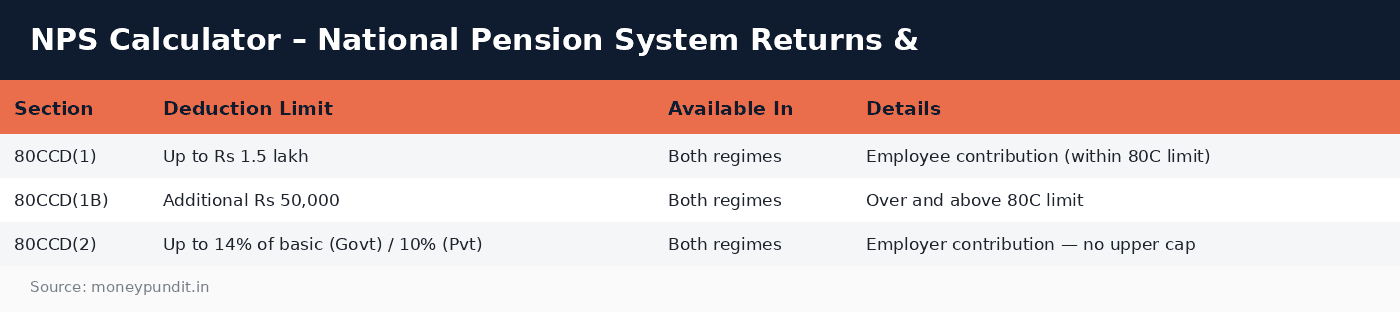
| Section | Deduction Limit | Available In | Details |
|---|---|---|---|
| 80CCD(1) | Up to Rs 1.5 lakh | Both regimes | Employee contribution (within 80C limit) |
| 80CCD(1B) | Additional Rs 50,000 | Both regimes | Over and above 80C limit |
| 80CCD(2) | Up to 14% of basic (Govt) / 10% (Pvt) | Both regimes | Employer contribution: no upper cap |
This means a salaried person can claim up to Rs 2 lakh in NPS deductions (Rs 1.5L under 80C + Rs 50K under 80CCD1B), plus unlimited employer contribution under 80CCD(2). For someone in the 30% tax bracket, the Rs 50,000 additional deduction alone saves Rs 15,600 in tax every year.
NPS Asset Allocation Options
Active Choice: You decide the allocation across E, C, G, and A classes. Maximum equity allocation is 75% up to age 50, then reduces by 2.5% each year. For young investors (under 35), an aggressive allocation of 75% equity, 15% corporate bonds, and 10% government securities is recommended.
Auto Choice (Lifecycle Fund): Asset allocation automatically adjusts based on your age. Three options: Aggressive (LC-75), Moderate (LC-50), and Conservative (LC-25), the number indicates maximum equity allocation at younger ages.
NPS Withdrawal Rules at Retirement
At age 60, you must use at least 40% of the corpus to purchase an annuity (monthly pension) from an empaneled insurance company. The remaining 60% can be withdrawn as a lump sum, which is completely tax-free.
If the total corpus is less than Rs 5 lakh, you can withdraw the entire amount as lump sum. Partial withdrawals (up to 25% of contributions) are allowed after 3 years for specific purposes like children education, marriage, home purchase, or medical treatment.
Best NPS Fund Managers (Performance)
Among NPS fund managers, SBI Pension Funds, HDFC Pension, and Kotak Pension have consistently been top performers in the equity (Tier-I Scheme E) category. When choosing a fund manager, compare the 5-year and since-inception returns across the E, C, and G categories, and remember you can switch fund managers once per year at no cost.
Frequently Asked Questions
NPS vs PPF: which is better? NPS offers potentially higher returns (10-14% vs 7.1% for PPF) due to equity exposure, and the additional Rs 50,000 tax deduction under 80CCD(1B). However, PPF offers guaranteed returns and full tax-free withdrawal. Ideally, use both: PPF for guaranteed debt allocation and NPS for equity-linked retirement savings with extra tax benefits.
Can I close NPS before 60? Premature exit before 60 is allowed after 5 years, but you must use at least 80% of the corpus for annuity purchase and only 20% can be withdrawn as lump sum. If corpus is below Rs 2.5 lakh, full withdrawal is allowed.
Is NPS mandatory for government employees? NPS is mandatory for all central government employees who joined service on or after January 1, 2004. State government employees are also covered under NPS in most states.
NPS Asset Allocation: Active vs Auto Choice
NPS offers two allocation strategies: Active Choice (you decide the equity-debt-government securities split, with equity capped at 75% until age 50, then reducing by 2.5% annually) and Auto Choice (lifecycle fund that automatically reduces equity as you age). Under Active Choice, aggressive investors should maximize equity (75%) in their 20s-30s for highest growth potential. NPS equity funds (Tier I, Scheme E) have delivered 12-14% CAGR since inception.
The three asset classes: Equity (E) for growth, Corporate Bonds (C) for moderate returns with some risk, and Government Securities (G) for safety. A balanced Active Choice allocation for a 35-year-old: 60% E + 25% C + 15% G. Review and rebalance annually. Under Auto Choice, the “Aggressive” lifecycle fund starts at 75% equity (age 35) and tapers to 15% by age 55, a good hands-off option. Use the calculator above to project your corpus under different allocation scenarios.
Maximizing NPS Tax Benefits Across Sections
NPS offers the most generous tax deductions of any single investment: Section 80CCD(1) within the 80C limit (₹1.5 lakh), Section 80CCD(1B) for additional ₹50,000 beyond 80C, and Section 80CCD(2) for employer’s contribution up to 14% of basic salary (not subject to the ₹1.5 lakh ceiling). A salaried employee with ₹8 lakh basic can claim: ₹1.5 lakh (80C) + ₹50,000 (80CCD(1B)) + ₹1.12 lakh (employer’s 14%) = ₹3.12 lakh in total NPS-related deductions.
At maturity (age 60), 60% of the corpus can be withdrawn as a lump sum (tax-free), and the remaining 40% must purchase an annuity from an IRDAI-registered insurer. Annuity income is taxable at your slab rate, but post-retirement slab rates are typically lower. If your total corpus is ₹5 lakh or less, you can withdraw 100% as lump sum. Compare NPS with PPF and EPF: each has different strengths. NPS offers the highest growth potential and maximum tax benefits, PPF offers completely tax-free maturity, and EPF provides employer matching. The optimal strategy: contribute to all three based on your Section 80C allocation and additional NPS-specific deductions.
The NPS trade-off is real: you lock in liquidity for a tax break and a disciplined retirement corpus. Run the numbers against your own retirement timeline before committing a large monthly contribution.
Frequently Asked Questions
How does the NPS calculator estimate my corpus?
It compounds your monthly contribution at the expected return you enter until your retirement age, then splits the corpus between a lump sum and an annuity. It is an estimate only, because NPS returns are market-linked and not guaranteed.
How much tax can I save with NPS?
Under the old tax regime, your own contribution counts towards the Section 80C limit, and an additional deduction of up to Rs 50,000 is available under Section 80CCD(1B). Employer contributions under Section 80CCD(2) are deductible within limits, including under the new regime.
Can I withdraw from NPS before age 60?
Tier 1 allows limited partial withdrawals for specific needs such as illness, higher education, marriage of children or buying a home, usually after three years. A full exit before 60 requires buying an annuity with a large share of the corpus. Check the current PFRDA rules before you decide.
What return should I assume in the NPS calculator?
Use a conservative range instead of one number. Try a lower, a middle and a higher case, because returns depend on your equity share and on market conditions over the years.
NPS calculator returns tax: Key Takeaways
Key points on nps calculator returns tax:
- The National Pension System (NPS) is a voluntary, long-term retirement savings scheme designed to enable systematic savings during the subscriber working life.
- Unlike PPF or FD which offer fixed returns, NPS returns depend on the asset allocation you choose and market performance.
- For someone in the 30% tax bracket, the Rs 50,000 additional deduction alone saves Rs 15,600 in tax every year.
Verify the latest nps calculator returns tax figures with Income Tax Department before you act.