
Hra tax exemption calculation in brief: When calculated correctly, HRA can save ₹50,000-₹2,00,000 in annual taxes, especially for those in metro cities with high rents.
HRA exemption is calculated as the lowest of three separate figures, not simply whatever HRA amount appears on your payslip, and paying rent to a parent or relative comes with its own specific documentation rules that many taxpayers get wrong. Here’s how to calculate and claim the maximum benefit correctly.
House Rent Allowance (HRA) exemption is one of the largest tax-saving opportunities for salaried individuals living in rented accommodation. When calculated correctly, HRA can save ₹50,000-₹2,00,000 in annual taxes, especially for those in metro cities with high rents.
HRA Exemption Calculation
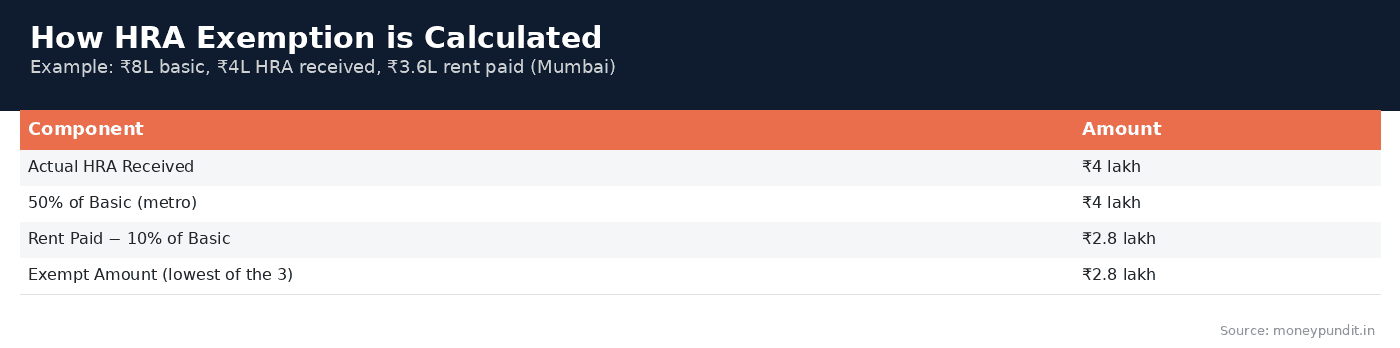
The exempt HRA is the lowest of three amounts: actual HRA received from your employer, 50% of basic salary for metro cities (40% for non-metro), and actual rent paid minus 10% of basic salary. For example, if your basic salary is ₹8 lakh, HRA received is ₹4 lakh, and rent paid is ₹3.6 lakh in Mumbai: the three values are ₹4 lakh, ₹4 lakh (50% of ₹8 lakh), and ₹2.8 lakh (₹3.6 lakh – ₹80,000). The lowest is ₹2.8 lakh. This becomes your tax-exempt HRA.
Documents Required for HRA Claim
Rent receipts with revenue stamp for rent below ₹5,000/month, or rent agreement plus bank transfer proof for higher amounts. If annual rent exceeds ₹1 lakh, you must provide the landlord’s PAN card details. If the landlord does not have PAN, a declaration to that effect is required. Maintain bank statements showing rent transfers as proof, cash payments are harder to substantiate and may be questioned during assessment.
HRA When Paying Rent to Family Members
You can pay rent to your parents and claim HRA exemption, provided the arrangement is genuine. Your parent must declare the rental income in their ITR. If your parent is in a lower tax bracket or is a senior citizen with basic exemption, the family saves net tax through this arrangement. However, paying rent to your spouse is not allowed for HRA exemption. Ensure rent agreements and regular bank transfers exist as documentation.
HRA for Those Living in Their Own House
If you live in your own house, you cannot claim HRA exemption. However, if you own a house in one city but live in rented accommodation in another city for work, you can claim both HRA exemption and home loan interest deduction under Section 24(b) simultaneously. This is a legitimate and powerful dual benefit for those who have relocated for work while maintaining property in their hometown.
Section 80GG: HRA Alternative for Self-Employed
Self-employed individuals and salaried persons who do not receive HRA can claim rent deduction under Section 80GG. The maximum deduction is the least of ₹5,000 per month, 25% of total income, or actual rent minus 10% of total income. This provides some relief but is significantly lower than HRA benefits available to salaried individuals.
Is HRA available under the new tax regime?
No: HRA exemption is not available under the new tax regime. If your HRA exemption is substantial (especially in metro cities), this alone may make the old regime more beneficial for you. Calculate both scenarios before choosing.
How HRA Exemption Is Calculated
HRA (House Rent Allowance) exemption is one of the most valuable tax benefits available to salaried individuals under the old tax regime. The exempt amount is the minimum of three values: actual HRA received from employer, 50% of basic salary for metro cities (Delhi, Mumbai, Chennai, Kolkata) or 40% for non-metro cities, and actual rent paid minus 10% of basic salary. Use our HRA Calculator to compute your exact exemption instantly.
For example, if your basic salary is ₹50,000/month, HRA received is ₹25,000/month, and rent paid is ₹20,000/month in a metro city: the three calculations are, actual HRA = ₹25,000, 50% of basic = ₹25,000, and rent minus 10% of basic = ₹20,000 – ₹5,000 = ₹15,000. The minimum is ₹15,000, so ₹15,000/month (₹1.8 lakh/year) is tax-exempt. To maximise exemption, ensure your rent exceeds 10% of basic salary by a healthy margin.
Documentation and Common Mistakes
To claim HRA exemption, you need rent receipts (for annual rent up to ₹1 lakh) and the landlord’s PAN card (mandatory when rent exceeds ₹1 lakh annually). Many employers require a rental agreement, keep it updated with current rent amounts. If paying rent to parents, it’s legitimate and accepted by the IT department provided your parents declare the rental income in their ITR.
Common mistakes that trigger scrutiny: claiming HRA while also claiming home loan interest deduction for a property in the same city (this is technically allowed if you have valid reasons like distance from workplace, but invites questions), not collecting landlord’s PAN for high rents, and inflating rent amounts without supporting bank transfer evidence. Always pay rent through bank transfer rather than cash for amounts above ₹5,000, it creates an auditable trail.
HRA Under New vs Old Tax Regime
This is critical: HRA exemption is NOT available under the new tax regime. If you’re paying high rent (₹15,000-₹40,000/month in metros), the HRA exemption alone can save ₹50,000-₹1.5 lakh in taxes, often making the old regime significantly better despite its higher tax rates. Use our Tax Calculator to compare both regimes with your actual HRA exemption factored in.
If you don’t receive HRA from your employer (common for self-employed individuals or those whose salary structure doesn’t include HRA), you can still claim rent deduction under Section 80GG. Up to ₹5,000/month or 25% of total income, whichever is lower. This is available in both old and new regimes. For a complete understanding of which regime benefits you more, factor in all deductions including HRA, Section 80C, and home loan interest before choosing between the new and old tax regimes.
References: Rbi.org.in
Source: rbi.org.in
HRA tax exemption calculation: Key Takeaways
Key points on hra tax exemption calculation:
- The exempt HRA is the lowest of three amounts: actual HRA received from your employer, 50% of basic salary for metro cities (40% for non-metro), and actual rent paid minus 10% of basic salary.
- If annual rent exceeds ₹1 lakh, you must provide the landlord’s PAN card details.
- You can pay rent to your parents and claim HRA exemption, provided the arrangement is genuine.
Verify the latest hra tax exemption calculation figures with Income Tax Department before you act.