
Home loan tax benefits in brief: A home loan in India offers significant tax benefits that can save you ₹3-5 lakh in taxes annually if utilised correctly.
A home loan can unlock tax deductions across three separate sections, 24(b), 80C, and 80EEA, that together can save a borrower well over ₹1 lakh a year, yet most people only claim the interest deduction and leave the rest unused. Here’s how each section actually works.
A home loan in India offers significant tax benefits that can save you ₹3-5 lakh in taxes annually if utilised correctly. These benefits are spread across multiple sections of the Income Tax Act: Section 24(b) for interest payments, Section 80C for principal repayment, and Section 80EEA for first-time homebuyers. Understanding these provisions helps you maximise your tax savings while fulfilling the dream of homeownership.
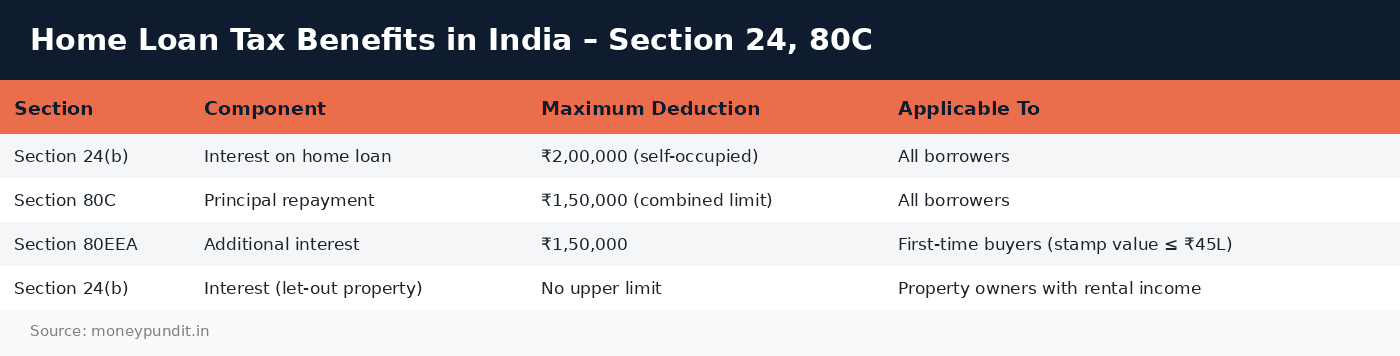
Home Loan Tax Benefits Summary
| Section | Component | Maximum Deduction | Applicable To |
|---|---|---|---|
| Section 24(b) | Interest on home loan | ₹2,00,000 (self-occupied) | All borrowers |
| Section 80C | Principal repayment | ₹1,50,000 (combined limit) | All borrowers |
| Section 80EEA | Additional interest | ₹1,50,000 | First-time buyers (stamp value ≤ ₹45L) |
| Section 24(b) | Interest (let-out property) | No upper limit | Property owners with rental income |
Section 24(b) – Interest Deduction
Section 24(b) allows you to claim a deduction on the interest paid on your home loan. For a self-occupied property, the maximum deduction is ₹2 lakh per financial year. For a let-out (rented) property, there is no upper limit on the interest deduction. You can claim the entire interest paid against rental income, and any excess creates a loss from house property that can be set off against other income up to ₹2 lakh per year.
The ₹2 lakh limit applies only when the following conditions are met: the loan was taken for acquisition or construction of the property, the acquisition or construction was completed within 5 years from the end of the financial year in which the loan was taken, and the property is self-occupied. If construction is not completed within 5 years, the deduction is limited to ₹30,000 instead of ₹2 lakh.
Pre-Construction Interest
Interest paid during the construction period (before you take possession) is not wasted. It can be claimed in five equal instalments starting from the year of completion. For example, if you paid ₹8 lakh as interest during 3 years of construction, you can claim ₹1.6 lakh per year for 5 years after possession, in addition to the regular interest deduction. However, the total deduction under Section 24(b) for self-occupied property cannot exceed ₹2 lakh in any single year.
Section 80C – Principal Repayment
The principal component of your home loan EMI qualifies for deduction under Section 80C, subject to the overall ₹1.5 lakh limit. In the early years of a home loan, the interest component dominates the EMI, but as the loan progresses, the principal portion increases. For a ₹50 lakh home loan at 8.5% for 20 years, the EMI is approximately ₹43,391, of which the principal component in the first year is about ₹8,000-₹9,000 per month.
Additionally, stamp duty and registration charges paid at the time of property purchase are eligible for Section 80C deduction in the year they are paid. For properties costing ₹50 lakh or more, stamp duty alone can be ₹2.5-4 lakh, easily exhausting the entire 80C limit in that year.
Section 80EEA – Additional Benefit for First-Time Buyers
First-time homebuyers can claim an additional deduction of up to ₹1,50,000 on interest paid, over and above the ₹2 lakh limit under Section 24(b). This effectively allows a total interest deduction of ₹3.5 lakh for eligible borrowers. The conditions include: the stamp duty value of the property must not exceed ₹45 lakh, the buyer must not own any other residential property on the date of loan sanction, and the loan must have been sanctioned between April 1, 2019 and March 31, 2022 (check current extensions).
Tax Benefits for Joint Home Loans
When a couple takes a joint home loan, both co-borrowers can individually claim tax deductions. Each borrower can claim up to ₹2 lakh interest deduction under Section 24(b) and up to ₹1.5 lakh principal deduction under Section 80C. This means a couple can save up to ₹7 lakh in deductions annually, ₹4 lakh on interest and ₹3 lakh on principal. Both parties must be co-owners of the property and co-borrowers of the loan.
Home Loan Benefits Under New vs Old Tax Regime
| Benefit | Old Tax Regime | New Tax Regime |
|---|---|---|
| Section 24(b) – Self-Occupied | Up to ₹2,00,000 | Up to ₹2,00,000 (from FY 2025-26) |
| Section 24(b) – Let-Out | No limit | No limit |
| Section 80C – Principal | Up to ₹1,50,000 | Not available |
| Section 80EEA | Up to ₹1,50,000 | Not available |
Budget 2025 extended the Section 24(b) deduction of ₹2 lakh for self-occupied property to the new tax regime, making it one of the few deductions now available under both regimes. However, 80C principal repayment and 80EEA additional interest remain exclusive to the old regime.
Practical Example
Amit and Neha take a joint home loan of ₹60 lakh at 8.5% for 20 years for a self-occupied flat. In the first year, they pay approximately ₹5.1 lakh as interest and ₹1.1 lakh as principal. Under the old regime, Amit claims ₹2 lakh (Section 24b interest) + ₹55,000 (80C principal share). Neha claims ₹2 lakh (Section 24b interest) + ₹55,000 (80C principal share). Combined annual tax deduction: ₹5.1 lakh. If both are in the 30% tax bracket, the tax savings amount to approximately ₹1.53 lakh per year. Substantially reducing the effective cost of the home loan.
Second Home Loan Tax Benefits
If you own two properties, you can declare one as self-occupied and the other as “deemed to be let-out” even if it is vacant. For the deemed let-out property, you must declare a notional rental income (fair market rent), but you can claim the entire interest paid without any ₹2 lakh cap. After deducting interest and a standard 30% deduction on rental income, if there is a loss, it can be set off against other income up to ₹2 lakh per year, with the balance carried forward for 8 years.
Frequently Asked Questions
Can I claim home loan benefits if the property is under construction?
You cannot claim tax benefits during the construction period. However, the interest paid during construction (pre-EMI interest) can be accumulated and claimed in 5 equal annual instalments starting from the year of completion/possession. Both Section 24(b) and Section 80C benefits commence from the year of completion.
Can I claim tax benefits on a home loan for a plot of land?
A loan taken solely to purchase a plot of land does not qualify for Section 24(b) interest deduction. However, if you take a loan for purchasing the plot and constructing a house on it, the interest deduction becomes available once the construction is completed (within 5 years). The Section 80C deduction for principal repayment is available only for loans taken for purchase or construction of a house, not for a vacant plot.
What happens to tax benefits if I sell the property before 5 years?
If you sell the property within 5 years of the end of the financial year in which possession was obtained, the Section 80C deductions claimed on principal repayment in earlier years are reversed. They are added back to your income in the year of sale. The Section 24(b) interest deductions already claimed are not reversed.
Can I claim HRA and home loan benefits simultaneously?
Yes, it is possible to claim both HRA exemption and home loan tax benefits simultaneously, though there are conditions. This typically works when you own a home in one city (on which you claim the loan benefit) but live and work in another city (where you rent and claim HRA). You must be able to justify why you need to rent despite owning a home. Working in a different city is the most common valid reason.
Home loan tax benefits: Key Takeaways
Key points on home loan tax benefits:
- Section 24(b) allows you to claim a deduction on the interest paid on your home loan.
- The principal component of your home loan EMI qualifies for deduction under Section 80C, subject to the overall ₹1.5 lakh limit.
- When a couple takes a joint home loan, both co-borrowers can individually claim tax deductions.
Verify the latest home loan tax benefits figures with Income Tax Department before you act.