
Car insurance in brief: The No Claim Bonus (NCB) is a powerful discount, starting at 20% for one claim-free year and reaching 50% after five consecutive claim-free years.
Third-party car insurance is legally mandatory in India and cheaper upfront, but it pays out nothing if your own car is damaged. A gap that can cost far more than the premium difference the first time you’re at fault in an accident. Here’s how to decide, and specific ways to lower your premium either way.
Types of Car Insurance
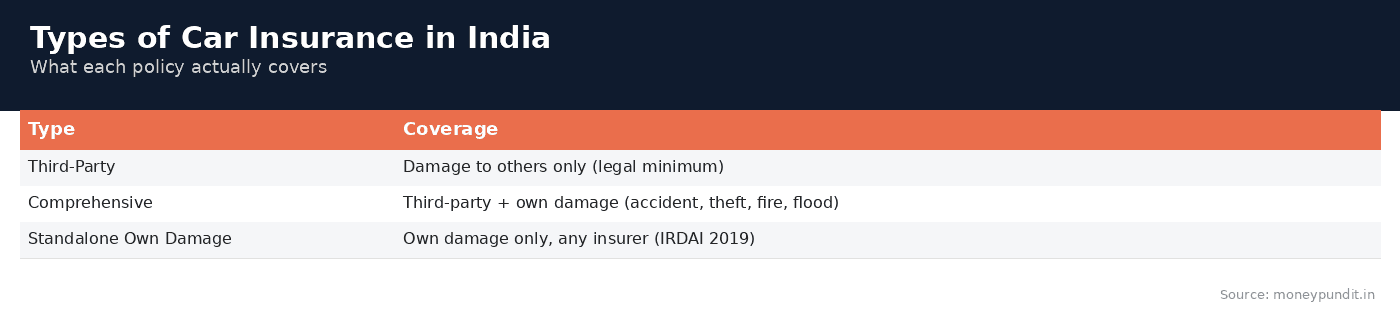
Third-party liability insurance is the legal minimum required under the Motor Vehicles Act. It covers damage you cause to other people, vehicles, or property, but not your own car. Comprehensive insurance includes third-party coverage plus own damage protection for your vehicle against accidents, theft, fire, floods, and vandalism. Standalone own damage (OD) policies can be purchased separately from any insurer, even if your third-party policy is from a different company. This flexibility was introduced by IRDAI in 2019.
How Car Insurance Premium is Calculated
The Insured Declared Value (IDV) is the maximum claim amount. Essentially your car’s current market value accounting for depreciation. Third-party premium is fixed by IRDAI based on engine capacity. Own damage premium depends on the IDV, car model and variant, city of registration, age of the vehicle, and your claim history. The No Claim Bonus (NCB) is a powerful discount, starting at 20% for one claim-free year and reaching 50% after five consecutive claim-free years.
Essential Add-On Covers
Zero depreciation add-on eliminates depreciation deduction on claims, so you get the full repair cost. This is crucial for cars under 5 years old. Engine protection covers engine damage from waterlogging, essential in flood-prone cities like Mumbai, Chennai, and Bengaluru. Return to invoice add-on pays the full invoice value in case of total loss instead of depreciated IDV. Roadside assistance provides towing, battery jumpstart, and flat tire help across India.
How to Save on Car Insurance
Compare quotes from at least 4-5 insurers on aggregator platforms. Increase your voluntary deductible to ₹5,000-₹15,000 to lower premiums by 10-20%. Install ARAI-approved anti-theft devices for a 2.5% discount. Maintain your NCB by avoiding small claims (pay minor repairs out of pocket). Buy third-party and OD policies from different insurers if the combination is cheaper. Renew before expiry to avoid losing your NCB.
What happens if my car insurance lapses?
Driving without valid third-party insurance is illegal and attracts a fine of ₹2,000 for first offense and ₹4,000 subsequently. You lose your accumulated NCB if the policy lapses beyond the grace period (usually 90 days). Some insurers allow NCB transfer if you renew within the grace window.
Should I buy car insurance online?
Online policies are typically 5-15% cheaper than agent-purchased policies. The coverage, claim process, and IRDAI regulations are identical. Online also allows easy comparison shopping and faster policy issuance.
Comprehensive vs Third-Party: Understanding the Difference
Third-party car insurance is legally mandatory under the Motor Vehicles Act and covers damage you cause to other people, vehicles, or property in an accident. It does not cover any damage to your own car. Comprehensive insurance includes third-party cover plus protection for your own vehicle against accidents, theft, fire, natural disasters, vandalism, and personal accident cover for the owner-driver. For a car worth ₹8-15 lakh, the premium difference between third-party (₹2,000-₹3,500) and comprehensive (₹8,000-₹20,000) is modest relative to the protection you receive.
For new cars and vehicles under 5 years old, comprehensive cover is almost always worth it, the cost of even minor repairs (bumper replacement ₹15,000-₹30,000, door dent repair ₹5,000-₹15,000, windshield replacement ₹8,000-₹25,000) can exceed your annual premium. For older cars where the insured declared value (IDV) has depreciated significantly, you might consider switching to third-party only, but evaluate the repair costs in your city first, as labour rates in metros can make even minor fixes expensive.
How to Reduce Your Car Insurance Premium
The no-claim bonus (NCB) is your biggest premium discount tool, it accumulates for each claim-free year: 20% after year 1, 25% after year 2, 35% after year 3, 45% after year 4, and 50% from year 5 onwards. A 50% NCB on a ₹15,000 base premium saves you ₹7,500 annually. Protect your NCB by paying for minor repairs out of pocket rather than filing small claims, a ₹5,000 claim that resets your NCB costs you far more in lost discounts over subsequent years.
Other premium reduction strategies: install ARAI-approved anti-theft devices for a 2.5% discount, opt for a voluntary deductible (agreeing to pay the first ₹2,500-₹15,000 of any claim) for 15-30% premium reduction, bundle with other policies from the same insurer for loyalty discounts, and renew before expiry to maintain continuity. Compare quotes online from at least 4-5 insurers, premium differences of 20-30% for identical coverage are common across insurers like ICICI Lombard, HDFC Ergo, Bajaj Allianz, and New India Assurance.
Essential Add-Ons Worth Paying For
Not all add-ons are necessary, but some provide exceptional value. Zero depreciation (or bumper-to-bumper) cover eliminates the depreciation deduction on plastic, rubber, and glass parts during claims, without it, you could pay 30-50% of replacement part costs from your pocket. This add-on costs 15-20% extra but is invaluable for cars under 5 years old.
Engine protection cover safeguards against water ingress damage during floods, a ₹500-₹1,500 add-on that can save ₹50,000-₹3 lakh in engine repair costs, especially important in flood-prone cities. Roadside assistance (₹300-₹500) provides 24/7 towing, flat tyre change, battery jump-start, and fuel delivery. Return to invoice cover pays the full invoice value (not depreciated IDV) in case of total loss or theft. Crucial for new cars where the IDV-invoice gap can be ₹1-3 lakh. Budget for your car’s total ownership cost including insurance, maintenance, and EMI payments to make informed vehicle purchase decisions.
Third-party cover meets the legal minimum; comprehensive protects your own car too. For a vehicle less than 5 years old, the extra premium is usually cheap insurance against a much larger repair bill.
References: Irdai.gov.in
Source: irdai.gov.in
Car insurance: Key Takeaways
Key points on car insurance:
- Third-party liability insurance is the legal minimum required under the Motor Vehicles Act.
- The Insured Declared Value (IDV) is the maximum claim amount.
- Zero depreciation add-on eliminates depreciation deduction on claims, so you get the full repair cost.
Verify the latest car insurance figures with IRDAI before you act.
Related guides: Insurance Guide, Family Floater vs Individual Health Insurance, Income Tax Calculator FY 2026.