

Looking for the best mutual funds 2026 to invest in? Choosing the right mutual fund can feel overwhelming with 40+ AMCs and thousands of schemes available in India. This comprehensive guide to the best mutual funds 2026 cuts through the noise and highlights the top-performing, consistently reliable funds across every major category, from large-cap stalwarts to aggressive small-cap picks, based on rolling returns, risk-adjusted performance, and fund manager track record.
Best Large Cap Mutual Funds 2026
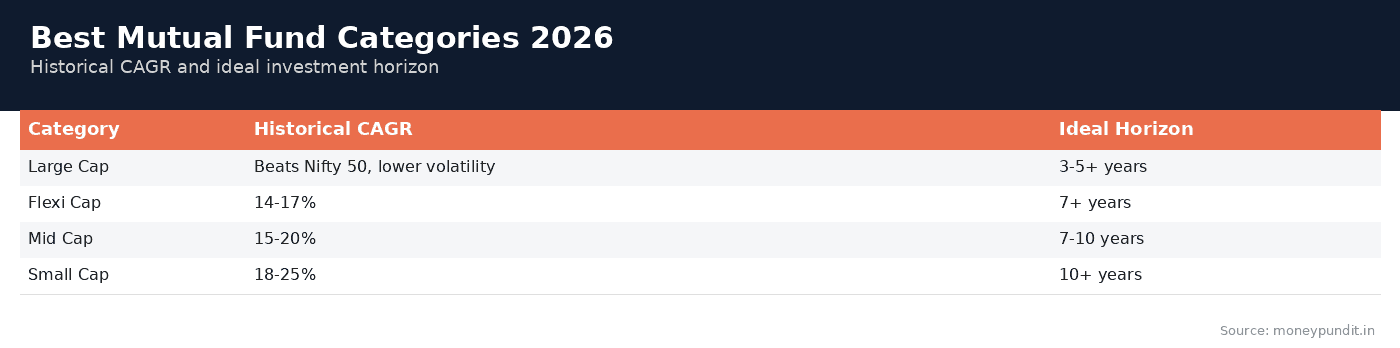
When selecting the best mutual funds 2026 in the large-cap category, note that these funds invest in India’s top 100 companies by market capitalization, offering stability with moderate growth. They’re ideal for conservative equity investors and those new to mutual funds. The best large-cap funds have consistently beaten the Nifty 50 benchmark over 5 and 10-year periods while maintaining lower volatility than mid and small-cap alternatives.
Top picks include funds from established houses that have demonstrated strong stock selection ability. Look for funds with expense ratios below 1%, consistent top-quartile performance over 3, 5, and 7 years, and fund managers with 10+ years of experience. Index funds tracking Nifty 50 are an excellent low-cost alternative for this category.
Best Flexi Cap Mutual Funds 2026
Flexi-cap funds offer the most versatility: fund managers can invest across large, mid, and small-cap stocks in any proportion based on market conditions. This flexibility allows skilled managers to shift allocation dynamically, moving to large-caps during volatile markets and increasing small-cap exposure during bull runs.
The best flexi-cap funds have delivered 14-17% CAGR over 10 years, outperforming most category-specific funds. They’re ideal as a core holding for long-term wealth creation, suitable for investors with 7+ year horizons who want diversified equity exposure without managing multiple funds.
Best Mid Cap Mutual Funds 2026
Mid-cap funds are among the best mutual funds 2026 picks for investors with a 7-10 year horizon who can tolerate higher volatility in exchange for potentially superior returns.
Mid-cap funds invest in companies ranked 101-250 by market capitalization. Businesses that are past the startup phase but still have significant growth potential. These funds have historically delivered 15-20% CAGR over long periods but come with higher volatility than large-caps. They require patience through 2-3 year down cycles.
Best Small Cap Mutual Funds 2026
Small-cap funds represent the most aggressive segment among the best mutual funds 2026 recommendations, suited for investors with a 10+ year horizon and high risk tolerance.
Small-cap funds invest in companies beyond the top 250, targeting high-growth businesses at early stages. They offer the highest return potential (18-25% CAGR in good phases) but also the steepest drawdowns during market corrections (40-60% falls are common). Suitable only for investors with 10+ year horizons and high risk tolerance.
Best ELSS Tax Saving Mutual Funds 2026
ELSS funds offer dual benefits: equity market returns plus tax deduction under Section 80C up to ₹1.5 lakh. With just a 3-year lock-in (shortest among 80C options), ELSS is the best tax-saving investment for most investors. Top ELSS funds have delivered 13-16% CAGR over 10 years, significantly outperforming PPF, tax-saving FDs, and NSC.
Best Index Funds and ETFs 2026
Index funds passively track market indices like Nifty 50, Nifty Next 50, or Nifty Midcap 150 at ultra-low expense ratios (0.1-0.3%). Over 10 years, most active large-cap funds have failed to beat the Nifty 50 consistently, making index funds the default recommendation for beginners and even experienced investors seeking simplicity and cost efficiency.
How to Choose the Best Mutual Funds 2026 for Your Portfolio
Match the fund category to your goal timeline: large-cap or balanced for 5-7 years, flexi/multi-cap for 7-10 years, mid-cap for 8-12 years, and small-cap for 10+ years. When evaluating the best mutual funds 2026, always compare against the benchmark (not just category average), prefer direct plans over regular, and don’t chase last year’s topper, consistency over 5+ years matters more than a single blockbuster year.
Should I invest in one fund or multiple funds?
For most investors, 3-5 funds is the sweet spot: 1-2 flexi/large-cap, 1 mid-cap, and optionally 1 ELSS and 1 international fund. More than 6-7 funds leads to over-diversification where your portfolio essentially mimics an index but with higher expense ratios. If in doubt, a single Nifty 50 index fund is a perfectly valid complete portfolio.
Are direct plans really better than regular plans?
Yes, always. Direct plans have 0.5-1.5% lower expense ratios than regular plans because they cut out the distributor commission. Over 20 years, this seemingly small difference creates a massive gap, a ₹10,000 monthly SIP in a direct plan returning 13% vs a regular plan returning 12% results in ₹10+ lakh more wealth. Use platforms like Groww, Kuvera, or Zerodha Coin for direct plan investing.
How to Build a Diversified Best Mutual Funds 2026 Portfolio
A well-constructed portfolio needs 3-5 funds across different categories, more than that creates overlap without adding diversification. Core holdings (60-70% of portfolio): one large-cap or Nifty 50 index fund for stability and one flexi-cap fund for across-the-board exposure. Satellite holdings (30-40%): one mid-cap fund for growth, one small-cap fund for aggressive returns (only if your horizon is 7+ years), or one international fund for geographic diversification.
For conservative investors: 40% large-cap index + 30% balanced advantage/hybrid + 30% short-duration debt fund. For moderate investors: 35% large-cap + 25% flexi-cap + 20% mid-cap + 20% debt/hybrid. For aggressive investors: 25% large-cap + 25% mid-cap + 25% small-cap + 15% sectoral/thematic + 10% international. Always check portfolio overlap before adding a new fund. If two funds hold more than 40% of the same stocks, you’re better off keeping just one.
Best Mutual Funds 2026: Trusted Resources & Regulatory Information
Before investing in the best mutual funds 2026, verify fund details through official sources. Check fund NAVs and factsheets on AMFI India, review AMC compliance records on SEBI, compare fund performance on Value Research Online, and track index benchmarks on NSE India. For tax-related queries on mutual fund gains, refer to the Income Tax Department portal.
Related MoneyPundit Guides
Explore our detailed category-specific guides for deeper analysis: Best Large Cap Funds India, Best Mid Cap Funds India, Best Small Cap Funds India, Best ELSS Funds India, Best Index Funds India, SIP vs Lumpsum Guide, Direct vs Regular Funds, and Best Investment Plan for 1 Lakh.
Best Mutual Funds 2026: Selection Criteria Beyond Past Returns
Past returns tell you about the fund’s history, not its future. More reliable indicators: fund manager consistency (has the same manager delivered across market cycles?), downside protection (how much did the fund fall during 2020 crash compared to its benchmark?), risk-adjusted returns (Sharpe ratio above 1.0 is good), and expense ratio (every 0.5% saved compounds into significant wealth over 15-20 years).
Use rolling returns instead of point-to-point: check the fund’s 3-year rolling return over every possible 3-year period in the last 10 years. A fund consistently delivering 12-14% rolling returns is more reliable than one swinging between 5% and 25%. For tax-saving allocation, include one ELSS fund to cover your Section 80C requirement. Review your portfolio in January each year: rebalance any fund that’s drifted more than 15% from its target allocation, and replace any fund that’s consistently underperformed its benchmark for 3+ consecutive years. Use our SIP Calculator to track whether you’re on course for your financial goals.
References: Amfiindia.com, Sebi.gov.in, Nseindia.com
Source: amfiindia.com
Source: sebi.gov.in
Source: nseindia.com
Frequently Asked Questions About Best Mutual Funds to Invest in 2026
How should I choose the best mutual funds in 2026?
Look at fund houses with a record of strong stock selection, match the category to your time horizon and risk tolerance, and compare costs and long-term consistency rather than one-year returns.
Why are flexi-cap funds a popular choice?
Flexi-cap funds offer the most versatility because managers can invest across large, mid and small-cap stocks. Past returns do not guarantee future performance.
Which mutual funds suit a 7 to 10 year horizon?
Mid-cap funds are among the picks for investors with a 7 to 10 year horizon who can tolerate volatility along the way.
What do large-cap mutual funds invest in?
Large-cap funds invest mainly in the biggest, most established listed companies, and are generally less volatile than mid or small-cap funds.