

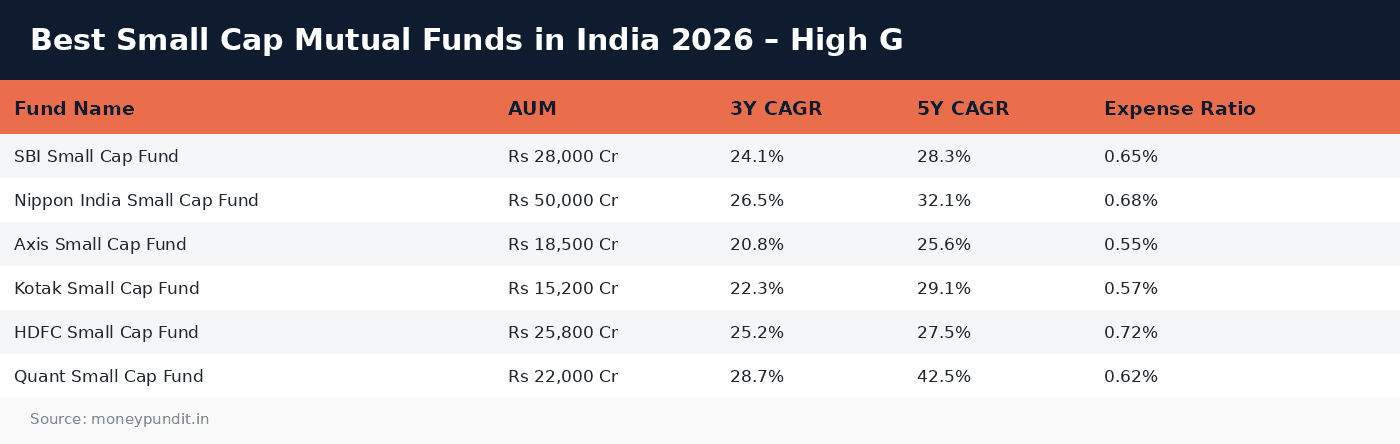
Small cap mutual funds invest at least 65% in companies ranked 251st onwards by market value, the most volatile corner of Indian equities. The table below lists every small cap scheme tracked in AMFI data with 1-year, 3-year and 5-year returns.
Small cap funds have produced some of the highest 10-year returns in Indian mutual fund history, and also some of the sharpest 50%+ drawdowns, sometimes in the very same fund a few years apart. Here’s what defines a small cap fund and which ones currently stand out.
What Are Small Cap Mutual Funds?
Small cap mutual funds invest primarily in companies ranked beyond 250th by market capitalisation on Indian stock exchanges. These companies typically have a market cap below Rs 15,000-20,000 crore. Small cap funds offer the highest growth potential among equity fund categories but also carry the highest risk and volatility.
Top Small Cap Funds for 2026
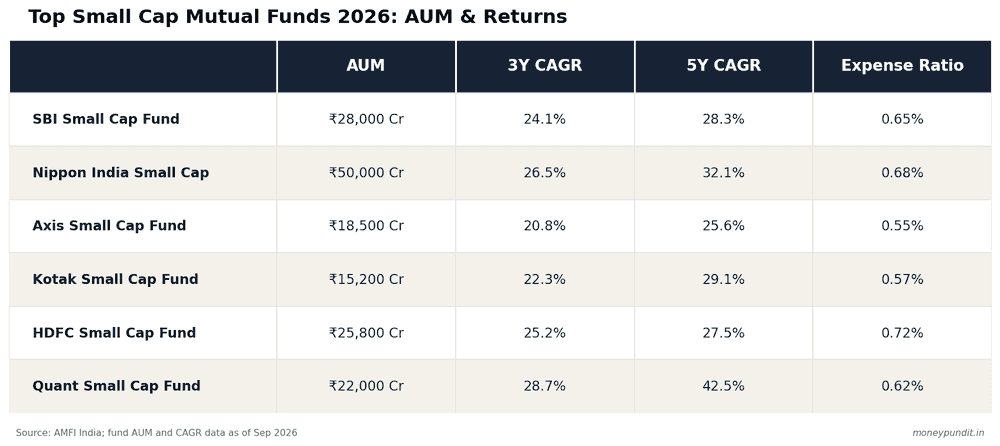
| # | Fund Name | NAV (₹) | 1Y Return ▼ | 3Y CAGR | 5Y CAGR |
|---|---|---|---|---|---|
| 1 | BANK OF INDIA SMALL CAP FUND | 66.85 | +29.78% | +21.60% | +19.95% |
| 2 | TRUSTMF SMALL CAP FUND | 13.92 | +27.91% | — | — |
| 3 | Union Small Cap Fund | 66.53 | +20.33% | +16.71% | +16.68% |
| 4 | Motilal Oswal Small Cap Fund | 17.38 | +19.89% | — | — |
| 5 | ITI Small Cap Fund | 37.68 | +18.63% | +22.92% | +18.16% |
| 6 | DSP Small Cap Fund | 250.80 | +17.05% | +16.54% | +16.98% |
| 7 | Aditya Birla Sun Life Small Cap Fund | 113.01 | +16.16% | +14.51% | +12.69% |
| 8 | Bajaj Finserv Small Cap Fund | 11.11 | +15.50% | — | — |
| 9 | JM Small Cap Fund | 11.85 | +15.49% | — | — |
| 10 | Mahindra Manulife Small Cap Fund | 23.20 | +14.39% | +18.73% | — |
| 11 | LIC MF Small Cap Fund | 39.35 | +14.34% | +17.31% | — |
| 12 | Invesco India Small Cap Fund | 52.59 | +14.07% | +21.88% | +19.07% |
| 13 | Quant Small Cap Fund | 314.64 | +12.54% | +16.92% | +18.53% |
| 14 | PGIM India Small Cap Fund - Direct Plan | 19.61 | +11.69% | +15.18% | +12.52% |
| 15 | Sundaram Small Cap Fund | 325.41 | +11.63% | +15.25% | +15.55% |
| 16 | BANDHAN Small Cap Fund | 56.45 | +10.28% | +22.67% | +18.86% |
| 17 | Mirae Asset Small Cap Fund | 12.67 | +9.93% | — | — |
| 18 | Axis Small Cap Fund | 133.77 | +7.93% | +14.42% | +14.94% |
| 19 | QUANTUM SMALL CAP FUND | 13.72 | +7.90% | — | — |
| 20 | Baroda BNP Paribas Small Cap Fund | 14.54 | +7.79% | — | — |
| 21 | Nippon India Small Cap Fund | 203.95 | +7.19% | +14.17% | +17.75% |
| 22 | Edelweiss Small Cap Fund | 52.11 | +5.90% | +14.14% | +15.75% |
| 23 | Sundaram Small Cap Fund | 40.10 | +5.83% | +5.71% | +7.23% |
| 24 | UTI Small Cap Fund | 29.03 | +4.93% | +13.19% | +14.10% |
| 25 | Kotak Small Cap Fund | 318.22 | +4.71% | +11.78% | +11.94% |
| 26 | SBI SMALL CAP FUND | 207.11 | +4.70% | +10.69% | +12.83% |
| 27 | Franklin India Small Cap Fund | 197.31 | +4.48% | +11.69% | +14.44% |
| 28 | ICICI Prudential Small Cap Fund | 102.09 | +3.74% | +11.11% | +13.38% |
| 29 | Canara Robeco Small Cap Fund | 44.35 | +3.11% | +11.26% | +13.66% |
| 30 | Tata Small Cap Fund | 44.25 | +0.27% | +11.51% | +15.06% |
| 31 | HDFC Small Cap Fund | 156.02 | -3.08% | +9.64% | +13.51% |
| 32 | Abakkus Small Cap Fund | 12.22 | — | — | — |
| 33 | The Wealth Company Small Cap Fund | 11.71 | — | — | — |
| 34 | Groww Small Cap Fund | 12.90 | — | — | — |
| 35 | Helios Small Cap Fund | 11.38 | — | — | — |
| 36 | Samco Small Cap Fund | 12.69 | — | — | — |
Data sourced from AMFI & mfapi.in. Returns are annualised CAGR. Past performance doesn't guarantee future results. Last updated: 14 Oct 2026
Why Small Cap Funds Outperform Long Term
Small cap companies are often in their early growth phase with significant room for expansion. A Rs 500 crore company can realistically grow to Rs 5,000 crore over a decade, delivering 10x returns. A Rs 5 lakh crore large cap company growing to Rs 50 lakh crore is far less likely. This asymmetric growth potential is why small cap funds have delivered 25-35% CAGR over certain 5-10 year periods.
However, this comes with significant drawdown risk. During the 2018-19 correction, many small cap funds fell 40-50% from their peaks. Investors with a minimum 7-10 year horizon and stomach for volatility are best suited for small cap allocation.
How Much to Allocate to Small Caps
Financial advisors recommend limiting small cap allocation to 10-20% of your overall equity portfolio, depending on age and risk tolerance. Young investors (under 30) with high risk appetite can go up to 25%, while investors above 45 should limit it to 5-10%.
The ideal approach is SIP investment in small cap funds rather than lumpsum. This helps average out the high volatility through rupee cost averaging. Avoid the temptation to invest in small caps when they have already rallied 50-100%. Historically, the best small cap SIP returns have come from investors who stayed invested through bear markets.
Risks of Small Cap Investing
Liquidity Risk: Small cap stocks can have low trading volumes. During market panic, selling pressure can cause disproportionate price drops because there are fewer buyers.
Business Risk: Small companies are more vulnerable to economic downturns, management quality issues, and competitive threats. Not all small caps will survive to become large caps.
Regulatory Risk: SEBI’s periodic regulatory changes (like minimum allocation rules) can force fund managers to buy or sell at unfavorable prices.
Frequently Asked Questions
Are small cap funds suitable for beginners? Small cap funds should not be a beginner’s first investment. Start with large cap or flexi cap funds, gain experience through one market cycle (3-5 years), and then add small cap exposure to your portfolio.
Should I exit small cap funds during a crash? No. Exiting during a crash locks in losses. If your investment horizon is still 5+ years, continue your SIP. Historically, the best recovery returns have come in the 1-2 years following a crash.
What is the ideal SIP amount for small cap funds? Start with Rs 2,000-5,000 per month in small cap SIP if your total monthly SIP budget is Rs 20,000-50,000. This keeps your small cap allocation within the recommended 10-20% range.
Why Small Cap Funds Offer the Highest Growth Potential
Small cap mutual funds invest at least 65% of their assets in companies ranked 251st and below by market capitalisation. These emerging companies, with market caps typically under ₹15,000-20,000 crore, represent India’s next generation of mid caps and large caps. The small cap universe spans over 1,500 listed companies across sectors from specialty chemicals and IT services to consumer brands and financial services, giving fund managers a vast opportunity set to find the next multi-bagger.
Historical performance speaks volumes: the Nifty Small Cap 250 index has delivered 15-18% CAGR over 10-15 year periods, outperforming both large caps (12-14%) and mid caps (14-17%). Many of today’s blue chips, companies like Bajaj Finance, Astral Poly, and Dixon Technologies, were once small caps that multiplied investors’ wealth 10-50x over a decade.
Understanding Small Cap Fund Risks
The higher return potential comes with proportionally higher volatility. During the COVID crash of March 2020, many small cap funds fell 40-60%, and some took 2-3 years to recover to pre-crash levels while large cap funds recovered within months. Liquidity risk is another concern: small cap stocks have lower trading volumes, meaning large redemptions can force fund managers to sell at unfavourable prices, amplifying losses.
The critical success factor is time horizon. Over any 1-3 year period, small cap returns are highly unpredictable, ranging from +80% to -40%. But over 7-10+ year periods, the probability of earning positive, market-beating returns increases significantly. If you can commit to a decade-long SIP without panicking during drawdowns, small cap funds have the potential to be your most rewarding allocation.
How to Invest in Small Cap Funds Wisely
Position sizing: Limit small cap exposure to 15-25% of your total equity portfolio. This is enough to benefit from the growth potential without risking devastating drawdowns to your overall wealth.
Always use SIP: Never invest lump sum in small caps: the volatility is too high for timing to work consistently. A monthly SIP averages out the volatility through rupee cost averaging. During market euphoria, resist increasing allocation; during crashes, maintain or increase your SIP, those are the months that deliver the best long-term returns.
Don’t chase last year’s topper: The fund topping the 1-year returns chart likely took concentrated bets that paid off, the same bets could reverse sharply. Instead, look for funds with strong 5-year and 7-year track records, experienced fund managers, a well-diversified portfolio (50+ stocks), and reasonable AUM, very large small cap funds (₹30,000+ crore) face liquidity challenges.
Small Cap vs Mid Cap: How to Allocate
Mid cap funds invest in companies ranked 101-250: more established than small caps with better liquidity. Mid caps offer 14-17% CAGR with moderate volatility. For most investors, a combination (15-20% mid cap + 10-15% small cap) provides better risk-adjusted returns than going all-in on either. Use a flexi cap fund or multi cap fund as your core holding and add small caps as a satellite for growth.
Tax-Smart Small Cap Investing
Small cap fund gains follow equity taxation: STCG at 20% (held under 12 months) and LTCG at 12.5% above ₹1.25 lakh (held over 12 months). The annual ₹1.25 lakh LTCG exemption can be used strategically. Book profits of ₹1.25 lakh each financial year to reset your cost base tax-free. When your small cap allocation exceeds target due to a rally, rebalance by switching profits to large cap or balanced advantage funds. Use our capital gains tax calculator to plan redemptions efficiently, and track returns with the MF returns calculator.
Small caps reward patience more than any other equity category, the returns are real, but only for investors who can genuinely hold through multi-year stretches of underperformance without bailing out at the bottom.
References: Amfiindia.com
Small cap mutual funds belong in the satellite part of a portfolio. Keep small cap mutual funds to a share you can hold through a 30% fall, and add to them gradually.
When you compare small cap mutual funds, check the top holdings, the average market cap and how the fund fell in past corrections. Small cap mutual funds with a steady 7-year record are rarer than those with one great year.
Small Cap Funds: Key Takeaways
Small cap funds can deliver the highest returns among equity categories and also the deepest falls, so keep them to a modest share of your equity holding and stay invested for 7 to 10 years. Some fund houses limit fresh lump-sum investments or SIP amounts when valuations are stretched, so check the current limits. Compare the 5-year CAGR with the Nifty Smallcap 250 index. Gains are taxed under equity rules: 20% on units sold within 12 months and 12.5% on gains above Rs 1.25 lakh a year after that. Compare other categories on the mutual fund categories hub, see mid cap funds for lower risk, estimate returns with the SIP calculator and read scheme documents on AMFI and SEBI before you invest. Mutual fund investments are subject to market risks.
Small Cap Funds: Questions Answered
What is a small cap mutual fund?
A small cap fund invests at least 65% of its assets in companies ranked 251st and below by market value. These companies are smaller and less liquid, which makes the fund more volatile.
How long should I stay invested in a small cap fund?
Plan for 7 to 10 years. Small cap funds can fall 30% to 40% in a weak market and take years to recover, so short holding periods carry a high risk of loss.
Is a SIP better than a lump sum for small cap funds?
A monthly SIP spreads your purchases across market highs and lows, which softens the impact of volatility. Many investors prefer it for small cap funds, especially when valuations are high.