

What Are Mutual Funds?
A mutual fund is a professionally managed investment vehicle that pools money from thousands of investors and invests it in a diversified portfolio of stocks, bonds, or other securities. In India, mutual funds are regulated by SEBI (Securities and Exchange Board of India), ensuring investor protection and transparency. As of 2026, the Indian mutual fund industry manages over ₹70 lakh crore in assets across 40+ AMCs (Asset Management Companies).
Mutual funds solve three problems for individual investors: professional management (you don’t need to pick stocks yourself), diversification (your money is spread across 30-100+ securities), and accessibility (start with as little as ₹100/month through SIP).
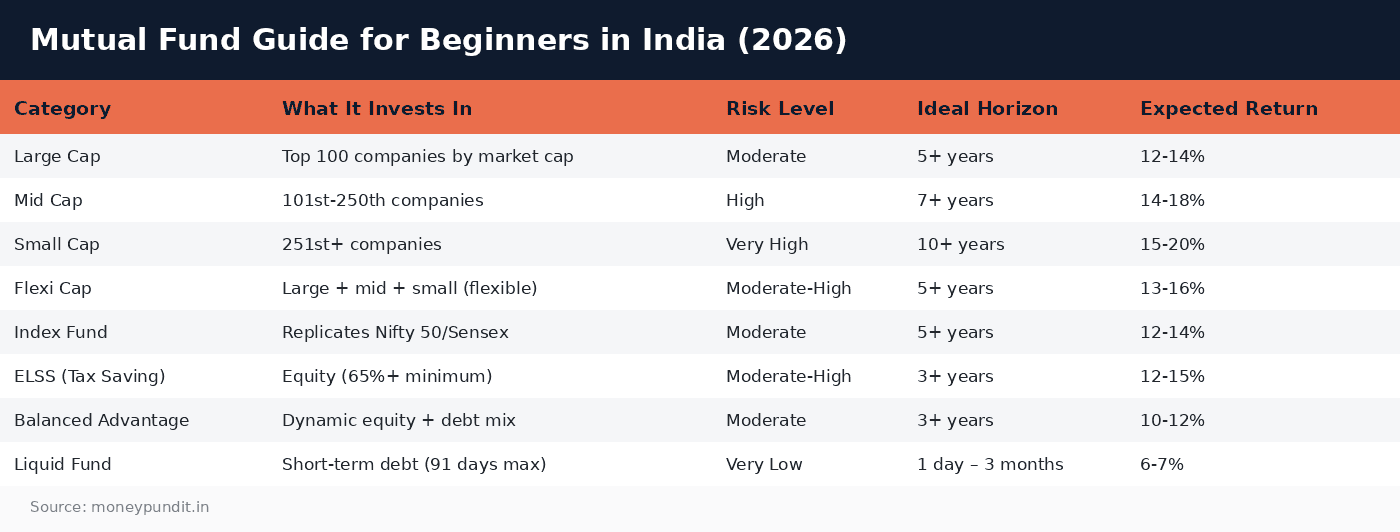
Types of Mutual Funds
| Category | What It Invests In | Risk Level | Ideal Horizon | Expected Return |
|---|---|---|---|---|
| Large Cap | Top 100 companies by market cap | Moderate | 5+ years | 12-14% |
| Mid Cap | 101st-250th companies | High | 7+ years | 14-18% |
| Small Cap | 251st+ companies | Very High | 10+ years | 15-20% |
| Flexi Cap | Large + mid + small (flexible) | Moderate-High | 5+ years | 13-16% |
| Index Fund | Replicates Nifty 50/Sensex | Moderate | 5+ years | 12-14% |
| ELSS (Tax Saving) | Equity (65%+ minimum) | Moderate-High | 3+ years | 12-15% |
| Balanced Advantage | Dynamic equity + debt mix | Moderate | 3+ years | 10-12% |
| Liquid Fund | Short-term debt (91 days max) | Very Low | 1 day – 3 months | 6-7% |
How to Start Investing in Mutual Funds
Step 1: Complete KYC: Do eKYC online using Aadhaar on any platform (one-time process). Step 2: Choose a platform: Direct mutual fund apps like Groww, Kuvera, Zerodha Coin, or AMC websites offer commission-free direct plans. Step 3: Select funds: Start with 1-2 diversified equity funds for long-term goals. Step 4: Start SIP: Set up auto-debit for disciplined monthly investing. Step 5: Stay invested: Don’t stop or redeem during market falls. The biggest wealth creation happens by simply staying invested through cycles.
Direct vs Regular Plans
Direct plans have lower expense ratios (0.3-1% less than regular) because they cut out the distributor commission. Over 20 years, this difference can mean 15-25% more wealth. For example, ₹10,000 SIP in a direct plan returning 13% vs regular plan returning 12% grows to ₹1.05 crore vs ₹95 lakh, a ₹10 lakh difference. Always choose direct plans unless you need a financial advisor’s guidance.
SIP: The Best Way to Invest
SIP (Systematic Investment Plan) invests a fixed amount every month, providing rupee cost averaging. You buy more units when prices are low and fewer when high. This removes the need for market timing and builds discipline. Start with whatever you can afford (even ₹500/month) and increase with your income using step-up SIP. The best SIP date is any date. Consistency matters more than timing.
How to Choose the Right Mutual Fund
Look for: consistent performance vs benchmark over 3, 5, and 7 years (not just 1 year); low expense ratio (under 1% for active, under 0.2% for index); experienced fund manager with 10+ years track record; fund house reputation and AUM (avoid very small funds); and alignment with your goal timeline and risk appetite. Don’t chase last year’s best performer, mean reversion is real.
Is mutual fund investment safe?
Mutual funds are regulated by SEBI and investor money is held by a custodian (not the AMC), making them structurally safe from fraud. However, market risk exists, equity fund values can fall 20-40% during crashes. This risk reduces with time: over any 10-year period, Nifty has never given negative returns. For beginners, balanced advantage funds offer a gentler introduction to equity investing.
How much money do I need to start?
You can start mutual fund SIP with as little as ₹100/month on some platforms, and ₹500/month on most. For lumpsum, minimum investment is typically ₹500-₹5,000. There is no maximum limit. Start with whatever is comfortable, even ₹2,000/month invested for 25 years at 12% grows to ₹37.9 lakh. The most important thing is to start, not the amount.
When should I sell my mutual funds?
Sell when: you have achieved your financial goal, the fund has consistently underperformed its benchmark for 6+ quarters, there is a fundamental change in fund strategy or manager, or you need to rebalance your portfolio. Do not sell because of short-term market falls, media panic, or a few months of underperformance. Time in the market beats timing the market.
How many mutual funds should I have?
For most investors, 3-5 funds is optimal: 1-2 diversified equity funds (flexi-cap or large-cap), 1 mid/small-cap fund, 1 debt fund, and optionally 1 international fund. More than 7-8 funds leads to over-diversification where your portfolio mimics an index but with higher costs. If in doubt, a single Nifty 50 index fund is a perfectly valid complete portfolio for beginners.
Frequently Asked Questions About Mutual fund guide beginners india
How do I start investing in mutual funds?
Complete a one-time eKYC online using Aadhaar, choose a platform, then pick a fund and invest either as a lump sum or through a SIP.
What is the difference between direct and regular mutual fund plans?
Direct plans have lower expense ratios, roughly 0.3-1% less than regular plans, because they cut out the distributor commission. Over 20 years this gap compounds into a meaningful difference.
What is a SIP in mutual funds?
A Systematic Investment Plan invests a fixed amount every month, giving you rupee cost averaging: you buy more units when prices are low and fewer when they are high.
Why should beginners choose mutual funds?
They give you professional management, so you do not need to pick stocks yourself, along with diversification across many holdings at a small starting amount.
Mutual fund guide beginners india: Key Takeaways
Key points on mutual fund guide beginners india:
- A mutual fund is a professionally managed investment vehicle that pools money from thousands of investors and invests it in a diversified portfolio of stocks, bonds, or other securities.
- Step 1: Complete KYC : Do eKYC online using Aadhaar on any platform (one-time process).
- Direct plans have lower expense ratios (0.3-1% less than regular) because they cut out the distributor commission.
Verify the latest mutual fund guide beginners india figures with AMFI before you act.
Explore our SIP calculator, tax calculator and FD rates guide to apply mutual fund guide beginners india to your own numbers, and revisit mutual fund guide beginners india each year.
Mutual Fund Guide Beginners: Using This Mutual Fund Guide Beginners Page
This mutual fund guide beginners page is updated for 2026. Bookmark this mutual fund guide beginners resource, then explore our SIP calculator, tax calculator and FD rates comparison to apply it. For official rules refer to the Reserve Bank of India website. Use this mutual fund guide beginners guide alongside our other mutual fund guide beginners resources to compare options before you decide.