

This Post Office MIS Calculator shows exactly how much fixed monthly income you’ll receive from a Monthly Income Scheme (MIS) deposit at India Post. Enter your deposit amount to see the monthly payout, annual income, and total interest earned over the 5-year term, based on the current 7.4% rate. Use the Post Office MIS Calculator above to test different deposit amounts before you invest.
Post Office MIS Calculator
Calculate your guaranteed monthly income from a Post Office Monthly Income Scheme deposit.
What Is the Post Office Monthly Income Scheme (MIS)?
POMIS is a Government of India savings scheme, operated through post offices, that pays a fixed monthly interest payout on a lump-sum deposit for a 5-year term. Unlike a fixed deposit that pays interest at maturity, MIS is built specifically to generate regular monthly cash flow, making it a popular choice for retirees and anyone who wants predictable income without touching their principal.
Current MIS Interest Rate & Deposit Limits
| Detail | Value |
|---|---|
| Interest Rate (Apr-Jun 2026, unchanged Oct-Dec 2026) | 7.4% per annum |
| Minimum Deposit | ₹1,000 (multiples of ₹1,000) |
| Maximum Deposit (Single Account) | ₹9,00,000 |
| Maximum Deposit (Joint Account) | ₹15,00,000 |
| Tenure | 5 years |
| Interest Type | Simple interest, paid monthly (not compounded) |
| Tax Benefit | None under Section 80C; interest fully taxable |
The rate is locked at the time of account opening for the full 5-year term. If the quarterly rate is revised later, your existing account is unaffected. Only new accounts get the new rate.
How Monthly Income Is Calculated
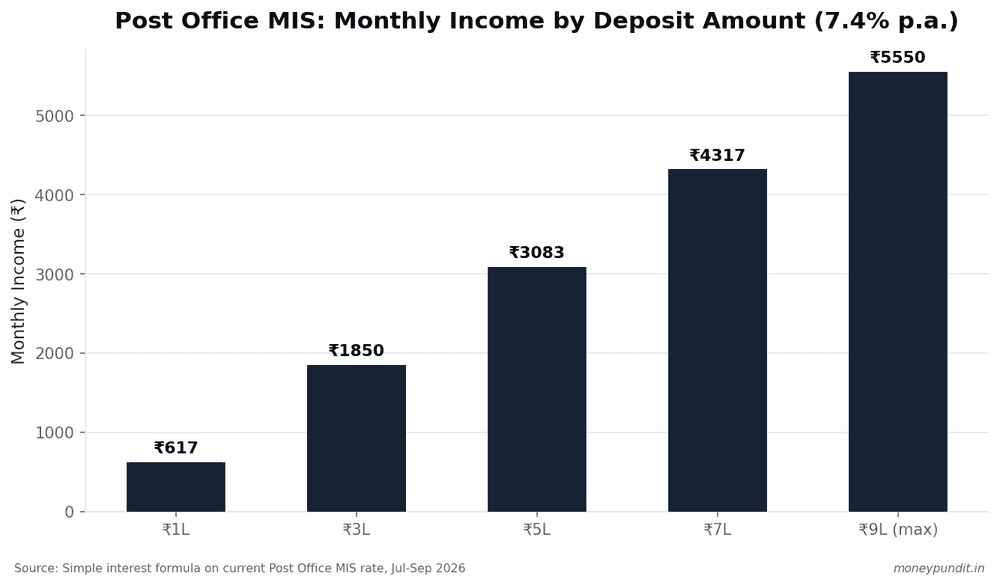
MIS pays simple interest, so the formula is straightforward: Monthly Income = (Deposit × Annual Rate) / 12. For example, a ₹9,00,000 deposit at 7.4% earns ₹66,600 a year, or ₹5,550 every month, for 5 years, with the full ₹9,00,000 returned at maturity.
MIS vs Other Post Office Schemes
| Scheme | Rate (Oct-Dec 2026) | Payout |
|---|---|---|
| Senior Citizen Savings Scheme | 8.2% | Quarterly |
| 5-Year Post Office Time Deposit | 7.5% | At maturity (compounded quarterly) |
| Monthly Income Scheme (MIS) | 7.4% | Monthly |
| Public Provident Fund | 7.1% | At maturity |
MIS is the only post office scheme designed to pay out every single month, which is its core advantage over SCSS’s quarterly payout or PPF’s lock-till-maturity structure. See the full Post Office Savings Schemes guide for all scheme comparisons.
Who Should Use the Post Office MIS?
Try the Post Office MIS Calculator with your own numbers first to confirm the payout fits your monthly budget.
MIS suits anyone who needs predictable monthly cash flow without touching their capital, retirees supplementing a pension, homemakers managing household budgets, or conservative savers who want a sovereign-backed alternative to a bank’s monthly-income FD. Because the scheme locks a fixed rate for a full 5 years and pays out monthly rather than compounding, it works best as an income tool, not a wealth-building one. For long-term growth, a scheme like PPF or equity mutual funds via SIP will typically outperform MIS over 10-15 years, since MIS interest doesn’t compound and is fully taxable.
Tax Treatment of MIS Interest
MIS interest is fully taxable at your income tax slab rate and does not qualify for any Section 80C deduction. India Post does not deduct TDS on MIS interest for resident depositors, but you are still required to declare and pay tax on it yourself. Senior citizens can claim a deduction of up to ₹50,000 on total interest income (including MIS) under Section 80TTB.
Official Resources
For official rules and current rates, refer to the National Savings Institute, Ministry of Finance, Government of India.
Related Guides & Tools
- Post Office Savings Schemes 2026 – Complete Guide
- PPF Account – Complete Guide
- FD Calculator
- Retirement Planning India Guide
Post Office MIS Monthly Income Example
| Account | Maximum deposit | Monthly income at 7.4% | Total interest over 5 years |
|---|---|---|---|
| Single | ₹9,00,000 | ₹5,550 | ₹3,33,000 |
| Joint | ₹15,00,000 | ₹9,250 | ₹5,55,000 |
Interest is paid monthly and the principal comes back at maturity after 5 years. The interest is taxable at your slab rate. Declare it in your tax return. The rate is reviewed every quarter.
Illustrative figures at the Oct-Dec 2026 rate.
Frequently Asked Questions
What is the current Post Office MIS interest rate?
The Post Office MIS rate is 7.4% per annum for the Apr-Jun 2026 quarter, unchanged for Oct-Dec 2026. This rate is fixed for the full 5-year tenure once your account is opened.
How much monthly income does Rs 9 lakh earn in MIS?
At the current 7.4% rate, a single-account deposit of the maximum Rs 9 lakh earns Rs 5,550 a month, or Rs 66,600 a year.
Does MIS interest compound?
No. MIS pays simple interest monthly; it does not compound within the scheme. To grow the payout further, many depositors reinvest their monthly interest into a recurring deposit.
Is MIS interest tax-free?
No. MIS interest is fully taxable at your income tax slab rate and does not qualify for any Section 80C deduction, unlike PPF or tax-saving FDs.
Can I withdraw my MIS deposit before 5 years?
Premature withdrawal is allowed after 1 year, with a penalty: 2% deduction from the principal if withdrawn between 1-3 years, and 1% if withdrawn between 3-5 years.
References: Nsiindia.gov.in
Reviewed by: MoneyPundit Team | Last updated: July 2, 2026
Data source: Interest rate sourced from the Ministry of Finance’s quarterly Small Savings Schemes notification (indiapost.gov.in), current for Oct-Dec 2026.
Methodology: This calculator applies the official Post Office MIS simple monthly-payout formula (no compounding, interest paid out monthly) on the current government-notified rate. Small savings rates are revised quarterly by the government, always confirm the current rate at your local post office or indiapost.gov.in before investing.