

Post office savings schemes in brief: With interest rates reviewed quarterly and currently ranging from 4% to 8.2%, post office schemes offer competitive returns compared to bank FDs while enjoying the full backing of the Government of India.
Post office schemes like PPF and SCSS carry a sovereign guarantee that no bank FD can match, and several of them currently pay more interest than comparable bank deposits, yet most Indians only know about PPF and ignore the rest. Here’s every major post office scheme and its current interest rate.
Comparing with banks? See post office vs bank FD rates 2026 for a side-by-side table.
For the latest verified numbers on every scheme covered here, check our live small savings interest rate tracker, updated daily against official sources.
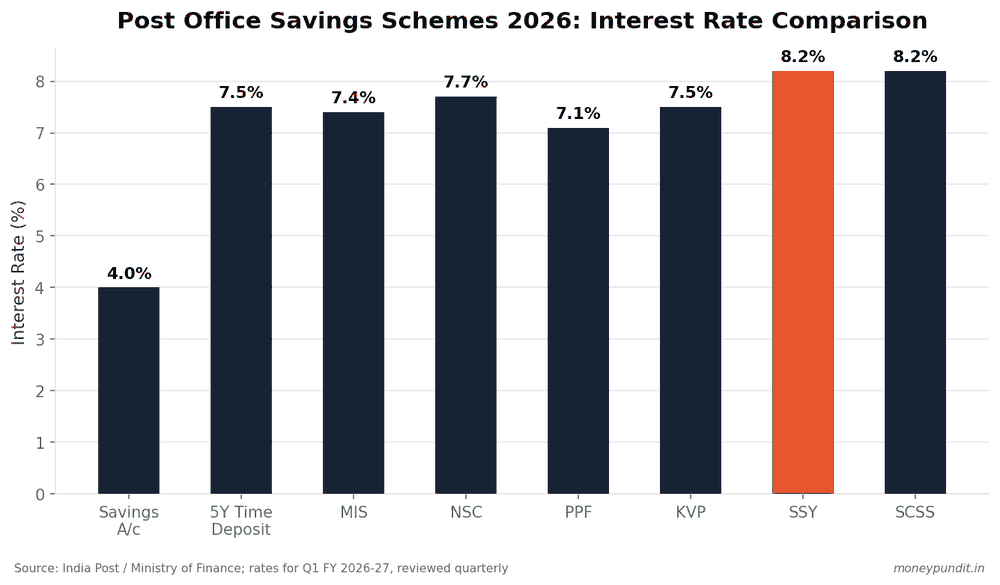
India Post offers a range of government-backed savings schemes that provide guaranteed returns with sovereign safety, making them ideal for conservative investors, senior citizens, and anyone seeking risk-free investment options. With interest rates reviewed quarterly and currently ranging from 4% to 8.2%, post office schemes offer competitive returns compared to bank FDs while enjoying the full backing of the Government of India.
All Post Office Savings Schemes – Interest Rates 2026
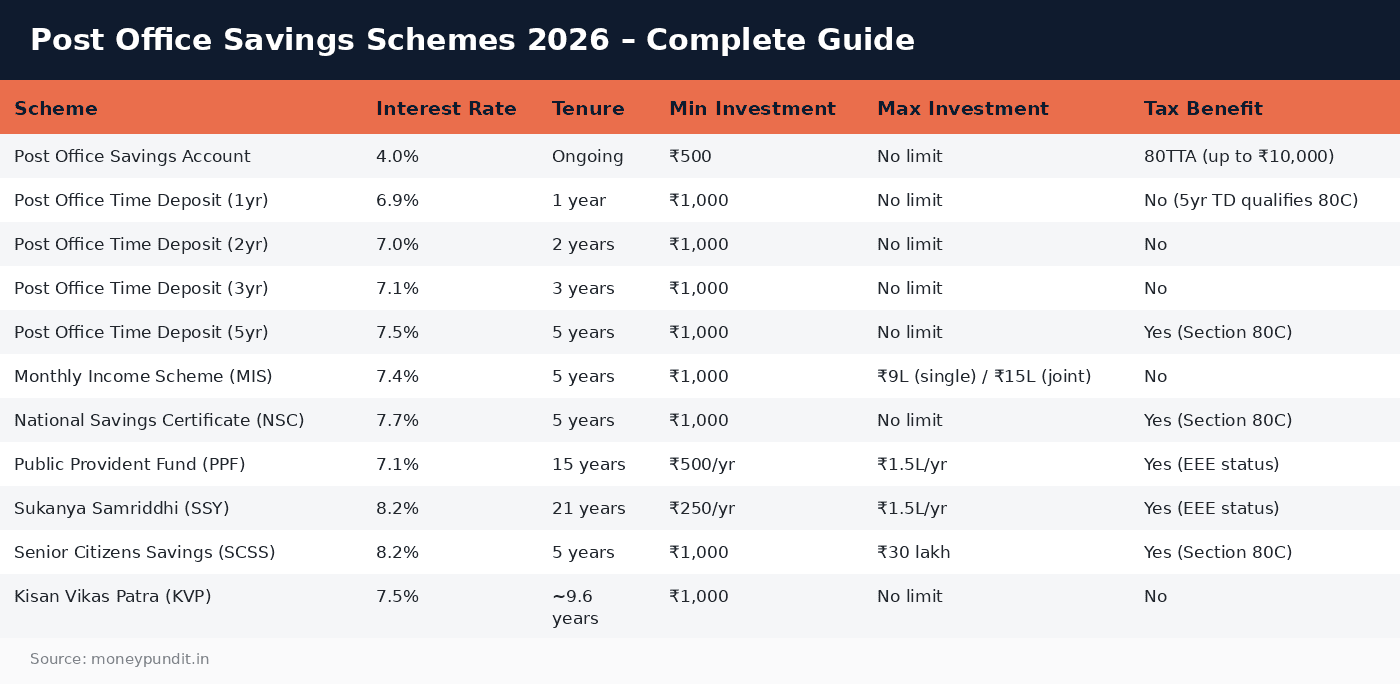
| Scheme | Interest Rate | Tenure | Min Investment | Max Investment | Tax Benefit |
|---|---|---|---|---|---|
| Post Office Savings Account | 4.0% | Ongoing | ₹500 | No limit | 80TTA (up to ₹10,000) |
| Post Office Time Deposit (1yr) | 6.9% | 1 year | ₹1,000 | No limit | No (5yr TD qualifies 80C) |
| Post Office Time Deposit (2yr) | 7.0% | 2 years | ₹1,000 | No limit | No |
| Post Office Time Deposit (3yr) | 7.1% | 3 years | ₹1,000 | No limit | No |
| Post Office Time Deposit (5yr) | 7.5% | 5 years | ₹1,000 | No limit | Yes (Section 80C) |
| Monthly Income Scheme (MIS) | 7.4% | 5 years | ₹1,000 | ₹9L (single) / ₹15L (joint) | No |
| National Savings Certificate (NSC) | 7.7% | 5 years | ₹1,000 | No limit | Yes (Section 80C) |
| Public Provident Fund (PPF) | 7.1% | 15 years | ₹500/yr | ₹1.5L/yr | Yes (EEE status) |
| Sukanya Samriddhi (SSY) | 8.2% | 21 years | ₹250/yr | ₹1.5L/yr | Yes (EEE status) |
| Senior Citizens Savings (SCSS) | 8.2% | 5 years | ₹1,000 | ₹30 lakh | Yes (Section 80C) |
| Kisan Vikas Patra (KVP) | 7.5% | ~9.6 years | ₹1,000 | No limit | No |
Rates for Q1 FY 2026-27. Government reviews rates quarterly.
Best Schemes for Different Goals
For Regular Monthly Income
The Post Office Monthly Income Scheme (POMIS) pays interest monthly at 7.4%. On a ₹9 lakh investment (maximum for single account), you receive approximately ₹5,550 per month. A couple can invest ₹15 lakh jointly, generating ₹9,250 monthly. This is ideal for retirees who need predictable monthly cash flow without market risk.
For Tax Saving Under 80C
PPF (7.1%, EEE tax status, 15-year lock-in), 5-year Post Office Time Deposit (7.5%, interest taxable), NSC (7.7%, interest reinvested qualifies for 80C), and SCSS (8.2%, for senior citizens) all qualify for Section 80C deduction. PPF and SSY are the standout options with their EEE status, investment, interest, and maturity all completely tax-free.
For Senior Citizens
SCSS at 8.2% is the best option: highest rate among all small savings schemes, quarterly interest payouts, and 80C tax benefit on the investment. The ₹30 lakh limit was increased from ₹15 lakh in Budget 2023, making it more useful for retirees with larger corpuses. Combined with POMIS, senior citizens can create a diversified income stream from post office schemes.
For Girl Child’s Future
Sukanya Samriddhi Yojana at 8.2% with complete tax exemption is unbeatable for parents of girls under 10. The 21-year tenure aligns perfectly with education and marriage timelines. No other investment offers 8.2% guaranteed, tax-free returns with sovereign backing.
Post Office vs Bank FDs
| Feature | Post Office Schemes | Bank FDs |
|---|---|---|
| Interest Rates | 6.9-8.2% | 6.0-7.5% (most banks) |
| Safety | Government of India guarantee | DICGC insurance up to ₹5 lakh |
| TDS | No TDS (except some schemes) | TDS on interest above ₹50,000 |
| Premature Withdrawal | Varies by scheme (generally stricter) | Available with penalty |
| Online Access | Improving (India Post Payments Bank) | Full digital access |
| Maximum Limit | Capped (varies by scheme) | No cap |
How to Open Post Office Accounts
Visit any post office with Aadhaar card, PAN card (for investments above ₹50,000), passport-size photographs, and the initial deposit amount. Many schemes are now available through India Post Payments Bank (IPPB) app and the DOP (Department of Posts) internet banking portal. Account opening typically takes 15-30 minutes at the post office. For PPF and SSY, accounts can also be opened at designated banks.
Frequently Asked Questions
Are post office investments completely safe?
Yes, all post office savings schemes carry a sovereign guarantee from the Government of India. Unlike bank deposits that are insured only up to ₹5 lakh by DICGC, post office deposits are guaranteed for the full amount regardless of the investment size. This makes them the safest investment option available in India.
Can I transfer my post office account to another city?
Yes, post office accounts including PPF and SSY can be transferred between post offices across India. Submit a transfer request at your current post office, and the account is transferred to the new branch within 7-15 working days. With the CBS (Core Banking Solution) implementation across post offices, transfers have become faster.
How are post office scheme interest rates decided?
The government reviews and announces small savings scheme interest rates every quarter based on the yields of comparable-tenure government securities. While the formula links small savings rates to G-Sec yields, the government has sometimes kept rates unchanged even when G-Sec yields fall, providing a floor for investor returns.
Comparing Returns Across Post Office Schemes
Post office schemes offer sovereign-backed safety with competitive rates, but each serves a different purpose. For short-term parking (1-3 years), Post Office Time Deposits and Monthly Income Scheme (MIS) at 7.4% are solid alternatives to bank FDs. For medium-term goals (5 years), the National Savings Certificate (NSC) at 7.7% provides Section 80C benefits with guaranteed returns. For long-term wealth building (15 years), the Public Provident Fund (PPF) at 7.1% offers completely tax-free maturity: unmatched by any other fixed-income instrument.
The Sukanya Samriddhi Yojana (SSY) currently offers the highest rate among all government schemes at 8.2%, exclusively for girl children, arguably the best guaranteed-return investment available in India today. Senior Citizens Savings Scheme (SCSS) at 8.2% is ideal for retirees seeking regular quarterly income with sovereign safety. Compare these rates with bank FD rates: post office schemes often offer 0.5-1% higher returns with government backing.
Tax Treatment and Investment Strategy
Tax treatment varies significantly: PPF and SSY are fully EEE (exempt at investment, accumulation, and maturity). NSC interest is taxable but qualifies for Section 80C reinvestment deduction. Post Office FD interest is fully taxable at slab rates, with TDS applicable if annual interest exceeds ₹50,000. KVP (Kisan Vikas Patra) doubles your money in approximately 115 months at current rates, but offers no tax benefits. Interest is fully taxable.
Optimal strategy: maximize SSY (₹1.5 lakh/year) if you have a daughter under 10, contribute to PPF (₹1.5 lakh/year limit) for tax-free long-term growth, use SCSS for post-retirement income, and deploy NSC for Section 80C tax savings when you’ve exhausted ELSS and PPF limits. All post office schemes can now be managed through India Post’s internet banking or via the Post Office Savings Bank app, no need to visit the branch for deposits or account statements.
Related reading: Post Office MIS Calculator
References: Sebi.gov.in
Post office savings schemes: Key Takeaways
Key points on post office savings schemes:
- The Post Office Monthly Income Scheme (POMIS) pays interest monthly at 7.4%.
- Many schemes are now available through India Post Payments Bank (IPPB) app and the DOP (Department of Posts) internet banking portal.
- Post office schemes offer sovereign-backed safety with competitive rates, but each serves a different purpose.
Verify the latest post office savings schemes figures with RBI before you act.