

Sovereign gold bonds sgb in brief: Sovereign Gold Bonds pay a fixed 2.5% annual interest on top of gold’s price appreciation.
Sovereign Gold Bonds pay a fixed 2.5% annual interest on top of gold’s price appreciation. A return no physical gold or gold ETF can match, since neither pays interest at all. Here’s how SGBs actually work, their tax treatment, and how to buy them.
Sovereign Gold Bonds (SGBs) have become one of the most popular gold investment options in India, offering the dual benefit of gold price appreciation plus a guaranteed 2.5% annual interest. Issued by the Reserve Bank of India on behalf of the Government of India, SGBs are the safest way to invest in gold without the hassles of storing physical gold. Here’s everything you need to know about SGBs in 2026.
What Are Sovereign Gold Bonds?
Sovereign Gold Bonds are government securities denominated in grams of gold. Each unit represents one gram of gold. When you buy an SGB, you’re essentially lending money to the government, which promises to pay you the equivalent market value of gold at maturity (after 8 years) plus 2.5% annual interest on the issue price. Since SGBs are backed by the Government of India, there is zero credit risk, making them the safest form of gold investment available.
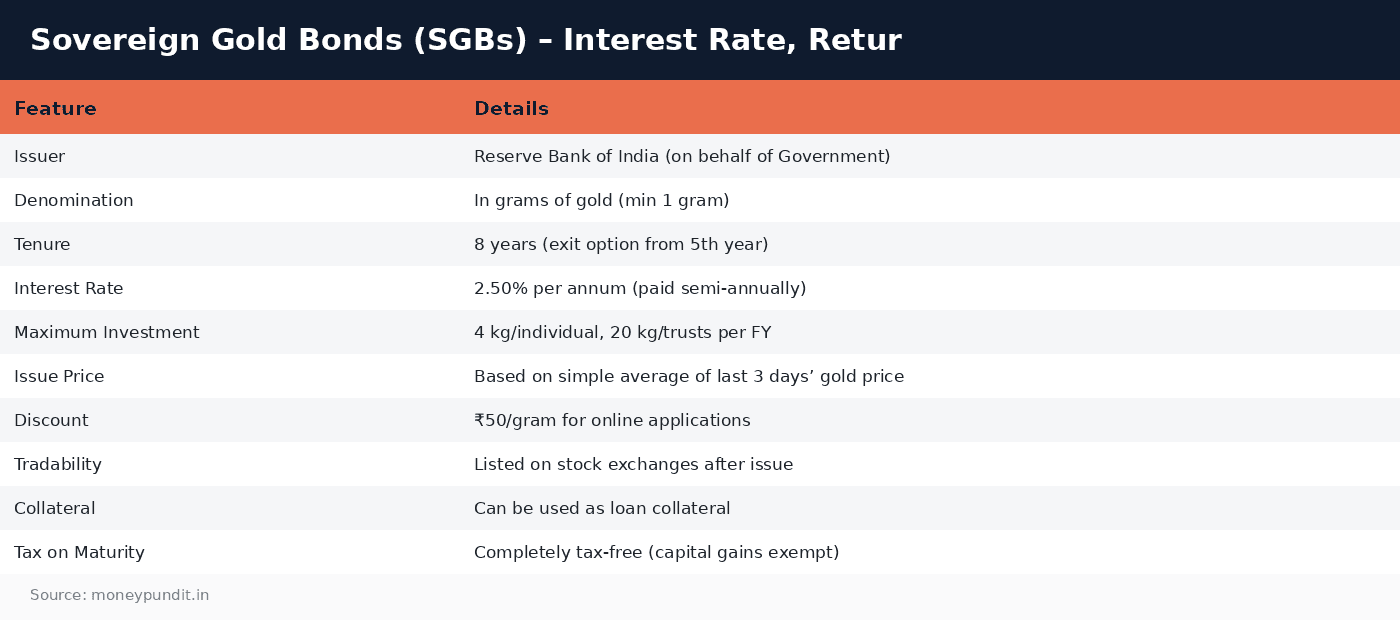
Key Features of SGBs
| Feature | Details |
|---|---|
| Issuer | Reserve Bank of India (on behalf of Government) |
| Denomination | In grams of gold (min 1 gram) |
| Tenure | 8 years (exit option from 5th year) |
| Interest Rate | 2.50% per annum (paid semi-annually) |
| Maximum Investment | 4 kg/individual, 20 kg/trusts per FY |
| Issue Price | Based on simple average of last 3 days’ gold price |
| Discount | ₹50/gram for online applications |
| Tradability | Listed on stock exchanges after issue |
| Collateral | Can be used as loan collateral |
| Tax on Maturity | Completely tax-free (capital gains exempt) |
Why SGBs Are Superior to Physical Gold
1. No Storage or Making Charges
Physical gold comes with making charges (10-25% for jewellery, 3-5% for coins), storage costs (bank locker fees of ₹2,000-10,000/year), and insurance costs. SGBs have none of these, they exist in demat form or as certificates of holding.
2. Extra 2.5% Annual Interest
Physical gold earns nothing while sitting in your locker. SGBs pay 2.5% per annum on the issue price, credited semi-annually to your bank account. Over 8 years, this adds up to 20% extra returns on your initial investment, in addition to gold price appreciation.
3. Tax-Free Capital Gains at Maturity
This is the biggest advantage. When you hold SGBs till maturity (8 years), the capital gains are completely tax-free, no LTCG, no STCG, nothing. Physical gold and gold mutual funds attract 12.5% LTCG tax on gains exceeding ₹1.25 lakh after 2 years. For a ₹10 lakh gold investment that doubles in 8 years, you’d save approximately ₹1.1 lakh in taxes with SGBs.
4. Purity Guaranteed
With physical gold, purity is always a concern: even hallmarked gold can have slight variations. SGBs are benchmarked to 999 purity (24 karat) gold prices published by IBJA (India Bullion and Jewellers Association), guaranteeing you the exact value.
SGB Returns – Historical Performance
SGBs issued in November 2015 (the first tranche) at ₹2,684/gram matured in November 2023 at approximately ₹6,132/gram, delivering total returns of around 150% (gold appreciation + interest), which translates to approximately 12% CAGR, completely tax-free. Recent SGB tranches issued in 2020-21 at ₹4,700-5,100/gram are already showing significant appreciation with gold prices crossing ₹7,500/gram in 2026.
How to Buy Sovereign Gold Bonds
SGBs are issued in tranches by RBI, typically 2-4 times per year. You can apply during the subscription period through scheduled commercial banks (SBI, HDFC, ICICI, etc.), designated post offices, Stock Holding Corporation of India, recognised stock exchanges (NSE, BSE), and online through netbanking (₹50/gram discount for online purchase).
You need a PAN card for purchase (mandatory for any amount) and KYC documents. Payment can be made via netbanking, NEFT/RTGS, demand draft, or cheque. The minimum investment is 1 gram and maximum is 4 kg per financial year for individuals.
Buying SGBs from the Secondary Market
If there’s no active RBI subscription window, you can buy existing SGBs from stock exchanges (NSE/BSE) through your demat account. Many SGB series are listed and trade at varying premiums or discounts to the gold price. The advantage is instant availability without waiting for RBI tranches. The disadvantage is that market liquidity can be low, and you may pay a premium over NAV. However, you still earn interest and get tax-free maturity if held till the original maturity date.
Tax Treatment of SGBs
The interest of 2.5% is taxable as per your income tax slab (added to your total income). Capital gains on maturity after 8 years are completely exempt from tax. If you redeem early (after 5th year using RBI’s exit window), capital gains are taxable as long-term capital gains at 12.5% with indexation benefit. If you sell on the stock exchange before maturity, gains are treated as LTCG (12.5% after 1 year) or STCG (at slab rate if held less than 1 year).
SGB vs Gold ETF vs Physical Gold vs Digital Gold
| Feature | SGB | Gold ETF | Physical Gold | Digital Gold |
|---|---|---|---|---|
| Returns | Gold + 2.5% interest | Gold price only | Gold price only | Gold price only |
| Tax (maturity) | Tax-free | 12.5% LTCG | 12.5% LTCG | 12.5% LTCG |
| Storage Cost | Nil | Expense ratio (0.5-1%) | Locker rent | 0.5-1% storage |
| Liquidity | Moderate (exchange) | High (exchange) | Low-Medium | High (app-based) |
| Making/Extra Charges | None | None | 10-25% | 2-3% spread |
| Min Investment | 1 gram (~₹7,500) | 1 unit (~₹50-500) | 0.5 gram | ₹1 |
| Collateral for Loan | Yes | Limited | Yes | No |
Frequently Asked Questions
Should I wait for a new SGB tranche or buy from the stock exchange?
If an RBI tranche is available, buy directly: you get the ₹50/gram online discount and the exact issue price based on recent gold rates. If no tranche is available and gold prices are rising, buying from the exchange makes sense to lock in current prices. Compare the exchange price with the current gold rate to ensure you’re not paying a significant premium.
Can I sell SGBs before 8 years?
Yes, in two ways. First, RBI offers premature redemption after the 5th year on interest payment dates. The redemption price is based on the prevailing gold price. Second, you can sell anytime on the stock exchange if you hold in demat form. However, for maximum tax benefit, holding till maturity is recommended.
What happens to SGBs if gold prices fall?
Your redemption value will be lower since it’s linked to the market gold price. However, you’ll still receive the 2.5% annual interest regardless of gold prices. If held till maturity, you won’t lose money unless gold prices at maturity are lower than your purchase price minus the total interest earned, which has never happened for any SGB series issued so far.
Are SGBs a good investment in 2026?
With gold prices at record highs (above ₹7,500/gram) and global uncertainty supporting further upside, SGBs remain an excellent long-term investment. The combination of gold price appreciation, 2.5% interest, and tax-free maturity makes SGBs arguably the best gold investment option available to Indian investors today.
References: Amfiindia.com
Sovereign gold bonds SGB: Key Takeaways
Key points on sovereign gold bonds sgb:
- Sovereign Gold Bonds are government securities denominated in grams of gold.
- Physical gold comes with making charges (10-25% for jewellery, 3-5% for coins), storage costs (bank locker fees of ₹2,000-10,000/year), and insurance costs.
- Recent SGB tranches issued in 2020-21 at ₹4,700-5,100/gram are already showing significant appreciation with gold prices crossing ₹7,500/gram in 2026.
Verify the latest sovereign gold bonds sgb figures with Income Tax Department before you act.