
Loan against fixed deposit in brief: The effective cost of borrowing is just the margin (1-2%) since your FD interest offsets most of the loan interest.
A loan against your FD typically costs just 1-2% more than the FD’s own interest rate, far cheaper than breaking the deposit early and losing the accrued interest, or taking a personal loan at double the rate. Here’s how it works and when it actually makes sense.
A loan against your fixed deposit is one of the cheapest borrowing options available in India, with interest rates just 1-2% above your FD rate. Instead of breaking your FD prematurely (and losing the interest rate benefit), you can pledge it as collateral and get instant funds at significantly lower rates than personal loans or credit cards. This guide explains how it works, when to use it, and how to apply.
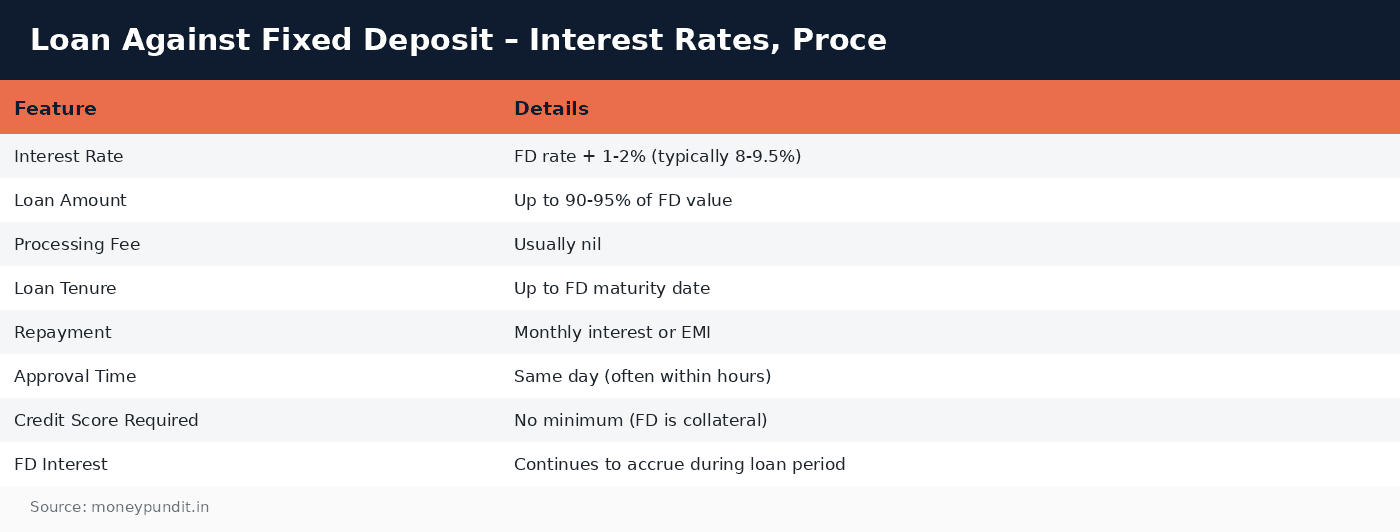
Loan Against FD – Key Features
| Feature | Details |
|---|---|
| Interest Rate | FD rate + 1-2% (typically 8-9.5%) |
| Loan Amount | Up to 90-95% of FD value |
| Processing Fee | Usually nil |
| Loan Tenure | Up to FD maturity date |
| Repayment | Monthly interest or EMI |
| Approval Time | Same day (often within hours) |
| Credit Score Required | No minimum (FD is collateral) |
| FD Interest | Continues to accrue during loan period |
How It Works
Your bank places a lien (hold) on your fixed deposit and disburses the loan amount to your savings account. Your FD continues earning its original interest rate throughout the loan period. You pay interest on the loan at FD rate + 1-2%. The effective cost of borrowing is just the margin (1-2%) since your FD interest offsets most of the loan interest. For a ₹5 lakh FD earning 7% with a loan at 9%, your net borrowing cost is effectively just 2%.
Loan Against FD vs Other Borrowing Options
| Option | Interest Rate | Processing Fee | Approval Time | Credit Score Impact |
|---|---|---|---|---|
| Loan Against FD | 8-9.5% | Nil | Same day | Minimal |
| Personal Loan | 10-24% | 1-3% | 1-7 days | Hard inquiry |
| Credit Card Cash | 24-42% | 2.5% | Instant | Increases utilisation |
| Gold Loan | 7-12% | 0.5-1% | 30 minutes | Minimal |
| Loan Against PPF | PPF rate + 1% | Nil | 1-2 days | None |
When Loan Against FD Makes Sense
Short-Term Cash Crunch
If you need funds for 1-6 months and have an FD maturing later, borrowing against it is far cheaper than a personal loan. Your FD continues earning interest, and the loan cost is marginal. Once you have the funds to repay (salary, bonus, or other income), close the loan without any prepayment penalty.
Preserving FD Interest Rate
If you booked an FD at 8% when rates were high and current rates have dropped to 6.5%, breaking the FD means re-investing at a lower rate. Borrowing against it at 9-10% for a short period preserves your higher FD rate. The math works especially well if the loan period is short and the rate difference between your FD and current rates is significant.
Emergency Without Breaking Investments
During emergencies, selling mutual funds or breaking FDs can trigger capital gains tax, exit loads, or loss of accumulated interest. A loan against FD provides immediate liquidity without disturbing your investment portfolio. Once the emergency passes, you repay the loan from regular income.
How to Apply
At Your Bank Branch
Visit the branch where your FD is held, fill a loan application form, and submit your FD receipt (if physical). The bank verifies your FD and disburses the loan, typically within a few hours. Some banks offer this through net banking or mobile app, allowing you to get the loan without visiting the branch.
Online Application
Several banks including SBI, HDFC, ICICI, and Axis allow you to apply for a loan against FD through their internet banking or mobile app. The process involves selecting the FD, choosing the loan amount (up to 90-95% of FD value), and confirming the disbursement. The loan amount is credited to your linked savings account instantly.
Repayment Options
Most banks offer flexible repayment: you can pay monthly interest and return the principal at the end, convert it to EMIs, or repay the entire amount (principal + interest) at any time without prepayment charges. If you do not repay the loan by the FD maturity date, the bank automatically deducts the loan outstanding from the FD maturity proceeds and pays you the balance.
Important Considerations
Tax-Saving FDs Cannot Be Pledged
5-year tax-saving FDs made under Section 80C cannot be used as collateral for loans because they have a mandatory lock-in period during which no premature withdrawal or pledge is allowed. Only regular (non-tax-saving) FDs qualify for loan against FD facility.
Joint FD Complications
If the FD is in joint names, all holders must consent to the loan. The loan application requires signatures from all FD holders. If the FD is in “Either or Survivor” mode, either holder can apply independently at some banks.
Impact on CIBIL Score
Since the loan is fully secured by your FD, it has minimal impact on your credit score. However, consistent timely interest payments can marginally improve your credit history. Defaulting on the loan (rare, since the bank can recover from the FD) would negatively affect your score.
Frequently Asked Questions
Can I get a loan against FD from a different bank?
Generally, the loan against FD facility is available only from the bank where the FD is held. Some banks may accept FDs from other banks as collateral, but this is uncommon and involves additional documentation. For convenience and speed, use the FD-holding bank.
Will my FD interest reduce if I take a loan against it?
No, your FD continues to earn interest at the original rate throughout the loan period. The lien placed on the FD does not affect its interest accrual. However, you cannot withdraw or break the FD while the loan is outstanding. You must first repay the loan to release the lien.
What is the maximum loan I can get?
Most banks offer up to 90% of the FD value for domestic deposits and up to 75-80% for NRE/NRO deposits. On a ₹10 lakh FD, you can get up to ₹9 lakh as a loan. Some banks may offer 95% for their premium customers or for shorter loan periods.
Is overdraft against FD better than a loan?
An overdraft (OD) against FD gives you a credit limit linked to your savings account. You only pay interest on the amount actually used, not the full sanctioned limit. This is ideal for irregular cash flow needs. A term loan disburses the full amount upfront. If you need funds intermittently, OD is more cost-effective. If you need a fixed lumpsum, a term loan works fine.
References: Amfiindia.com
Loan against fixed deposit: Key Takeaways
Key points on loan against fixed deposit:
- Your bank places a lien (hold) on your fixed deposit and disburses the loan amount to your savings account.
- If you need funds for 1-6 months and have an FD maturing later, borrowing against it is far cheaper than a personal loan.
- Visit the branch where your FD is held, fill a loan application form, and submit your FD receipt (if physical).
Verify the latest loan against fixed deposit figures with RBI before you act.