
Fire movement in brief: The core idea is simple: save and invest aggressively (50-70% of income) for 10-15 years to build a corpus large enough to sustain your lifestyle indefinitely through passive income.
The FIRE formula is deceptively simple: save 25 times your annual expenses and you can theoretically stop working, but applying it in India means accounting for healthcare costs, inflation, and family obligations that the original Western framework doesn’t fully capture. Here’s how to adapt it.
FIRE, Financial Independence, Retire Early, is a movement that has gained significant traction among young Indian professionals who dream of breaking free from the 9-to-5 grind well before the traditional retirement age of 60. The core idea is simple: save and invest aggressively (50-70% of income) for 10-15 years to build a corpus large enough to sustain your lifestyle indefinitely through passive income. But is FIRE realistic in India? This guide explores the math, strategies, and challenges.
The FIRE Formula
The foundation of FIRE is the 25x rule: your retirement corpus should be 25 times your annual expenses. If you spend ₹6 lakh per year (₹50,000/month), you need ₹1.5 crore. If you spend ₹12 lakh per year, you need ₹3 crore. The 25x multiple is based on the 4% safe withdrawal rate. Withdrawing 4% of your corpus annually should sustain it for 30+ years when invested in a balanced portfolio of equity and debt. The fire movement in India relies heavily on disciplined, long-term investing, so it’s worth using our SIP Calculator to model exactly how fast your monthly investments can compound toward that 25x target.
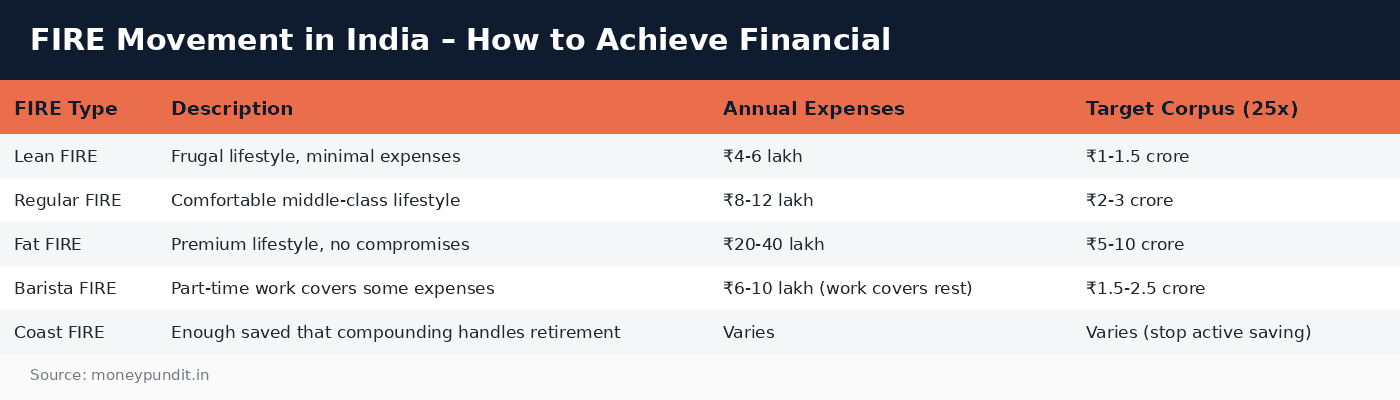
Types of FIRE
| FIRE Type | Description | Annual Expenses | Target Corpus (25x) |
|---|---|---|---|
| Lean FIRE | Frugal lifestyle, minimal expenses | ₹4-6 lakh | ₹1-1.5 crore |
| Regular FIRE | Comfortable middle-class lifestyle | ₹8-12 lakh | ₹2-3 crore |
| Fat FIRE | Premium lifestyle, no compromises | ₹20-40 lakh | ₹5-10 crore |
| Barista FIRE | Part-time work covers some expenses | ₹6-10 lakh (work covers rest) | ₹1.5-2.5 crore |
| Coast FIRE | Enough saved that compounding handles retirement | Varies | Varies (stop active saving) |
How Much Do You Need to Save Monthly?
| FIRE Target | Timeline 10 years (12% CAGR) | Timeline 15 years (12% CAGR) | Timeline 20 years (12% CAGR) |
|---|---|---|---|
| ₹2 crore | ₹87,000/month | ₹40,000/month | ₹20,000/month |
| ₹3 crore | ₹1,30,000/month | ₹60,000/month | ₹30,000/month |
| ₹5 crore | ₹2,17,000/month | ₹1,00,000/month | ₹50,000/month |
Assumes 12% CAGR from diversified equity portfolio with annual 10% step-up in SIP amount.
FIRE Strategy for Indian Context
Phase 1: Increase Savings Rate
The savings rate is the single most important factor in FIRE. If you save 20% of your income, FIRE takes 35+ years. At 50% savings rate, it takes about 15 years. At 70%, approximately 8-10 years. Focus on increasing income (skill upgrades, side hustles, career moves) and controlling lifestyle inflation rather than extreme frugality. In India, housing and lifestyle costs in tier-2 cities can be 40-60% lower than metros, making geoarbitrage a powerful FIRE accelerator.
Phase 2: Invest Aggressively
During the accumulation phase, maintain 80-90% equity allocation through diversified index funds and quality active mid/small cap funds. EPF and PPF provide a stable debt foundation. Maximise tax-advantaged accounts: EPF contribution, NPS (₹50,000 extra deduction under 80CCD1B), and ELSS for Section 80C. Every rupee saved in taxes is a rupee added to your FIRE corpus.
Phase 3: Build Multiple Income Streams
True financial independence becomes more robust with diversified income sources. Dividend stocks providing ₹2-3 lakh annually, rental income from REITs or property, freelance consulting (Barista FIRE approach), and interest from debt investments create a safety net that does not entirely depend on portfolio withdrawals.
The 4% Rule: Does It Work in India?
The 4% safe withdrawal rate was developed for the US market with its specific inflation and return characteristics. In India, higher inflation (6-7% vs 2-3% in the US) means you may need a lower withdrawal rate (3-3.5%) or a larger corpus. However, Indian equity markets have also delivered higher nominal returns (12-15% vs 10% in the US), partially offsetting the higher inflation. A conservative approach: use the 3.5% rule in India, meaning you need approximately 28-29 times annual expenses instead of 25x.
India-Specific FIRE Challenges
Healthcare Costs
Healthcare inflation in India runs at 10-15% annually. Without employer-sponsored health insurance (which you lose upon early retirement), you need comprehensive family health coverage costing ₹30,000-₹1,00,000 annually, increasing each year. Budget for a ₹1 crore super top-up health plan and factor premium escalation into your FIRE calculations.
Children’s Education
Quality education costs in India are rising at 8-12% annually. An engineering degree that costs ₹8 lakh today could cost ₹25-30 lakh in 15 years. If you plan to retire early with school-age children, the education fund must be separately earmarked and not considered part of the FIRE corpus.
Social and Family Expectations
Indian culture often involves financial responsibilities beyond the nuclear family, supporting parents, contributing to family events, and social obligations. These expenses are difficult to predict and can strain a FIRE budget. Build a buffer of 10-15% above your calculated FIRE number to account for such cultural responsibilities.
Post-FIRE Income Strategy
After achieving FIRE, structure your withdrawals tax-efficiently. Use the ₹1.25 lakh LTCG exemption on equity mutual funds annually. Withdraw from debt funds with indexation benefit for amounts above the equity exemption. Maintain 2-3 years of expenses in liquid funds to avoid selling equity during market downturns. This bucket strategy (immediate cash + medium-term debt + long-term equity) provides stability while maximising post-tax returns.
Frequently Asked Questions
Is FIRE possible in India with a ₹15-₹20 lakh salary?
Lean FIRE (₹1.5-2 crore corpus) is achievable in 12-15 years with a ₹15-20 lakh salary if you save 50%+ of your income and invest in equity. This requires disciplined spending, possibly living in a tier-2 city, and avoiding lifestyle inflation. Regular or Fat FIRE would require higher income or longer timelines.
What if the market crashes right when I retire early?
This is called “sequence of returns risk”: the biggest threat to early retirees. Mitigate it by maintaining a 2-3 year cash/debt buffer, being flexible with withdrawals (reduce spending 10-20% during downturns), having the ability to earn some income through part-time work (Barista FIRE), and keeping a slightly larger corpus than the minimum 25x.
Should I pay off my home loan before FIRE?
Yes, entering early retirement without any debt, especially a home loan, is strongly recommended. EMI obligations on a fixed corpus create stress and reduce flexibility. If your FIRE target is ₹3 crore and you have a ₹50 lakh home loan, your effective FIRE number is ₹3.5 crore. Prioritise home loan prepayment in the years leading to your FIRE date.
References: Amfiindia.com
Fire movement: Key Takeaways
Key points on fire movement:
- The foundation of FIRE is the 25x rule: your retirement corpus should be 25 times your annual expenses.
- Assumes 12% CAGR from diversified equity portfolio with annual 10% step-up in SIP amount.
- The savings rate is the single most important factor in FIRE.
Verify the latest fire movement figures with RBI before you act.