
Savings account interest rates in India now start at 2.50% at almost every large bank, and the only way to earn more is a higher balance at a small finance bank or a few private banks. This page lists the rates of public sector banks, private banks and small finance banks, with the balance slab and the date each rate took effect. Rates were checked on 5 October 2026.
NRI account holders: compare NRE FD rates 2026 too.
Savings Account Interest Rates: Public Sector Banks
Every public sector bank we could confirm pays 2.50% at ordinary balances. Higher rates start only at balances of ₹100 crore or more.
| Bank | Interest rate | Balance slab | Rate effective |
|---|---|---|---|
| State Bank of India | 2.50% | Same on all balances | Effective 15 Jun 2025 |
| Punjab National Bank | 2.50% | Up to ₹100 crore | Effective 1 Oct 2025 |
| Bank of Baroda | 2.50% | ₹1 lakh to below ₹50 crore | Effective 22 Aug 2025 |
| Canara Bank | 2.50% | Up to ₹50 lakh | Effective 5 Sep 2026 |
| Bank of India | 2.50% | Up to ₹50 crore | Effective 1 Sep 2026 |
| Bank of Maharashtra | 2.50% | Up to ₹1 crore | Effective 1 Sep 2025 |
| Indian Bank | 2.50% | Up to ₹10 lakh | Effective 4 Jul 2026 |
| UCO Bank | 2.50% | ₹10 lakh and above | Effective 23 Jun 2025 |
| Union Bank of India | 2.50% | Up to ₹50 lakh | Effective 10 Aug 2026 |
Source: Business Today, 10 Sep 2026. Central Bank of India, Indian Overseas Bank and Punjab & Sind Bank are not in that comparison and are not listed here until a current rate is confirmed from the bank.
Savings Account Interest Rates: Small Finance Banks
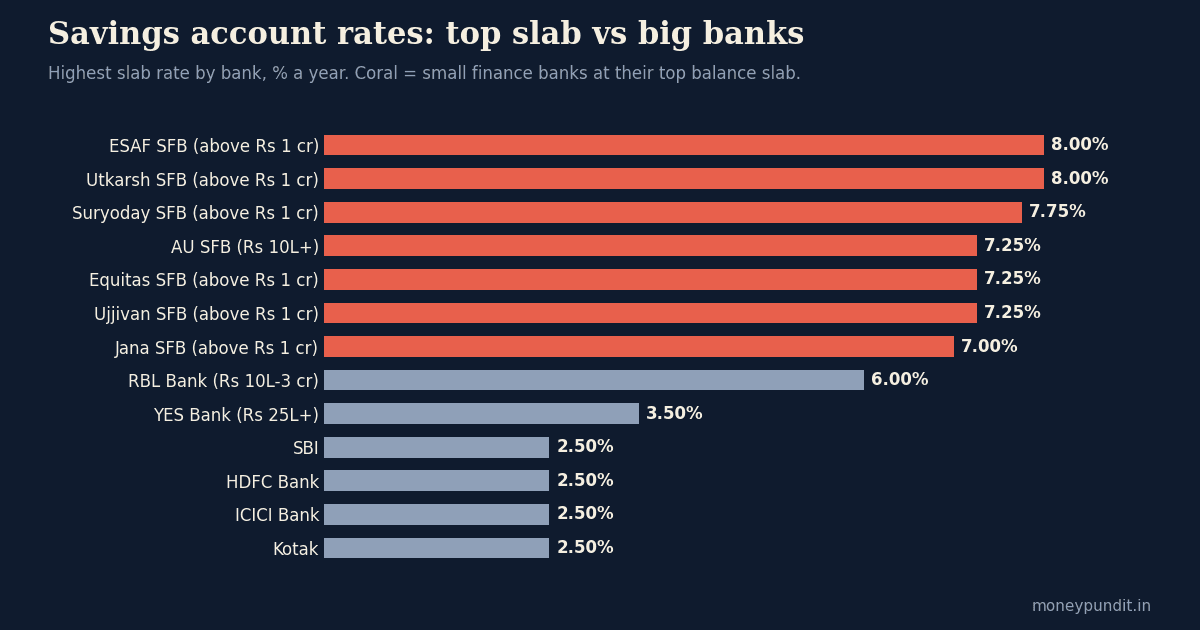
Small finance banks pay the highest rates, but the headline rate applies only to large balances. At smaller balances they pay far less, and many apply slab rates only to the part of the balance in each slab, so check how a bank applies them before you move money.
| Bank | Base rate | Higher slabs | Minimum balance |
|---|---|---|---|
| AU Small Finance Bank | 2.75% (up to ₹5L) | 5.00% (₹5-10L); 7.25% (₹10L-25cr) | None |
| Equitas Small Finance Bank | 3.50% (up to ₹5L) | 5.00% (₹5-10L); 6.50% (₹10-25L); 7.00% (₹25L-1cr); 7.25% (above ₹1cr) | ₹5,000 |
| ESAF Small Finance Bank | 3.00% (up to ₹1L) | 5.50% (₹1-5L); 6.00% (₹5-10L); 7.00% (₹10-25L); 7.50% (₹25L-1cr); 8.00% (above ₹1cr) | None |
| Jana Small Finance Bank | 2.75% (up to ₹1L) | 3.50% (₹1-5L); 5.00% (₹5-10L); 6.75% (₹10L-1cr); 7.00% (above ₹1cr) | ₹5,000 |
| Suryoday Small Finance Bank | 3.25% (up to ₹1L) | 5.00% (₹1-5L); 6.25% (₹5-10L); 7.50% (₹10L-1cr); 7.75% (above ₹1cr) | None |
| Utkarsh Small Finance Bank | 3.25% (up to ₹1L) | 4.25% (₹1-5L); 5.50% (₹5-10L); 7.00% (₹10L-1cr); 8.00% (above ₹1cr) | ₹2,000 |
| Ujjivan Small Finance Bank | 3.25% (up to ₹5L) | 5.00% (₹5-10L); 7.00% (₹10L-1cr); 7.25% (above ₹1cr) | None |
| Unity Small Finance Bank | 3.50% (up to ₹5L) | 7.25% (above ₹5L) | ₹1,000 |
| North East Small Finance Bank | 4.00% (up to ₹5L) | 7.25% (above ₹5L) | None |
Source: PolicyBazaar slab table, checked 5 October 2026. Capital Small Finance Bank is not listed because no current savings rate could be confirmed.
Savings Account Interest Rates: Private Banks
| Bank | Base rate | Higher balances |
|---|---|---|
| ICICI Bank | 2.50% | Same on all balances (from June 2026) |
| Kotak Mahindra Bank | 2.50% | Same on all balances (from 9 Jul 2025) |
| HDFC Bank | 2.50% | Up to ₹50 lakh; confirm slabs above on the bank site |
| Axis Bank | 2.50% | Slab-based; confirm on the bank site |
| Federal Bank | 2.50% | Up to ₹1 lakh; higher slabs for large balances (revised 16 Jul 2026) |
| YES Bank | 2.50% | 2.75% (₹1-10L); 3.50% (₹25 lakh to ₹100 crore, from 7 Apr 2026) |
| IDFC FIRST Bank | 2.50% | 2.75% (₹1-10L) |
| IndusInd Bank | 2.50% | 3.00% (₹1-10L) |
| RBL Bank | 3.00% (up to ₹5L) | 5.00% (₹5-10L); 6.00% (₹10L-3cr), from 1 Oct 2026 |
| Bandhan Bank | 2.70% (₹1-5L) | 4.85% (₹5-10L) |
| DBS Bank | 2.50% (up to ₹2L) | 5.00% (₹2L-50L) |
| SBM Bank India | 2.75% (up to ₹5L) | Higher slabs on the bank site |
| DCB Bank | 2.25% (₹1-5L) | 3.75% (₹5-10L) |
Sources: bank rate notices and PolicyBazaar, checked 5 October 2026. Private banks revise slabs often, so confirm on the bank’s site before you decide. CSB, City Union, Dhanlaxmi, J&K, Karnataka, Karur Vysya, Nainital, South Indian and Tamilnad Mercantile banks are not listed yet because their current savings rates are not confirmed.
What Higher Savings Account Interest Rates Are Worth
On a ₹10 lakh balance, 2.50% earns about ₹25,000 a year. A bank paying 7% on a balance of that size would earn about ₹70,000, which is ₹45,000 more, but only if that rate applies to your whole balance. Where slab rates apply only to the part of the balance above a threshold, the gain is smaller. Interest is taxable, so the real gain is lower still.
Are Small Finance Banks Safe?
Small finance banks are regulated by the Reserve Bank of India and their deposits are insured by the DICGC up to ₹5 lakh per depositor per bank, covering principal and interest together. That is the same cover as at a large bank. If you keep more than ₹5 lakh, split it across banks.
Tax on Savings Account Interest
Savings account interest is added to your income and taxed at your slab rate. Under the old tax regime, Section 80TTA lets individuals under 60 deduct up to ₹10,000 of savings interest, and Section 80TTB lets senior citizens deduct up to ₹50,000 of interest from savings accounts and deposits. These deductions are not available under the new regime. Banks deduct TDS on savings interest only in limited cases, so report the interest yourself.
What to Check Beyond the Rate
Check the minimum balance, the charge for missing it, how often interest is credited (usually quarterly, calculated daily on the closing balance), and whether the app and branch network suit you. A monthly penalty of ₹500 to ₹1,000 can wipe out the extra interest.
A Simple Savings Strategy
Keep money you need for daily spending in a large bank, and keep your emergency fund where it earns more. For money you will not need for a year or more, a fixed deposit pays much more than any savings account. See our best FD rates and senior citizen FD rates for every bank, and track small savings rates on the interest rate tracker.
Highest Savings Account Interest Rate in India
The highest rate we could confirm is 8.00%, paid by ESAF Small Finance Bank and Utkarsh Small Finance Bank on balances above ₹1 crore. For balances under ₹10 lakh the best slab rates are about 5% to 6%, at banks such as ESAF, Equitas, RBL Bank and DBS Bank, so the headline 7% to 8% rates apply only to large deposits.
Zero Balance Savings Account
A zero balance savings account has no minimum balance requirement. Basic accounts such as the SBI Basic Savings Bank Deposit Account carry no minimum balance charge. If your balance often falls below the minimum at a bank that charges for it, a zero balance account avoids those penalties.
Best Savings Account for ₹10 Lakh
At ₹10 lakh, the large banks pay 2.50% and several small finance banks pay 5% to 7.50%, depending on the slab (AU Small Finance Bank 7.25% from ₹10 lakh, Jana 6.75%, Suryoday 7.50%, Utkarsh 7.00%). Because DICGC insures only ₹5 lakh per bank, splitting ₹10 lakh across two banks keeps the whole amount insured. For money you do not need for a year, compare these with fixed deposit rates.
Frequently Asked Questions
Which bank gives the highest savings account interest in India?
Among the banks we confirmed, ESAF Small Finance Bank and Utkarsh Small Finance Bank pay up to 8.00% on balances above ₹1 crore. For balances below ₹10 lakh, RBL Bank and DBS Bank pay more than most.
What is the savings account interest rate at SBI?
SBI pays 2.50% a year on all savings balances, effective 15 June 2025.
Is savings account interest taxable?
Yes. It is added to your income. Under the old regime you can deduct up to ₹10,000 under Section 80TTA, or ₹50,000 for senior citizens under Section 80TTB.
How is savings account interest calculated?
Banks calculate it daily on the closing balance and credit it quarterly, though some credit monthly.
Is my money safe in a small finance bank?
Deposits up to ₹5 lakh per bank are insured by the DICGC, the same as at any other bank.
This article is general information, not investment advice. Check current rates and terms with the bank before you open an account.
Compare: debit card charges India 2026: annual fees, ATM fees and minimum balance penalties by bank for the fees and minimum balance rules that go with the account.
Related guide: Read our guide on how to close a bank account in India.