

The Public Provident Fund (PPF) is one of India’s most popular long-term savings instruments, offering guaranteed returns backed by the Government of India. With its unique EEE (Exempt-Exempt-Exempt) tax status, where the investment, interest earned, and maturity amount are all completely tax-free. PPF remains an unbeatable option for risk-averse investors looking to build a retirement corpus or save for long-term goals.
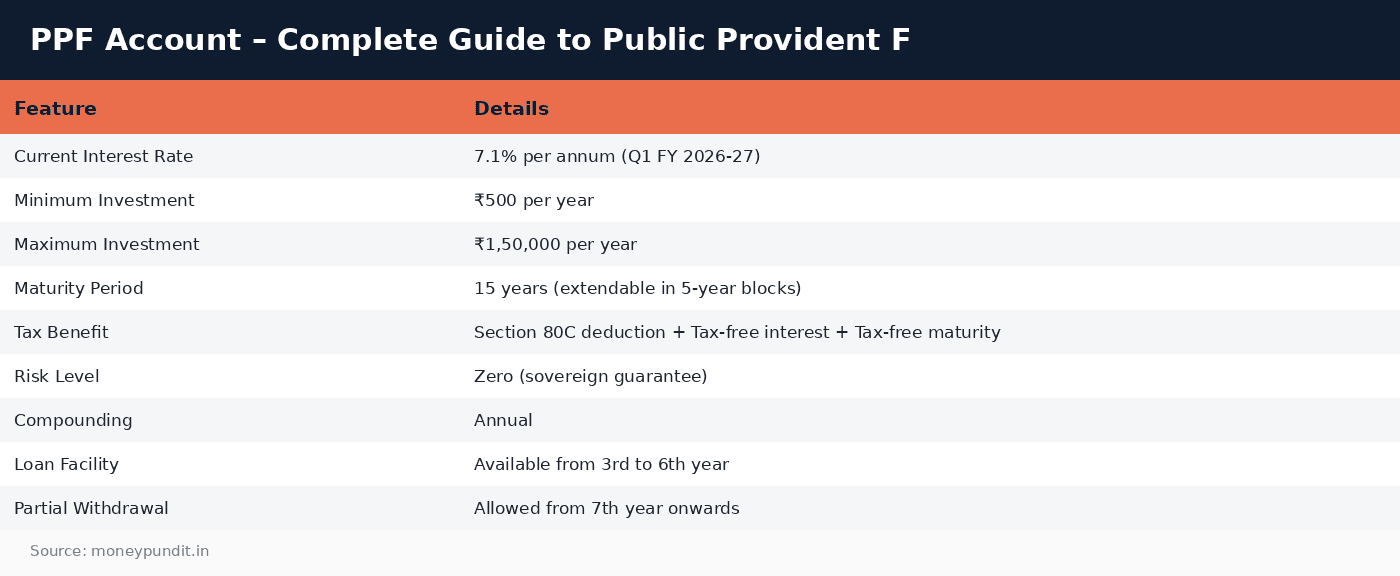
PPF Key Features at a Glance
| Feature | Details |
|---|---|
| Current Interest Rate | 7.1% per annum (Q1 FY 2026-27) |
| Minimum Investment | ₹500 per year |
| Maximum Investment | ₹1,50,000 per year |
| Maturity Period | 15 years (extendable in 5-year blocks) |
| Tax Benefit | Section 80C deduction + Tax-free interest + Tax-free maturity |
| Risk Level | Zero (sovereign guarantee) |
| Compounding | Annual |
| Loan Facility | Available from 3rd to 6th year |
| Partial Withdrawal | Allowed from 7th year onwards |
How PPF Interest is Calculated
PPF interest is calculated on the minimum balance between the 5th and the last day of each month, but credited only once at the end of the financial year (March 31). This calculation method has an important implication: to maximise your interest earnings, you should deposit your PPF contribution before the 5th of every month. If you invest ₹1.5 lakh as a lumpsum, doing so before April 5th ensures your entire annual contribution earns interest for the full year.
For example, if you deposit ₹1,50,000 on April 3rd, your interest for April is calculated on the full ₹1,50,000. But if you deposit on April 7th, the April interest is calculated on the previous month-end balance (which could be zero for a new account). This difference, compounded over 15 years, can result in a meaningful difference in your final corpus.
PPF Maturity Calculation
If you invest the maximum ₹1,50,000 annually at 7.1% interest rate for 15 years, your maturity amount would be approximately ₹40.68 lakh. Your total investment over 15 years is ₹22.5 lakh, and the interest earned is approximately ₹18.18 lakh. Completely tax-free. After maturity, you can extend the PPF account in blocks of 5 years with or without additional contributions, allowing the corpus to continue compounding tax-free.
Where to Open a PPF Account
PPF accounts can be opened at designated post offices and scheduled commercial banks including SBI, Bank of Baroda, ICICI Bank, HDFC Bank, Axis Bank, and others. Online PPF accounts are available through net banking portals of most major banks, making it convenient to open and manage without visiting a branch. Each individual can hold only one PPF account. Opening multiple accounts is not permitted, and if discovered, the duplicate account is deactivated.
PPF for Different Life Stages
Young Professionals (Age 22-30)
Starting a PPF account early provides the maximum benefit of compounding. Even if you cannot invest the full ₹1.5 lakh initially, start with ₹500-₹5,000 per month and increase as your income grows. A PPF account opened at 25 can be extended to age 55 (15 years + two 5-year extensions + another extension), creating a substantial tax-free retirement corpus. The discipline of mandatory annual contributions also builds good saving habits.
Parents (For Minor Children)
Parents or guardians can open a PPF account in the name of a minor child. However, the combined contribution to the parent’s own PPF and the child’s PPF cannot exceed ₹1.5 lakh per year for Section 80C deduction purposes. The child’s PPF account matures 15 years from opening, and the child takes over management after turning 18. This is an excellent way to create a tax-free education or marriage fund.
Pre-Retirement (Age 50-60)
If you are 10-15 years from retirement and have never opened a PPF, starting now still makes sense. The guaranteed, tax-free 7.1% return is attractive for the conservative portion of your retirement portfolio. After the initial 15-year maturity, you can continue making contributions and extensions, providing a steady tax-free income stream during retirement.
PPF Loan and Withdrawal Rules
Loan Against PPF
From the 3rd financial year to the 6th financial year of your PPF account, you can take a loan of up to 25% of the balance at the end of the second preceding financial year. The interest rate on such loans is 1% above the prevailing PPF interest rate. The loan must be repaid within 36 months. While the interest rate is reasonable, ELSS or other investments can usually be liquidated more efficiently.
How to apply: Submit Form D (available at your bank/post office branch, or downloadable via net banking) along with your PPF passbook. Most banks process the loan within 7-10 working days and credit it directly to your linked savings account, no separate collateral or guarantor is needed since the loan is secured against your own PPF balance.
Worked example: If your PPF balance at the end of FY 2023-24 was ₹4,00,000, you can borrow up to ₹1,00,000 (25%) in FY 2026-27. At a PPF rate of 7.1% + 1% = 8.1% simple interest, a ₹1,00,000 loan repaid over 24 months costs roughly ₹13,000-16,000 in total interest, substantially cheaper than a personal loan (typically 11-16%) or gold loan (9-14%), provided you repay within the mandatory 36-month window. Missed repayments attract a higher 6% penal rate on the unpaid portion.
When it makes sense: A PPF loan suits short-term liquidity needs (medical emergency, wedding expense) where you’re confident of repaying within 3 years, the low rate and zero processing fee make it cheaper than most secured or unsecured loans. If you need funds for longer, or can’t guarantee repayment within 36 months, partial withdrawal (available from year 7 onwards, see below) or a regular personal loan may suit better.
Partial Withdrawal
From the 7th financial year onwards, you can withdraw up to 50% of the balance at the end of the 4th preceding financial year or the preceding year, whichever is lower. Only one withdrawal per financial year is permitted. These withdrawals are completely tax-free and do not reduce the 80C benefit claimed on previous contributions.
PPF vs Other Fixed-Return Investments
| Feature | PPF | EPF | NSC | Tax-Saving FD |
|---|---|---|---|---|
| Interest Rate | 7.1% | 8.25% | 7.7% | 6.5-7.5% |
| Lock-in | 15 years | Till retirement | 5 years | 5 years |
| Tax on Interest | Exempt | Exempt (up to ₹2.5L/yr) | Taxable at slab | Taxable at slab |
| Tax on Maturity | Exempt | Exempt | N/A | N/A |
| Self-Employed Access | Yes | No | Yes | Yes |
| Extension Possible | Yes (5-year blocks) | N/A | No (reinvest) | No (renew) |
Frequently Asked Questions
Can NRIs open or maintain a PPF account?
NRIs cannot open new PPF accounts. However, if a resident Indian who already has a PPF account becomes an NRI, they can continue the account until maturity (15 years from opening). They cannot extend it beyond maturity. The account will earn interest until maturity but no further contributions may be allowed depending on the bank’s interpretation of current RBI guidelines.
What happens if I don’t invest the minimum ₹500 in a year?
If you fail to deposit the minimum ₹500 in any financial year, your PPF account becomes dormant (inactive). To reactivate it, you need to pay the shortfall of ₹500 for each defaulted year plus a penalty of ₹50 per year of default. The account continues to earn interest even in the dormant state, but you cannot make withdrawals or take loans until it is reactivated.
Is PPF better than ELSS for tax saving?
Both serve different purposes. PPF is better for risk-averse investors who want guaranteed, tax-free returns and have a 15-year horizon. ELSS is better for investors comfortable with market risk who want potentially higher returns (12-15%) with a shorter 3-year lock-in. Ideally, use both, PPF for the safe portion and ELSS for the growth portion of your 80C allocation.
Can I transfer my PPF account between banks?
Yes, PPF accounts can be transferred between banks and post offices. Submit a transfer request at your current branch, and the account along with its history is transferred to the new branch. This is useful if you relocate or want to manage your PPF through a bank with better online facilities.
Related reading: PPF Interest Rate History
References: Rbi.org.in