
PPF interest rates have been revised more than 20 times since the scheme launched in 1968, from a high of 12% through the 1980s and 1990s down to today’s 7.1%. Understanding this history helps explain why the PPF account is still worth opening even at today’s lower rate, and what to expect if rates move again. Here is the complete year-wise and quarter-wise rate history, how the rate is actually decided, and what it means for your long-term corpus.
Current PPF Interest Rate (October-December 2026)
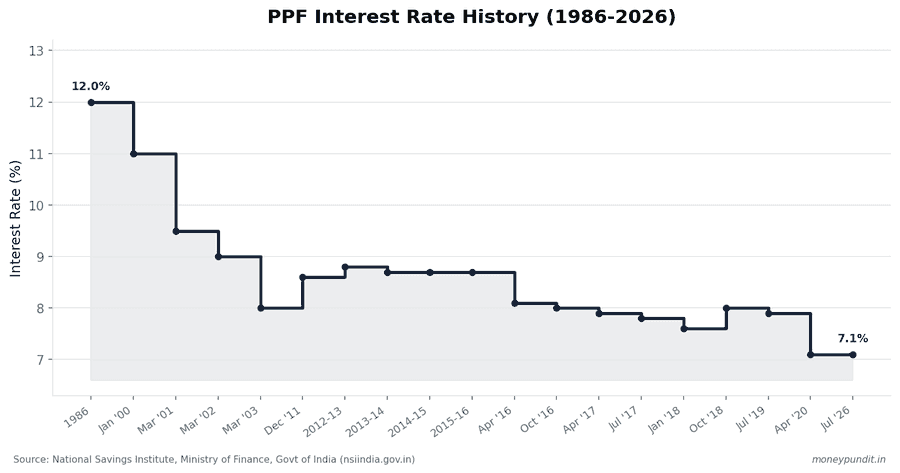
The PPF interest rate for the October-December 2026 quarter is 7.1% per annum, unchanged since April 2020. This is the longest stretch of rate stability in PPF’s history. Over six years without a single revision, compared to the frequent quarterly swings seen between 2016 and 2020.
Full PPF Interest Rate History (1986-2026)
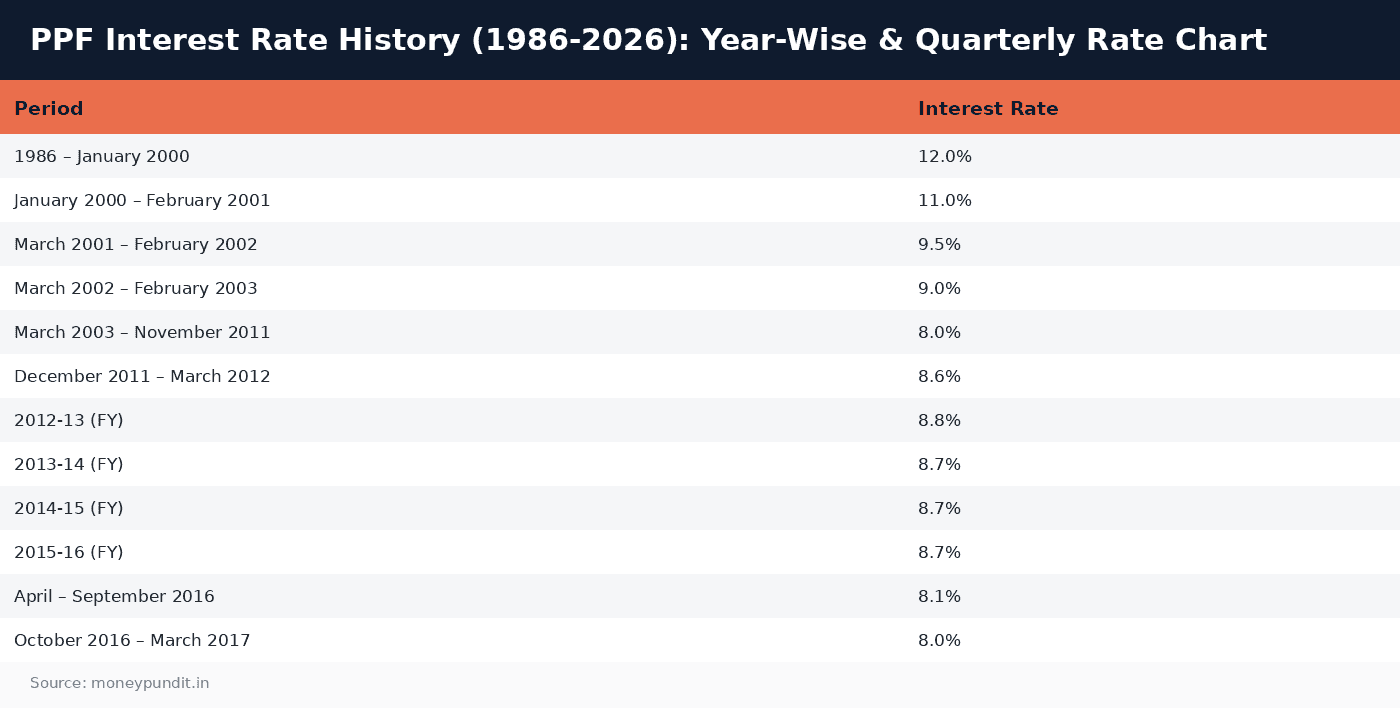
Rates were revised annually until April 2016, after which the government moved to quarterly reviews linked to benchmark government security yields plus a small markup.
| Period | Interest Rate |
|---|---|
| 1986 – January 2000 | 12.0% |
| January 2000 – February 2001 | 11.0% |
| March 2001 – February 2002 | 9.5% |
| March 2002 – February 2003 | 9.0% |
| March 2003 – November 2011 | 8.0% |
| December 2011 – March 2012 | 8.6% |
| 2012-13 (FY) | 8.8% |
| 2013-14 (FY) | 8.7% |
| 2014-15 (FY) | 8.7% |
| 2015-16 (FY) | 8.7% |
| April – September 2016 | 8.1% |
| October 2016 – March 2017 | 8.0% |
| April – June 2017 | 7.9% |
| July – December 2017 | 7.8% |
| January – September 2018 | 7.6% |
| October 2018 – June 2019 | 8.0% |
| July 2019 – March 2020 | 7.9% |
| April 2020 – March 2026 | 7.1% |
| April – June 2026 | 7.1% |
| July – September 2026 | 7.1% |
| October – December 2026 | 7.1% |
How the PPF Interest Rate Is Decided
Since April 2016, PPF and other small savings schemes have their interest rates reviewed every quarter by the Ministry of Finance, based on the previous quarter’s average yield on government securities of comparable maturity, plus a small spread (historically around 0.25%). Before 2016, rates were revised only once a year, which caused sharper jumps when they did change. The scheme was effectively insulated from market movements for months or years at a stretch.
This means PPF is not truly “fixed” for 15 years. The rate that applies is whatever is current in each quarter, not the rate on the day you opened the account. A rate cut reduces the interest earned on your existing balance going forward, and a rate hike increases it, for every PPF account holder simultaneously.
What Rate Changes Mean for Your PPF Corpus
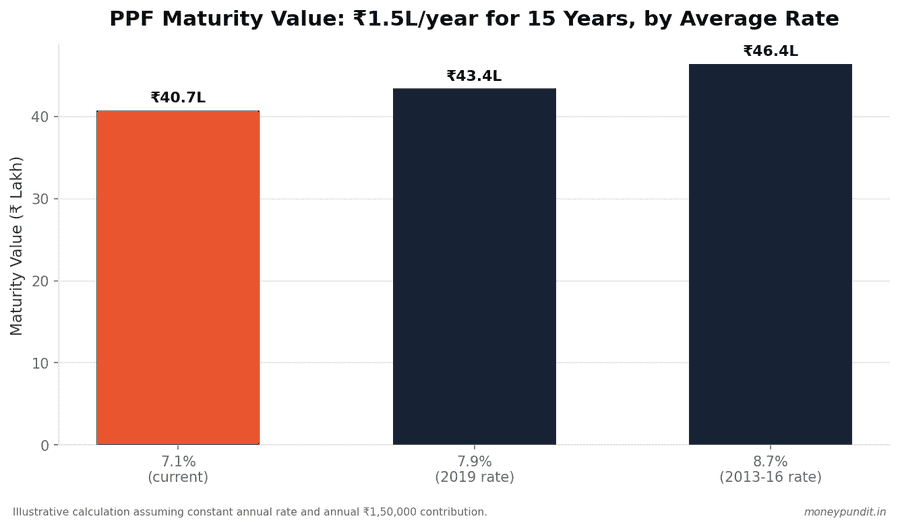
Because PPF compounds annually on the minimum monthly balance, even a 0.5-1% swing in rate compounds meaningfully over a 15-year term. For example, investing ₹1,50,000/year for 15 years:
| Average Rate | Approx. Maturity Value |
|---|---|
| 7.1% | ₹40.7 lakh |
| 7.9% | ₹43.4 lakh |
| 8.7% | ₹46.4 lakh |
Use the PPF Calculator to model your own contribution amount and see how a rate change would affect your specific maturity value.
PPF Rate vs Inflation: Is 7.1% Still Worth It?
India’s retail inflation has averaged roughly 5-6% over the past few years. Against that, PPF’s 7.1% tax-free rate still delivers a positive real return, and because the interest is completely tax-free under the EEE structure, the effective pre-tax equivalent for someone in the 30% tax bracket works out closer to 10.1%, which comfortably beats most bank fixed deposits on a post-tax basis. This is the core reason PPF remains attractive even in a lower-rate environment: the comparison that matters isn’t 7.1% versus a fixed deposit’s headline rate, it’s 7.1% tax-free versus a taxable alternative’s post-tax return.
Where PPF Rates Are Officially Announced
The Ministry of Finance’s Department of Economic Affairs notifies small savings interest rates via an official circular ahead of each quarter, published on the National Savings Institute website and typically covered within days by all major financial news outlets. There is no need to check any third-party source for the current rate. The bank or post office where your PPF account is held will also reflect the revised rate automatically from the effective date.
Official Resources
For the current and historical official notification of small savings interest rates, refer to the National Savings Institute, an office of the Ministry of Finance, Government of India.
Related Guides & Tools
- PPF Account – Complete Guide to Public Provident Fund in India
- PPF Calculator – Returns & Tax Benefits
- PPF vs FD vs ELSS: Which Tax-Saving Investment Is Best
- Post Office Savings Schemes 2026 – Interest Rates Guide
Frequently Asked Questions
What is the current PPF interest rate?
The PPF interest rate for the October-December 2026 quarter is 7.1% per annum, the same rate that has applied since April 2020.
How often does the PPF interest rate change?
Since April 2016, the rate is reviewed every quarter by the Ministry of Finance. Before that, it was reviewed only once a year. A quarterly review does not always mean a rate change. The rate has stayed at 7.1% for over 24 consecutive quarters now.
Does a PPF rate change affect my existing balance, or only new deposits?
It affects your entire existing balance, not just new deposits. PPF does not lock in the rate from the year you opened the account, every account holder earns whatever the current quarter’s rate is on their full balance.
What was the highest PPF interest rate ever offered?
PPF paid 12% per annum from 1986 until January 2000, the highest rate in the scheme’s history.
Will PPF rates go up again?
PPF rates are linked to government security yields, so they move (up or down) when benchmark bond yields move meaningfully for a sustained period. No one can predict the exact timing, but rates are reviewed and announced by the Ministry of Finance every quarter, so any change would be reflected then.
References: Nsiindia.gov.in
Related reading: See how PPF stacks up against NPS and RBI bonds in our comparison.