
Nps vs epf vs ppf in brief: Salaried Indians often end up contributing to all three, NPS, EPF, and PPF, without ever comparing what each actually returns, how liquid it is, or how it’s taxed at withdrawal.
Salaried Indians often end up contributing to all three, NPS, EPF, and PPF, without ever comparing what each actually returns, how liquid it is, or how it’s taxed at withdrawal. Here’s a feature-by-feature breakdown of India’s three biggest retirement savings pillars.
Comparing India’s Three Pillars of Retirement Savings
NPS (National Pension System), EPF (Employee Provident Fund), and PPF (Public Provident Fund) are the three most important retirement savings vehicles for Indian investors. Each has distinct features, tax benefits, and return profiles. Understanding the differences helps you create an optimal retirement strategy using the right combination of all three.
Feature-by-Feature Comparison
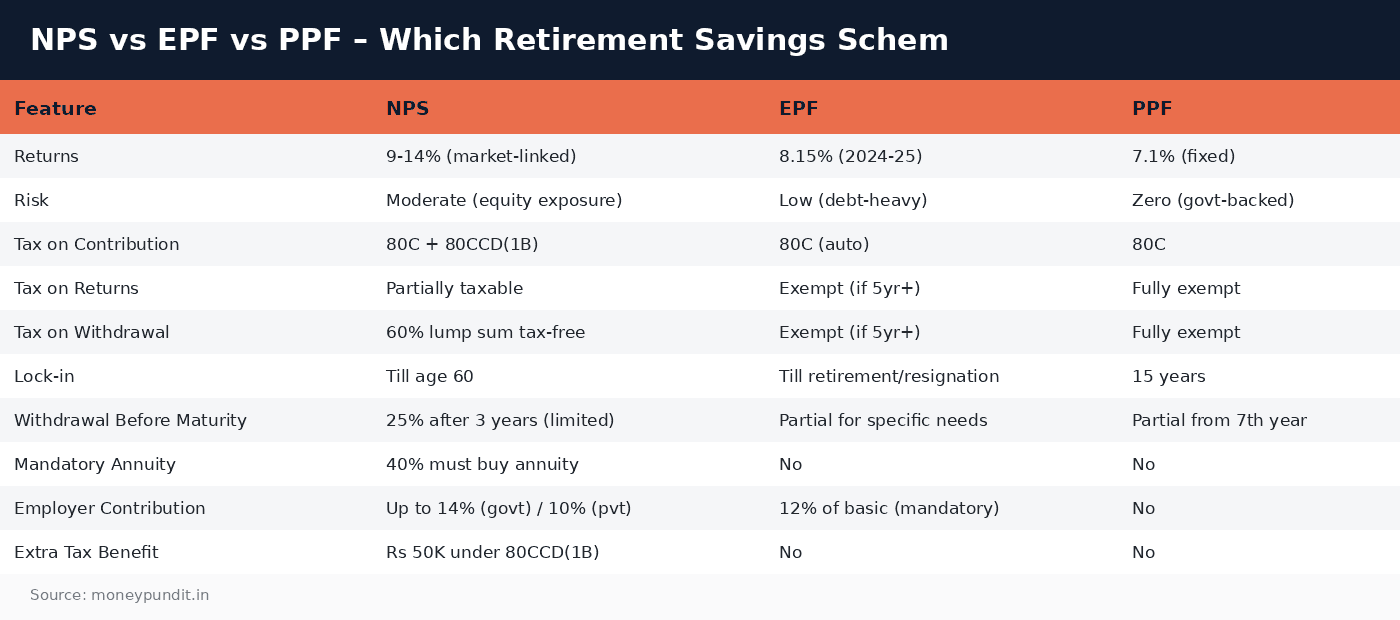
| Feature | NPS | EPF | PPF |
|---|---|---|---|
| Returns | 9-14% (market-linked) | 8.15% (2024-25) | 7.1% (fixed) |
| Risk | Moderate (equity exposure) | Low (debt-heavy) | Zero (govt-backed) |
| Tax on Contribution | 80C + 80CCD(1B) | 80C (auto) | 80C |
| Tax on Returns | Partially taxable | Exempt (if 5yr+) | Fully exempt |
| Tax on Withdrawal | 60% lump sum tax-free | Exempt (if 5yr+) | Fully exempt |
| Lock-in | Till age 60 | Till retirement/resignation | 15 years |
| Withdrawal Before Maturity | 25% after 3 years (limited) | Partial for specific needs | Partial from 7th year |
| Mandatory Annuity | 40% must buy annuity | No | No |
| Employer Contribution | Up to 14% (govt) / 10% (pvt) | 12% of basic (mandatory) | No |
| Extra Tax Benefit | Rs 50K under 80CCD(1B) | No | No |
The Optimal Retirement Strategy
Rather than choosing one over the others, use all three in a complementary way:
EPF (Foundation): If you are salaried, EPF is mandatory. Your 12% + employer’s 12% contribution creates a solid debt-based retirement corpus. Do not withdraw EPF when switching jobs. Let it compound.
PPF (Tax-Free Debt): PPF provides guaranteed, tax-free returns with EEE status. Invest the maximum Rs 1.5 lakh per year if possible. This forms the risk-free backbone of your retirement savings.
NPS (Equity Boost): NPS adds equity exposure to your retirement portfolio with an extra Rs 50,000 tax deduction under 80CCD(1B). Choose aggressive auto-choice (LC-75) or active choice with 75% equity for maximum growth.
How Much Do You Need to Retire?
A common rule of thumb is you need 25-30 times your annual expenses at retirement. If your current annual expenses are Rs 6 lakh (Rs 50,000/month) and you plan to retire in 25 years with 6% annual inflation, your expenses at retirement would be approximately Rs 25.7 lakh per year. You would need a corpus of Rs 6.4-7.7 crore to sustain a 30-year retirement using the 4% withdrawal rule.
This may seem daunting, but with systematic contributions to EPF, PPF, and NPS plus equity mutual fund SIPs, achieving this corpus over a 25-30 year career is entirely feasible with disciplined investing.
Frequently Asked Questions
Should I invest in both NPS and PPF? Yes, ideally. PPF gives guaranteed tax-free returns for the debt portion, while NPS provides equity exposure with extra tax benefits. Together, they create a balanced retirement portfolio.
Can I withdraw EPF after switching jobs? You can transfer EPF to your new employer (recommended) or withdraw after 2 months of unemployment. Withdrawal before 5 years of total service makes the amount taxable.
What happens to NPS at age 60? You must use at least 40% of the corpus to buy an annuity (monthly pension). The remaining 60% can be withdrawn as a tax-free lump sum. If the total corpus is below Rs 5 lakh, you can withdraw everything.
Comparing the Three Pillars of Retirement Savings
NPS, EPF, and PPF serve different retirement planning needs. EPF is mandatory for salaried employees (earning basic up to ₹25,000 since 17 September 2026, or voluntarily for higher salary), offering 8.25% guaranteed returns with employer matching. PPF is voluntary with 7.1% tax-free returns and a 15-year lock-in. NPS is market-linked with asset allocation across equity, corporate bonds, and government securities, offering potentially higher returns (10-12% historical equity allocation returns) but without any guarantee.
The tax treatment differs significantly. PPF enjoys full EEE status, contributions (up to ₹1.5 lakh under Section 80C), interest, and maturity are all tax-free. EPF also has EEE status for contributions up to ₹2.5 lakh/year. NPS offers an additional ₹50,000 deduction under 80CCD(1B) beyond the 80C limit, but at maturity, only 60% is tax-free while 40% must be used to purchase an annuity (which generates taxable income).
Returns Comparison and Risk Profile
Over the last 10 years, NPS Tier-1 equity schemes have delivered 12-14% CAGR, significantly outperforming EPF’s 8-8.5% and PPF’s 7-8%. However, NPS returns are not guaranteed, they depend on market performance and your chosen asset allocation. Conservative investors who prioritise certainty should lean toward EPF and PPF, while those comfortable with market risk and seeking higher long-term returns should maximise NPS equity allocation (up to 75% in active choice).
Use our NPS Calculator and PPF Calculator to project corpus accumulation under different scenarios. A blended approach typically works best: EPF forms the mandatory base, PPF provides the guaranteed tax-free anchor, and NPS adds the market-linked growth component with additional tax benefits.
The Optimal Combination Strategy
For maximum tax efficiency and retirement corpus building: let EPF accumulate through your employer (don’t withdraw at job changes. Transfer via UAN), invest ₹1.5 lakh in PPF for the guaranteed tax-free component under Section 80C, and invest ₹50,000 in NPS (Tier-1, aggressive equity allocation if under 40) for the additional 80CCD(1B) deduction. This three-instrument combination gives you ₹2 lakh in tax deductions beyond the basic 80C limit while building a diversified retirement corpus across guaranteed and market-linked instruments.
For the self-employed (who don’t have EPF access), the combination shifts: maximise PPF (₹1.5 lakh/year, 80C benefit), invest in NPS (₹50,000 for 80CCD(1B) + additional amounts up to ₹1.5 lakh for 80CCD(1) within 80C), and supplement with equity mutual fund SIPs for the growth component. Plan your retirement corpus target first, then work backward to determine the required monthly allocation across these instruments. The earlier you start, the less aggressive your contributions need to be, starting at 25 versus 35 roughly halves the monthly investment needed for the same retirement corpus.
References: Amfiindia.com
Related Resources
For a step-by-step framework covering your full retirement corpus, asset allocation by age, and withdrawal strategy across NPS, EPF, and PPF together, see our Complete Retirement Planning Guide.
Frequently Asked Questions
Can I invest in NPS, EPF and PPF at the same time?
Yes. They are separate schemes with separate rules and limits. EPF is for salaried employees, PPF accepts up to Rs 1.5 lakh a year, and NPS has its own contribution rules, so many investors hold all three for different roles in a retirement plan.
Which is best for retirement: NPS, EPF or PPF?
None wins on every count. EPF suits salaried people because the employer contributes too, PPF gives a government-backed, tax-free, fixed-rate return with a 15-year lock-in, and NPS is market-linked, so it has higher return potential and higher risk. The right mix depends on your risk appetite and time horizon.
Which of the three has the most flexible withdrawals?
All three are designed for long-term saving. PPF has a 15-year lock-in with limited partial withdrawals, EPF allows partial withdrawals for specified needs and full withdrawal on retirement, and NPS Tier 1 is locked until age 60 apart from limited partial withdrawals for specific purposes.
Is the interest on EPF and PPF taxable?
PPF interest is tax-free. EPF interest is tax-free in most cases, but interest on employee contributions above Rs 2.5 lakh a year is taxable. Check the latest rules on the official EPFO and income tax sites before you plan.
Nps vs epf vs ppf: Key Takeaways
Key points on nps vs epf vs ppf:
- NPS (National Pension System), EPF (Employee Provident Fund), and PPF (Public Provident Fund) are the three most important retirement savings vehicles for Indian investors.
- Rather than choosing one over the others, use all three in a complementary way:
- A common rule of thumb is you need 25-30 times your annual expenses at retirement.
Verify the latest nps vs epf vs ppf figures with NPS Trust before you act.
Related reading: For a wider view that adds RBI bonds, see our PPF vs NPS vs RBI bonds comparison.