

Vpf voluntary provident fund in brief: If you’re a salaried employee looking for a safe, high-return, tax-efficient investment, VPF deserves serious consideration.
VPF lets you contribute beyond the mandatory EPF limit while still earning the same EPF interest rate, currently among the highest guaranteed, tax-free returns available to any salaried employee in India. Here’s how VPF works, its current rate, and when it makes sense over other options.
Voluntary Provident Fund (VPF) is one of the best-kept secrets in Indian retirement planning. It offers the same high EPF interest rate (8.25% for FY 2025-26), complete tax-free returns up to a limit, and allows salaried employees to voluntarily increase their provident fund contributions beyond the mandatory 12%. If you’re a salaried employee looking for a safe, high-return, tax-efficient investment, VPF deserves serious consideration.
What Is VPF (Voluntary Provident Fund)?
VPF is an extension of the Employee Provident Fund (EPF) that allows employees to contribute more than the mandatory 12% of basic salary towards their provident fund. While the employer’s contribution remains fixed at 12% (split between EPF and EPS), the employee can voluntarily contribute up to 100% of their basic salary and dearness allowance to VPF. The additional contribution earns the same interest rate as EPF and enjoys similar tax benefits.
VPF Interest Rate 2026
The VPF interest rate for FY 2025-26 is 8.25%, which is the same as the EPF interest rate declared by EPFO. This rate has remained attractive compared to other fixed-income instruments. Here’s a historical comparison:
Last verified: 22 October 2026 against EPFO and finance ministry announcements. The CBT fixed 8.25% for FY 2025-26 on 2 March 2026 and the finance ministry concurred in June 2026.
| Financial Year | VPF/EPF Interest Rate | PPF Rate |
|---|---|---|
| 2025-26 | 8.25% | 7.1% |
| 2024-25 | 8.25% | 7.1% |
| 2023-24 | 8.25% | 7.1% |
| 2022-23 | 8.15% | 7.1% |
| 2021-22 | 8.10% | 7.1% |
The rate for FY 2026-27 is declared only after the year ends, so 8.25% is not a guarantee for future years.
Key Benefits of VPF
1. Higher Interest Rate Than Most Fixed-Income Options
At 8.25%, VPF offers significantly better returns than PPF (7.1%), bank FDs (6-7%), and savings accounts (2.5-4%). It’s one of the highest-yielding risk-free investments available to salaried Indians.
2. EEE Tax Status (Exempt-Exempt-Exempt)
The interest on your own EPF and VPF contributions is tax-free only up to a combined ₹2.5 lakh a year (₹5 lakh if there is no employer contribution). Within that limit the interest and the maturity amount are tax-free. Your contribution earns a Section 80C deduction (capped at ₹1.5 lakh together with PPF, ELSS and other 80C items) only under the old tax regime; the new regime allows no 80C deduction.
3. Compounding Power Over Long Periods
Since VPF is linked to your employment and contributions happen monthly via salary deduction, the power of compounding works exceptionally well. A monthly VPF contribution of ₹10,000 at 8.25% grows to about ₹95 lakh over 25 years (₹30 lakh contributed), with no tax on the growth while you stay under the ₹2.5 lakh yearly limit.
4. Automatic Salary Deduction (Discipline)
VPF contributions are deducted directly from your salary, enforcing financial discipline. You don’t need to remember to invest each month, it happens automatically.
5. Same Safety as EPF
VPF is managed by the Employee Provident Fund Organisation (EPFO), a government body. Your money is invested primarily in government securities and high-quality bonds, making it virtually risk-free.
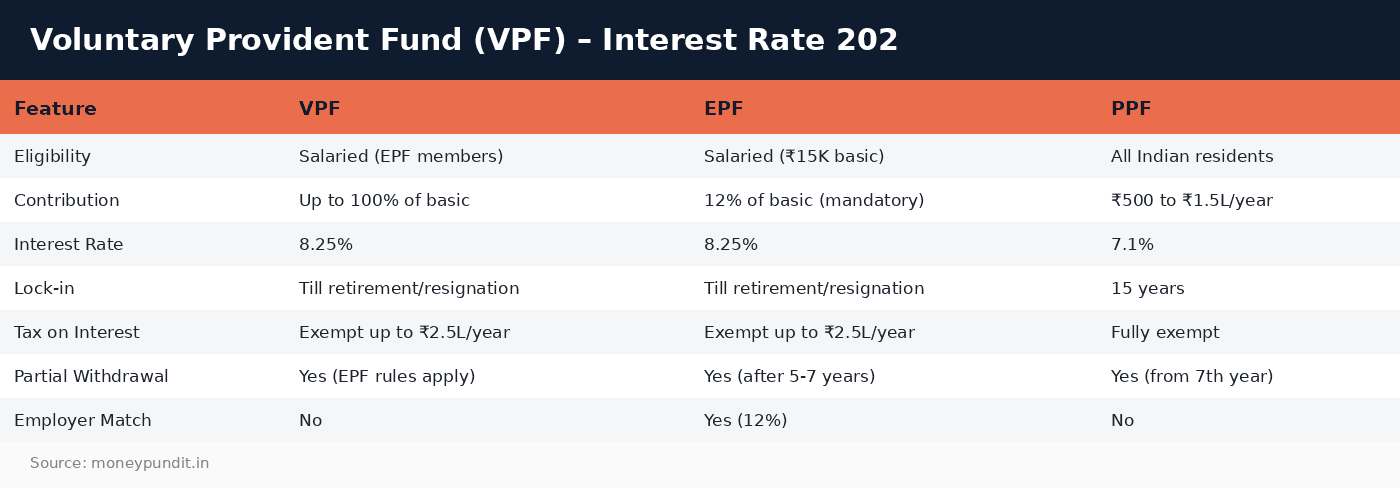
VPF vs EPF vs PPF – Comparison
| Feature | VPF | EPF | PPF |
|---|---|---|---|
| Eligibility | Salaried (EPF members) | Salaried (₹15K basic) | All Indian residents |
| Contribution | Up to 100% of basic | 12% of basic (mandatory) | ₹500 to ₹1.5L/year |
| Interest Rate | 8.25% | 8.25% | 7.1% |
| Lock-in | Till retirement/resignation | Till retirement/resignation | 15 years |
| Tax on Interest | Exempt up to ₹2.5L/year | Exempt up to ₹2.5L/year | Fully exempt |
| Partial Withdrawal | Yes (EPF rules apply) | Yes (conditions apply) | Yes (from 7th year) |
| Employer Match | No | Yes (12%) | No |
Tax Rules for VPF (Important 2026 Update)
Since Budget 2021, interest earned on employee EPF/VPF contributions exceeding ₹2.5 lakh per year is taxable. This means if your total employee contribution to EPF + VPF exceeds ₹2.5 lakh annually, the interest on the excess amount is taxed at your income tax slab rate. For most employees contributing only to EPF, this limit isn’t breached. But if you’re making large VPF contributions, plan accordingly.
For example, if your total EPF + VPF employee contribution is ₹4 lakh a year, the interest on the excess ₹1.5 lakh is taxable. Spread evenly over the year, that interest is about ₹6,700 at 8.25%, taxed at your slab rate (about ₹2,100 at the 30% slab including cess).
What ₹10,000 a Month in VPF Becomes
Last verified: 22 October 2026. Assumes ₹10,000 deposited every month, 8.25% a year, interest worked out on each month’s running balance and credited at year-end (the EPFO method), rate held constant.
| Years | You deposit | Value at 8.25% | Interest earned |
|---|---|---|---|
| 10 | ₹12 lakh | ₹18.4 lakh | ₹6.4 lakh |
| 15 | ₹18 lakh | ₹34.7 lakh | ₹16.7 lakh |
| 25 | ₹30 lakh | ₹95.1 lakh | ₹65.1 lakh |
₹10,000 a month is ₹1.2 lakh a year. Add your regular 12% EPF share and check that the combined employee contribution stays under ₹2.5 lakh to keep all interest tax-free.
How to Start VPF Contributions
Starting VPF is straightforward. Submit a request to your HR or payroll department to increase your EPF contribution percentage. Some companies allow this through their HRMS portal. You can choose any percentage above 12%. For instance, setting it to 20% means 8% extra goes to VPF. The increased contribution starts from the next salary cycle and continues until you change it. Note that once you increase VPF for a financial year, most companies don’t allow reduction mid-year.
Who Should Invest in VPF?
VPF is ideal for salaried employees who have a low to moderate risk appetite and want guaranteed, tax-efficient returns. It’s especially beneficial if you’ve already maxed out your PPF contribution (₹1.5 lakh/year) and want more exposure to safe fixed-income instruments. However, if you’re young with a high risk appetite and a long investment horizon (20+ years), equity mutual fund SIPs may deliver better inflation-adjusted returns despite the volatility.
Frequently Asked Questions
Can I withdraw VPF money before retirement?
Yes, VPF follows the same withdrawal rules as EPF. You can make partial withdrawals for specific purposes like home purchase, medical emergency, or education subject to EPFO conditions on service period and purpose. Full withdrawal is allowed upon resignation or retirement.
Is VPF better than PPF?
VPF offers a higher interest rate (8.25% vs 7.1%) and has no annual contribution limit (vs ₹1.5 lakh for PPF). However, PPF is available to everyone including self-employed individuals, while VPF is only for salaried EPF members. PPF also has a fixed 15-year maturity, while VPF is locked until you leave employment.
Does VPF have any risk?
VPF is backed by the government through EPFO, so it carries minimal credit risk. The interest rate is reviewed annually and could decrease in future, but historically it has remained above 8%. The main risk is liquidity. Your money is locked until you resign or retire.
What is the current VPF interest rate?
8.25% a year for FY 2025-26, the same as EPF. EPFO’s trustees fixed it on 2 March 2026 and the finance ministry concurred in June 2026. The rate is reset every year.
Is VPF interest taxable?
Only the part earned on your own contributions above ₹2.5 lakh a year (EPF + VPF combined) is taxed, at your slab rate. Below that, interest and maturity proceeds are tax-free.
Does VPF help under the new tax regime?
The interest is still tax-free within the ₹2.5 lakh limit, but contributions earn no Section 80C deduction in the new regime. Check your own tax workings before raising VPF only for the deduction.
References: EPFO
Vpf voluntary provident fund: Key Takeaways
Key points on vpf voluntary provident fund:
- VPF is an extension of the Employee Provident Fund (EPF) that allows employees to contribute more than the mandatory 12% of basic salary towards their provident fund.
- The VPF interest rate for FY 2025-26 is 8.25%, which is the same as the EPF interest rate declared by EPFO.
- At 8.25%, VPF offers significantly better returns than PPF (7.1%), bank FDs (6-7%), and savings accounts (2.5-4%).
Verify the latest vpf voluntary provident fund figures with EPFO before you act.