

Why Tax Planning Matters
Tax planning is the legal process of arranging your finances to minimize income tax liability. For salaried Indians earning ₹10-25 lakh, effective tax planning can save ₹50,000 to ₹2,00,000 annually. The key is to start early in the financial year (April) rather than rushing in January-March, which leads to poor investment decisions driven by tax deadlines rather than financial goals.
Good tax planning aligns with your overall financial goals: the best tax-saving investments (like ELSS, PPF, NPS) are also excellent wealth-building instruments. This guide walks you through a systematic approach to save maximum tax while building long-term wealth.
Step 1: Choose Your Tax Regime
Before planning deductions, decide between the old and new tax regimes. The new regime offers lower slab rates with a standard deduction of ₹75,000 but no other major deductions. The old regime allows deductions under 80C, 80D, HRA, home loan interest, and more. As a rule of thumb: if your total deductions exceed ₹3.75-4 lakh, the old regime saves more tax. For income up to ₹12 lakh, the new regime is almost always better due to the Section 87A rebate.
Step 2: Maximize Section 80C (₹1.5 Lakh)
Section 80C is the most popular tax-saving section with a ₹1.5 lakh limit. Before investing separately, check what already counts: your EPF contribution (employee share of 12% of basic) is automatically eligible. The remaining gap should be filled with: ELSS mutual funds (3-year lock-in, equity returns of 12-15%), PPF (15-year lock-in, 7.1% guaranteed, EEE status), or SSY if you have a daughter. Avoid tax-saving FDs (5-year lock-in, 6.5-7% with taxable interest) and insurance-cum-investment plans (poor returns).
Step 3: NPS for Extra ₹50,000 (Section 80CCD1B)
Over and above the ₹1.5 lakh 80C limit, you can claim an additional ₹50,000 deduction by investing in NPS under Section 80CCD(1B). For someone in the 30% tax bracket, this saves ₹15,600 in tax (including cess). NPS offers extremely low expense ratios and has historically delivered 10-12% returns in the equity tier. The partial lock-in until 60 makes it a disciplined retirement vehicle.
Step 4: Health Insurance (Section 80D)
Health insurance premiums are deductible under Section 80D: up to ₹25,000 for self and family, plus ₹25,000 for parents (₹50,000 if parents are senior citizens). This means a total deduction of ₹50,000-₹75,000 is possible. Preventive health check-up costs up to ₹5,000 are included within this limit. Beyond tax savings, adequate health insurance protects against financial devastation from medical emergencies.
Step 5: HRA Optimization
If you live in rented accommodation, HRA exemption can be your largest tax saver. In metro cities, the exemption can be ₹2-4 lakh annually for those paying significant rent. If you live with parents, consider paying them rent (they must declare it as income), this converts non-deductible living expenses into a legitimate tax deduction. Ensure you have rent receipts and landlord’s PAN for rent exceeding ₹1 lakh/year.
Step 6: Home Loan Benefits
Home loan borrowers in the old regime get two powerful deductions: interest paid up to ₹2,00,000 (Section 24b) and principal repayment up to ₹1,50,000 (Section 80C, shared with other 80C investments). For a joint home loan, both co-borrowers can claim these deductions independently, effectively doubling the benefit. Registration and stamp duty charges are also eligible under 80C in the year of purchase.
Step 7: Salary Restructuring
Request your employer to optimize your salary structure: include food coupons/meal card (₹2,200/month tax-free), LTA (Leave Travel Allowance, exempt twice in a 4-year block for domestic travel), NPS employer contribution (up to 14% of basic for government, 10% for private, deductible under 80CCD2 with no upper limit linked to income), and reimbursements for phone, internet, and books used for work.
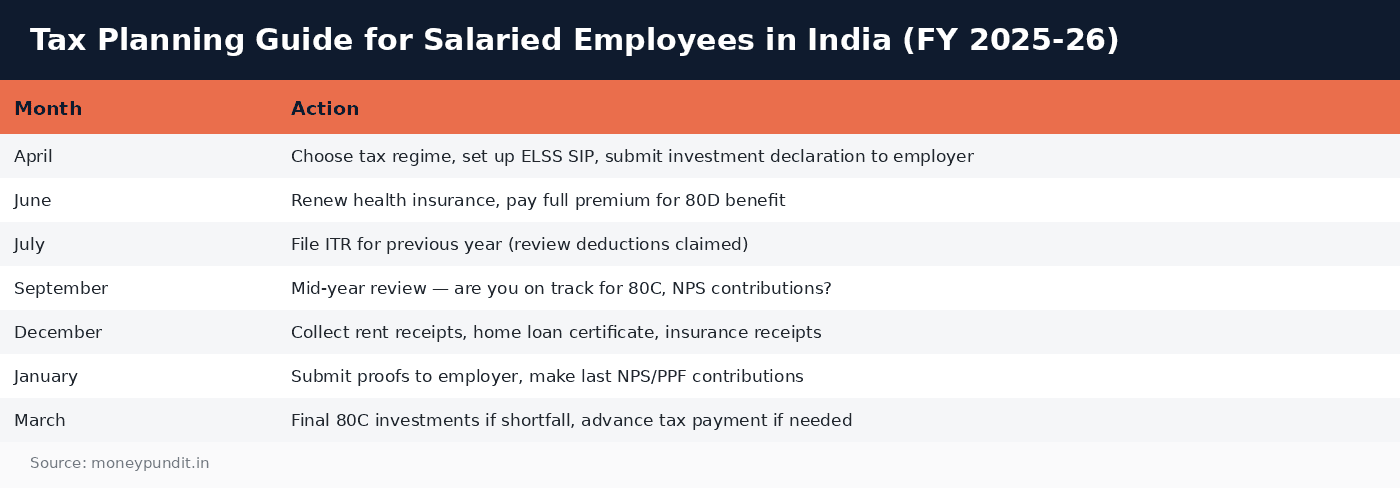
Tax Planning Calendar
| Month | Action |
|---|---|
| April | Choose tax regime, set up ELSS SIP, submit investment declaration to employer |
| June | Renew health insurance, pay full premium for 80D benefit |
| July | File ITR for previous year (review deductions claimed) |
| September | Mid-year review: are you on track for 80C, NPS contributions? |
| December | Collect rent receipts, home loan certificate, insurance receipts |
| January | Submit proofs to employer, make last NPS/PPF contributions |
| March | Final 80C investments if shortfall, advance tax payment if needed |
What is the maximum tax I can save through deductions?
Under the old regime, maximum deductions possible: 80C (₹1.5L) + NPS 80CCD1B (₹50K) + 80D (₹75K) + HRA (₹3L+) + Home loan Sec 24 (₹2L) + Standard deduction (₹50K) = approximately ₹8.25+ lakh. For someone earning ₹20 lakh, this reduces taxable income to under ₹12 lakh, bringing tax down from ₹3.12L (new regime) to approximately ₹1.17L, a saving of nearly ₹2 lakh.
Is ELSS better than PPF for tax saving?
ELSS has shorter lock-in (3 years vs 15 years), higher potential returns (12-15% vs 7.1%), and equity market exposure. PPF offers guaranteed returns, sovereign safety, and EEE tax status (ELSS gains above ₹1.25L attract 12.5% LTCG). For investors under 45 with moderate risk appetite, ELSS is generally better. For conservative investors or those near retirement, PPF provides safety. Ideally, use both, ELSS via SIP for growth and PPF for guaranteed foundation.
Can I save tax without investing any money?
Yes, several deductions require no fresh investment: EPF contribution (auto-deducted), home loan EMI (principal under 80C and interest under Sec 24), children’s school tuition fees (80C, up to 2 children), stamp duty on property purchase (80C), and education loan interest (80E). HRA exemption also requires no investment, just rent payment documentation.
Tax planning guide india: Key Takeaways
Key points on tax planning guide india:
- Tax planning is the legal process of arranging your finances to minimize income tax liability.
- Before planning deductions, decide between the old and new tax regimes.
- Section 80C is the most popular tax-saving section with a ₹1.5 lakh limit.
Verify the latest tax planning guide india figures with Income Tax Department before you act.
Explore our SIP calculator, tax calculator and FD rates guide to apply tax planning guide india to your own numbers, and revisit tax planning guide india each year.
Tax Planning Guide: Using This Tax Planning Guide Page
This tax planning guide page is updated for 2026. Bookmark this tax planning guide resource, then explore our SIP calculator, tax calculator and FD rates comparison to apply it. For official rules refer to the Reserve Bank of India website. Use this tax planning guide guide alongside our other tax planning guide resources to compare options before you decide.
Frequently Asked Questions
What deductions can a salaried employee claim?
Under the old regime, common deductions include Section 80C investments, 80D health insurance premiums, HRA and home loan interest. The new regime allows far fewer, so compare both before choosing.
Which tax regime is better for me?
It depends on your deductions. If you claim large deductions such as HRA, home loan interest and 80C, the old regime can win; otherwise the new regime is often simpler and cheaper. Use our tax calculator to compare.
When should I start tax planning?
At the beginning of the financial year. Spreading investments such as ELSS SIPs and PPF across the year avoids a last-minute rush in February and March.