
Corporate fd in brief: Corporate FDs from companies like Bajaj Finance often pay 1-2% more interest than a bank FD for the same tenure, but that extra return comes with credit risk a bank FD simply doesn’t carry.
Corporate FDs from companies like Bajaj Finance often pay 1-2% more interest than a bank FD for the same tenure, but that extra return comes with credit risk a bank FD simply doesn’t carry. Here’s how current corporate FD rates compare, and what that extra risk actually means.
Corporate fixed deposits offered by NBFCs and housing finance companies typically provide 0.5-2% higher interest rates than bank FDs, making them attractive for income-seeking investors. Companies like Bajaj Finance, Shriram Finance, Mahindra Finance, and PNB Housing offer FDs directly to the public. However, corporate FDs carry higher credit risk than bank deposits, understanding this risk-reward trade-off is essential before investing.
Top Corporate FD Rates – 2026
| Company | Credit Rating | Regular Rate (1-3 yr) | Senior Citizen Rate | Min Investment |
|---|---|---|---|---|
| Bajaj Finance | AAA/Stable (CRISIL) | 7.40% – 8.25% | +0.25% | ₹15,000 |
| Shriram Finance | AA+/Stable | 7.60% – 8.49% | +0.50% | ₹5,000 |
| Mahindra Finance | AAA/Stable | 7.40% – 8.10% | +0.25% | ₹5,000 |
| PNB Housing Finance | AA+/Stable | 7.35% – 7.90% | +0.25% | ₹10,000 |
| HDFC Ltd (merged with HDFC Bank) | AAA | Now bank FD rates | Standard | Bank FD rules |
Rates as of May 2026. Rates vary by tenure and may change without notice.
How Corporate FDs Differ from Bank FDs
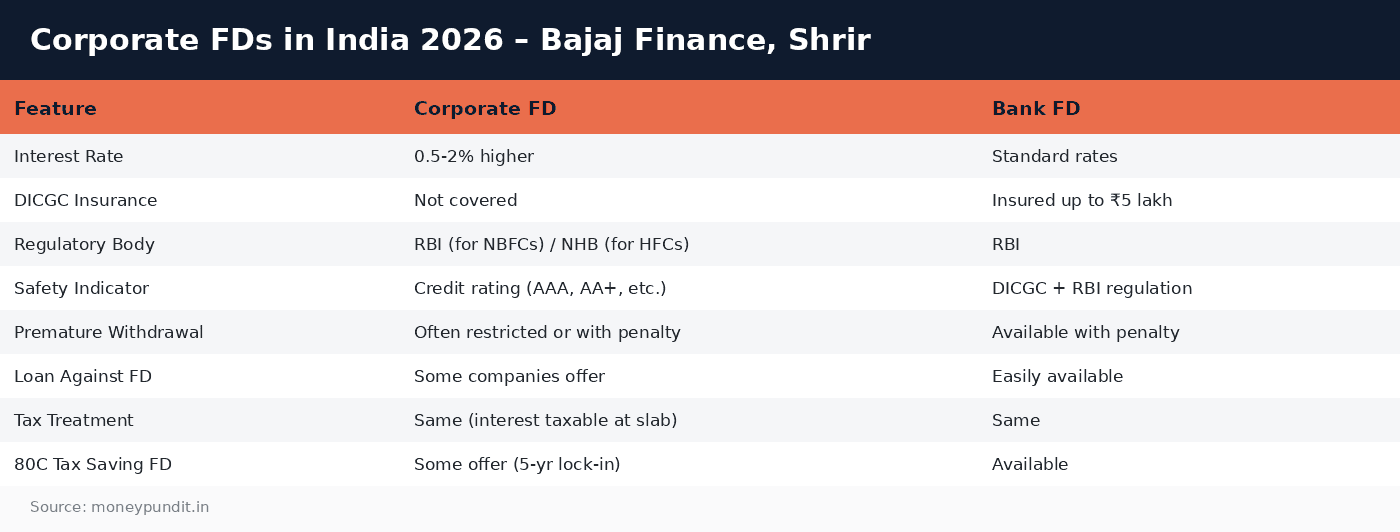
| Feature | Corporate FD | Bank FD |
|---|---|---|
| Interest Rate | 0.5-2% higher | Standard rates |
| DICGC Insurance | Not covered | Insured up to ₹5 lakh |
| Regulatory Body | RBI (for NBFCs) / NHB (for HFCs) | RBI |
| Safety Indicator | Credit rating (AAA, AA+, etc.) | DICGC + RBI regulation |
| Premature Withdrawal | Often restricted or with penalty | Available with penalty |
| Loan Against FD | Some companies offer | Easily available |
| Tax Treatment | Same (interest taxable at slab) | Same |
| 80C Tax Saving FD | Some offer (5-yr lock-in) | Available |
Understanding Credit Ratings
The credit rating is the most important factor when choosing a corporate FD. Ratings indicate the company’s ability to repay your deposit on time.
| Rating | Meaning | Risk Level | Should You Invest? |
|---|---|---|---|
| AAA | Highest safety, strongest financials | Very Low | Yes, confidently |
| AA+ | High safety, strong financials | Low | Yes, with some caution |
| AA | Adequate safety | Low to Moderate | Yes, limited allocation |
| A+ and below | Moderate to low safety | Moderate to High | Generally avoid for FDs |
Stick to AAA and AA+ rated corporate FDs only. Companies like Bajaj Finance (AAA) and Shriram Finance (AA+) have strong track records and regulated business models. Avoid FDs from lesser-known companies offering very high rates (10%+). These often have poor credit quality and significant default risk.
Bajaj Finance FD – Why It Is So Popular
Bajaj Finance FD is the most popular corporate FD in India, holding over ₹60,000 crore in deposits. Its popularity stems from the AAA credit rating (highest possible), competitive interest rates (7.40-8.25%), systematic deposit plans similar to SIPs, easy online investment process through their website and app, and strong brand trust built over decades. The company has never defaulted on any FD payment in its history.
Risks of Corporate FDs
No DICGC Insurance
Unlike bank FDs where up to ₹5 lakh is insured per bank, corporate FD deposits have zero insurance protection. If the company defaults, you become an unsecured creditor and may lose part or all of your investment. Cases like DHFL (2019) where the NBFC defaulted on FD payments serve as a sobering reminder of this risk.
Liquidity Risk
Premature withdrawal from corporate FDs is often more restrictive than bank FDs. Some companies may not allow premature withdrawal for certain tenures, or the penalty may be higher. In financial stress situations, the company might delay or restrict premature withdrawals. Exactly when you need the money most.
Concentration Risk
If you invest a large portion of your savings in a single company’s FD, you are concentrated in one credit risk. Diversify across 2-3 highly-rated corporate FDs and maintain the majority of your fixed-income allocation in bank FDs or government-backed instruments like PPF and NSC.
Smart Corporate FD Strategy
Limit corporate FD investment to 15-20% of your total fixed-income portfolio. Choose only AAA or AA+ rated companies. Diversify across 2-3 companies rather than putting everything in one. Prefer shorter tenures (1-3 years) to reduce long-term credit risk. Regularly check for any credit rating downgrades, if a company’s rating drops below AA, consider not renewing when the FD matures.
Frequently Asked Questions
Are corporate FDs safe?
AAA-rated corporate FDs from well-established NBFCs like Bajaj Finance and Mahindra Finance are considered relatively safe, though not as safe as bank FDs (which have DICGC insurance) or government instruments (which have sovereign guarantee). The key risk is that in a severe financial crisis, even well-rated companies can face stress.
Is TDS deducted on corporate FD interest?
Yes, TDS at 10% is deducted if your annual interest income from a company exceeds ₹5,000. You can submit Form 15G (below 60 years) or Form 15H (above 60 years) if your total income is below the taxable limit to avoid TDS deduction. The interest is fully taxable at your slab rate regardless of TDS.
Can I invest in corporate FDs online?
Yes, most major NBFCs offer online FD investment through their websites and apps. Bajaj Finance, Shriram Finance, and Mahindra Finance have seamless online application processes with e-KYC, digital payment, and electronic FD receipts. Some mutual fund platforms like Kuvera and Wint Wealth also offer access to corporate FDs.
What happens if the company goes bankrupt?
FD holders are unsecured creditors in the company’s insolvency proceedings. Under the IBC (Insolvency and Bankruptcy Code), secured creditors and employees are paid first. FD holders may receive partial recovery over an extended period (as seen in the DHFL case where recovery was 30-40% over 2+ years). This is why sticking to the highest-rated companies is crucial.
References: Amfiindia.com
Corporate FD: Key Takeaways
Key points on corporate fd:
- The credit rating is the most important factor when choosing a corporate FD.
- Bajaj Finance FD is the most popular corporate FD in India, holding over ₹60,000 crore in deposits.
- Unlike bank FDs where up to ₹5 lakh is insured per bank, corporate FD deposits have zero insurance protection.
Verify the latest corporate fd figures with RBI before you act.