

Ppf vs nps vs rbi bonds in brief: The current interest rate is 7.1% per annum, compounded annually, revised quarterly by the government.
PPF, NPS, and RBI Floating Rate Savings Bonds all offer government-backed safety, but they differ enormously on lock-in, liquidity, and tax treatment at withdrawal, three factors that matter more than the headline interest rate for most long-term savers. Here’s the complete comparison.
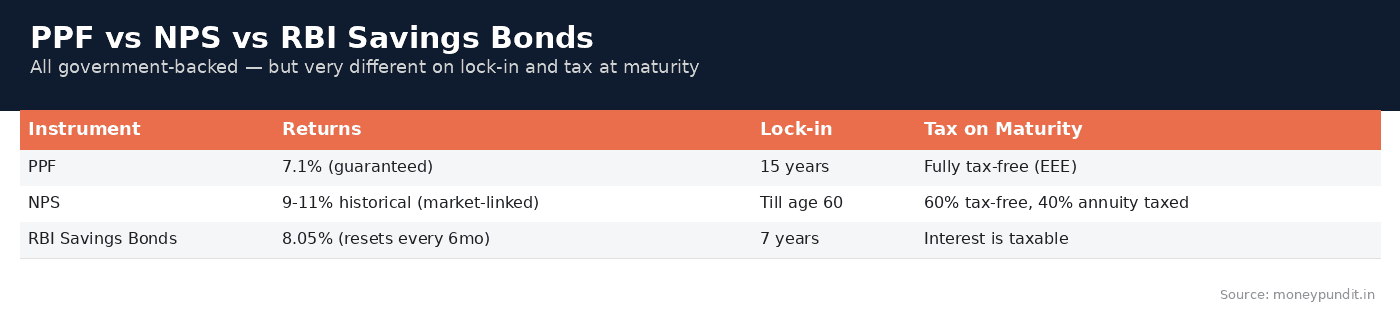
Three government-backed fixed-income instruments dominate the landscape for long-term savers in India: the Public Provident Fund (PPF), the National Pension System (NPS), and RBI Floating Rate Savings Bonds. Each is safe, tax-advantaged, and suited to a different purpose. Understanding which to prioritize, or how to combine them, is one of the smartest financial decisions you can make.
Public Provident Fund (PPF)
PPF is the gold standard of safe long-term investing in India. The current interest rate is 7.1% per annum, compounded annually, revised quarterly by the government. Key features: 15-year lock-in (extendable in 5-year blocks), maximum deposit of ₹1.5 lakh per year, and EEE (Exempt-Exempt-Exempt) tax status, contributions are deductible under 80C, interest is tax-free, and maturity proceeds are tax-free.
The lock-in is a feature, not a bug. It forces long-term saving and prevents impulsive withdrawals. Partial withdrawals are allowed from Year 7, and loans are available from Year 3.
National Pension System (NPS)
NPS is designed specifically for retirement. It invests across equity (up to 75%), corporate bonds, and government securities based on your chosen allocation. Returns are market-linked, historically 9–11% per annum over long periods for aggressive allocations, unlike PPF’s fixed rate.
Tax benefits are exceptional: ₹1.5 lakh under 80C + additional ₹50,000 under 80CCD(1B). Total ₹2 lakh per year. The downside: 60% of the corpus can be withdrawn tax-free at age 60, but the remaining 40% must be used to buy an annuity, which generates regular pension income taxed at your slab rate.
RBI Floating Rate Savings Bonds
RBI Bonds are currently offering 8.05% per annum (reset every 6 months, linked to NSC rate + 35 bps). They have a 7-year lock-in, no tax deduction on investment, but interest is taxable. They’re ideal for investors in lower tax brackets who want higher yields than bank FDs with sovereign safety.
How to Use All Three Together
A practical approach for a salaried Indian in the accumulation phase: maximize PPF (₹1.5 lakh/year) for tax-free long-term savings, contribute to NPS for the extra ₹50,000 80CCD(1B) deduction and equity exposure, and use RBI Bonds for surplus capital that doesn’t fit in PPF if you’re in a lower tax bracket.
Don’t treat these as mutually exclusive. They serve different functions in a well-rounded fixed-income portfolio.
PPF, NPS, and RBI Bonds at a Glance
All three are government-backed long-term savings instruments, but they serve fundamentally different purposes and have different risk-return profiles. PPF is a guaranteed-return, tax-free savings vehicle ideal for conservative investors. NPS is a market-linked retirement fund with equity exposure offering potentially higher returns. RBI Floating Rate Savings Bonds (2020) offer a variable rate linked to the NSC rate, currently at 8.05%, with a 7-year lock-in.
Returns Comparison
PPF currently offers 7.1% per annum, compounded annually: fully guaranteed by the government and reviewed quarterly. Historically, PPF rates have ranged from 7% to 12% over the past three decades. NPS returns are market-linked and depend on your asset allocation: the equity (E) component has delivered 12-14% CAGR over 10 years, corporate bonds (C) 8-10%, and government securities (G) 7-9%. A balanced NPS allocation (50% equity, 30% corporate bonds, 20% G-sec) has historically returned approximately 10-11% CAGR. RBI Bonds pay the NSC rate + 0.35%, reset semi-annually: currently 8.05%, higher than both PPF and many FDs.
Tax Treatment: The Critical Differentiator
PPF enjoys the coveted EEE (Exempt-Exempt-Exempt) status: contributions qualify for Section 80C deduction (up to ₹1.5 lakh), interest is tax-free, and the maturity amount is completely exempt. This makes PPF the most tax-efficient of the three, with an effective post-tax return of 7.1%, far higher than an FD’s post-tax return of 4.5-5.5% for someone in the 30% bracket.
NPS has a partial EEE structure: contributions get 80C deduction plus an additional ₹50,000 under 80CCD(1B), but at maturity, 60% is tax-free lump sum while 40% must be annuitised (annuity income is taxable). RBI Bonds have no tax benefit at all: no 80C deduction on investment, and interest is fully taxable at your slab rate, making the effective return just 5.6% for someone in the 30% bracket.
Liquidity and Lock-in Periods
PPF has a 15-year lock-in with partial withdrawals allowed from year 7 (up to 50% of balance). It can be extended in 5-year blocks indefinitely. NPS is locked until age 60 with limited partial withdrawals (25% of own contributions after 3 years, maximum 3 times). Early exit requires 80% annuitisation, the strictest lock-in of the three. RBI Bonds have a 7-year lock-in with no premature withdrawal (except for senior citizens after 4-6.5 years depending on age at purchase). For liquidity, PPF wins.
Which Should You Choose?
The optimal strategy often combines all three based on their strengths. Invest ₹1.5 lakh in PPF for guaranteed, tax-free returns and 80C benefit. Add ₹50,000 in NPS for the exclusive 80CCD(1B) deduction and equity exposure for retirement. If you still have surplus and want higher fixed returns than FDs, RBI Bonds at 8.05% are attractive despite the tax on interest. Beyond these three, direct additional savings into equity mutual fund SIPs for the highest long-term growth potential. Use our retirement calculator to check if this combined approach meets your retirement target.
References: Amfiindia.com
Source: amfiindia.com
Frequently Asked Questions
Which is better: PPF, NPS or RBI Savings Bonds?
PPF offers tax-free, sovereign-backed returns. NPS offers market-linked growth with extra tax benefits but restricted withdrawals. RBI bonds offer a fixed, taxable rate. The right choice depends on your goal and tax situation.
Is PPF interest tax-free?
Yes, interest and maturity proceeds are tax-free under the current rules, and contributions up to the annual limit qualify under Section 80C in the old regime.
Can I withdraw from NPS before retirement?
Only partially under specific conditions. At maturity, a portion must be used to buy an annuity as per prevailing rules.
PPF vs NPS vs RBI bonds: Key Takeaways
Key points on ppf vs nps vs rbi bonds:
- PPF is the gold standard of safe long-term investing in India.
- Returns are market-linked, historically 9–11% per annum over long periods for aggressive allocations, unlike PPF’s fixed rate.
- RBI Bonds are currently offering 8.05% per annum (reset every 6 months, linked to NSC rate + 35 bps).
Verify the latest ppf vs nps vs rbi bonds figures with NPS Trust before you act.