

Term insurance vs ulip in brief: On maturity (after the lock-in period, typically 5 years), you receive the accumulated fund value.
A ULIP salesperson will tell you it’s ‘insurance plus investment,’ but running the numbers usually shows a term plan bought separately from a mutual fund SIP beats a ULIP on both cover amount and returns for the same premium. Here’s exactly where that gap comes from.
Every year, lakhs of Indians are sold ULIPs, Unit Linked Insurance Plans, by bank relationship managers and insurance agents. The pitch sounds compelling: “Get life cover AND market-linked returns in one product.” The reality is more sobering. Here’s why most financial experts recommend keeping insurance and investment completely separate.
What is a ULIP?
A ULIP is an insurance product that also invests part of your premium in market-linked funds (equity, debt, or balanced). After deducting charges, the remaining premium is invested. On death, the nominee receives the higher of sum assured or fund value. On maturity (after the lock-in period, typically 5 years), you receive the accumulated fund value.
The Hidden Cost Problem
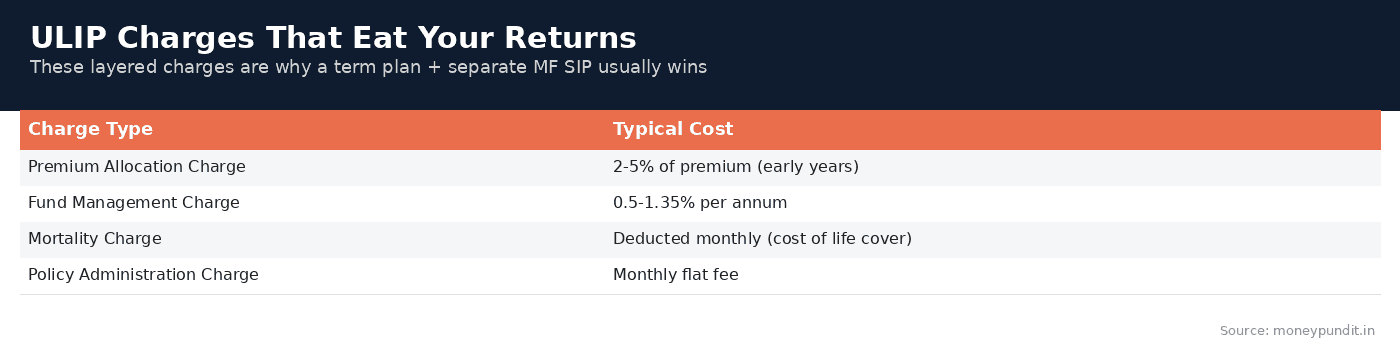
ULIPs come with multiple layers of charges: Premium Allocation Charge (deducted upfront, typically 2–5% of premium in early years), Policy Administration Charge (monthly flat fee), Fund Management Charge (0.5–1.35% per annum on fund value), and Mortality Charge (cost of the life cover, deducted monthly).
In the first 2–3 years, a significant portion of your premium doesn’t even get invested. It goes toward agent commissions and company charges. This is why breaking a ULIP early results in substantial losses.
Term Insurance: Pure Protection at a Fraction of the Cost
A term plan provides only life cover: no investment component. A healthy 30-year-old can get ₹1 crore of cover for as little as ₹8,000–₹12,000 per year. That’s it. If you don’t die during the term, you get nothing back. But that’s the point, you’re buying protection, not investment returns.
The “Buy Term + Invest the Difference” Math
Suppose a ULIP costs ₹1 lakh/year. An equivalent term plan costs ₹15,000/year. Invest the ₹85,000 difference in a Nifty 50 index fund (historical returns ~12% CAGR) for 20 years. The index fund will almost certainly outperform the ULIP’s investment component after charges, by a wide margin.
When ULIPs Might Make Sense
ULIPs have improved: newer products have much lower charges and the 5-year lock-in forces disciplined investing. They can work for people who otherwise wouldn’t invest the “saved” premium, or for HNIs who’ve exhausted other tax-saving instruments and want 80C benefits on larger amounts.
But for most middle-class Indians, the formula remains simple: buy adequate term cover (10–15x annual income), invest separately in mutual funds, and keep the two permanently separate.
The Fundamental Problem with ULIPs
ULIPs (Unit Linked Insurance Plans) combine life insurance with mutual fund investment in a single product. While this sounds convenient, the combination results in a product that is mediocre at both functions. The life cover in a ULIP is typically 10x the annual premium, so a ₹1 lakh/year ULIP gives only ₹10 lakh cover, woefully inadequate for most families. Meanwhile, the investment component earns mutual fund-like returns but with significantly higher charges: premium allocation charges (2-5% in early years), fund management charges (1-1.35%), mortality charges (increasing with age), and policy administration charges.
Term Insurance: Pure Protection at Lowest Cost
Term insurance provides pure life cover without any investment component, if you die during the policy period, your nominee gets the sum assured; if you survive, you get nothing back. This “no survival benefit” structure is actually the key advantage: by eliminating the investment component, term plans offer the highest life cover at the lowest premium. A 30-year-old non-smoker can get ₹1 crore cover for just ₹700-900 per month. The same cover through a ULIP would cost ₹10,000+ per month.
The rule of thumb for life insurance: your total cover should be 10-15x your annual income plus outstanding liabilities (home loan, other debts). For someone earning ₹15 lakh/year with a ₹30 lakh home loan, the ideal cover is ₹1.5-2.25 crore + ₹30 lakh = approximately ₹2 crore. This is achievable only through term insurance at an affordable premium.
The “Keep Insurance and Investment Separate” Principle
Financial advisors universally recommend separating insurance and investment because: you can buy adequate cover through a cheap term plan, and invest the premium difference in mutual fund SIPs that historically deliver better returns with lower charges. Consider: a ₹1 crore ULIP costs approximately ₹1 lakh/year. A ₹1 crore term plan costs ₹10,000/year. The ₹90,000 saved, invested in a flexi cap fund at 12% CAGR for 20 years, grows to approximately ₹79 lakh: while you’ve had ₹1 crore cover all along. The ULIP, after charges, would likely accumulate ₹50-60 lakh for the same total outflow.
When ULIPs Might Make Sense (Rare Cases)
Post-2020, SEBI-regulated ULIPs have lower charges than older versions. ULIPs can make sense in very limited scenarios: for HNIs (High Net Worth Individuals) looking for tax-free maturity above ₹2.5 lakh annual premium (where mutual fund LTCG applies), for investors who lack discipline and need a forced lock-in (5-year minimum), or for those who want automatic insurance + investment in one product and are okay with suboptimal returns on both. For everyone else, the combination of term insurance + ELSS SIP (for 80C tax saving) or term + index fund SIP delivers better outcomes.
How to Choose the Right Term Insurance Plan
Key factors: Claim settlement ratio: choose insurers with 97%+ CSR (LIC, HDFC Life, ICICI Prudential, Max Life are consistently high). Cover amount: 10-15x annual income minimum. Tenure: cover until age 60-65 when your dependents become financially independent. Riders: consider critical illness and accidental death riders for comprehensive protection. Premium payment mode: annual payment is cheapest (monthly costs 5-8% more due to loading charges). Claim the premium as deduction under Section 80C (up to ₹1.5 lakh).
References: Amfiindia.com
Source: amfiindia.com
Frequently Asked Questions
Why is term insurance better than ULIP for protection?
Term insurance gives a high cover at a low premium. A ULIP bundles insurance with investment, with charges that reduce both cover and returns.
Can I invest in a ULIP for returns?
You can, but mutual funds and PPF are usually cheaper and more transparent. Compare charges, lock-in and returns before deciding.
How much term cover should I buy?
A common guide is 10 to 15 times your annual income, adjusted for loans and dependants.
Term insurance vs ULIP: Key Takeaways
Key points on term insurance vs ulip:
- A ULIP is an insurance product that also invests part of your premium in market-linked funds (equity, debt, or balanced).
- In the first 2–3 years, a significant portion of your premium doesn’t even get invested.
- A term plan provides only life cover: no investment component.
Verify the latest term insurance vs ulip figures with IRDAI before you act.