

Mutual fund taxation in brief: The Budget 2024 brought significant changes, a unified LTCG rate of 12.5%, increased exemption to ₹1.25 lakh, and revised holding periods.
Equity and debt mutual funds are taxed under completely different rules in India. Mix them up and you could misreport gains that trigger a tax notice, or overpay on a fund that actually qualified for a lower rate. Here’s the complete FY 2026-27 tax reference for both categories.
Mutual fund taxation in India follows a structured framework based on the type of fund (equity or debt), the holding period, and the nature of income (capital gains or dividends). The Budget 2024 brought significant changes, a unified LTCG rate of 12.5%, increased exemption to ₹1.25 lakh, and revised holding periods. This comprehensive guide explains the current tax rules so you can plan your investments and redemptions tax-efficiently.
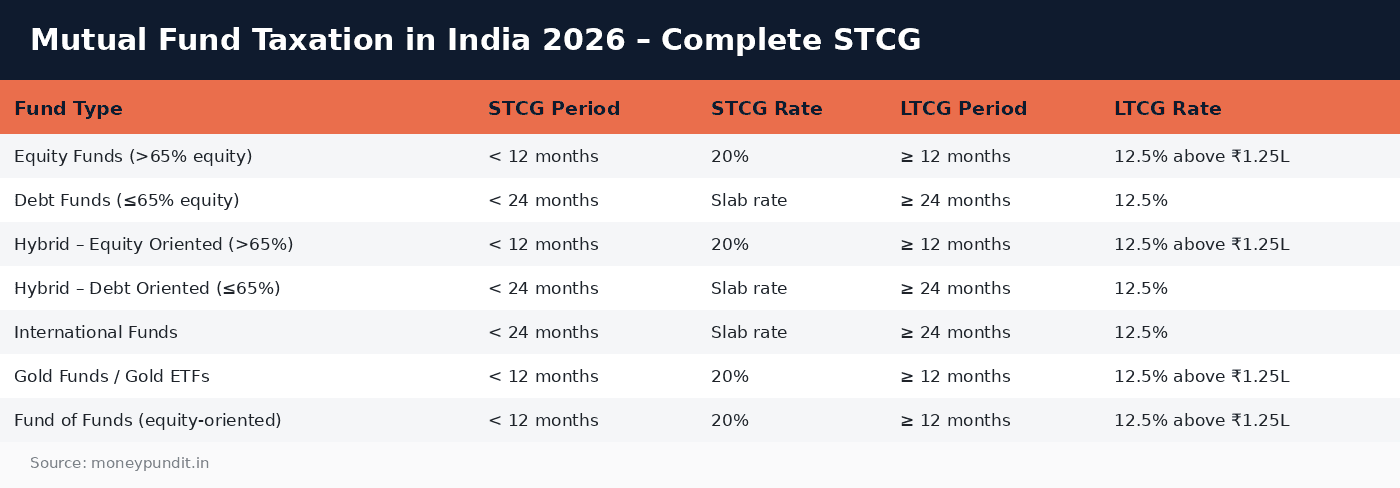
Mutual Fund Tax Rates – Quick Reference (FY 2026-27)
| Fund Type | STCG Period | STCG Rate | LTCG Period | LTCG Rate |
|---|---|---|---|---|
| Equity Funds (>65% equity) | < 12 months | 20% | ≥ 12 months | 12.5% above ₹1.25L |
| Debt Funds (≤65% equity) | < 24 months | Slab rate | ≥ 24 months | 12.5% |
| Hybrid – Equity Oriented (>65%) | < 12 months | 20% | ≥ 12 months | 12.5% above ₹1.25L |
| Hybrid – Debt Oriented (≤65%) | < 24 months | Slab rate | ≥ 24 months | 12.5% |
| International Funds | < 24 months | Slab rate | ≥ 24 months | 12.5% |
| Gold Funds / Gold ETFs | < 12 months | 20% | ≥ 12 months | 12.5% above ₹1.25L |
| Fund of Funds (equity-oriented) | < 12 months | 20% | ≥ 12 months | 12.5% above ₹1.25L |
The ₹1.25 Lakh LTCG Exemption
For equity-oriented mutual funds, the first ₹1.25 lakh of long-term capital gains in a financial year is completely tax-free. This is a combined limit across all equity funds and stocks, not per fund. If your total equity LTCG across all funds and direct equity is ₹2 lakh, only ₹75,000 (₹2L – ₹1.25L) is taxable at 12.5%.
Smart investors deliberately book ₹1.25 lakh in profits each year (even if they plan to stay invested) by selling and immediately rebuying. This resets the cost basis to the higher current value, effectively making ₹1.25 lakh of annual gains permanently tax-free.
Dividend (IDCW) Taxation
Since FY 2020-21, mutual fund dividends (now called IDCW, Income Distribution cum Capital Withdrawal) are fully taxable in the investor’s hands at their income tax slab rate. The fund house deducts 10% TDS on dividends exceeding ₹5,000 per year per fund house. For investors in the 30% tax bracket, the effective tax on dividends is 30% plus cess, making the Growth option significantly more tax-efficient than IDCW for wealth creation.
SIP Taxation: Each Instalment is Separate
This is a critical concept that many SIP investors miss. Each SIP instalment is treated as a separate investment with its own purchase date and holding period. When you redeem, the FIFO (First In, First Out) method applies. The oldest units are sold first.
For a 24-month running SIP in an equity fund: if you redeem all units, the units from the first 12 SIPs (held for more than 12 months) qualify for LTCG treatment (12.5%), while units from the last 12 SIPs (held for less than 12 months) attract STCG at 20%. This creates a blended tax rate on the overall redemption.
Tax on Switching Between Funds
Switching from one mutual fund to another (even within the same AMC) is treated as a redemption from the old fund and a purchase in the new fund. Capital gains tax applies on the redeemed units based on the holding period and fund type. This means switching has the same tax implications as selling. Plan your switches carefully to minimise tax impact, especially if some units have not completed their LTCG holding period.
Exit Load vs Tax: Both Matter
Most equity funds charge a 1% exit load if redeemed within 1 year. This is separate from capital gains tax. If you redeem equity fund units within 12 months, you face both 1% exit load AND 20% STCG tax. Waiting just past the 1-year mark eliminates the exit load and reduces the tax rate from 20% STCG to 12.5% LTCG (with ₹1.25L exemption). This double benefit makes the 1-year holding period a critical threshold for equity funds.
Tax-Efficient Redemption Strategies
Stagger Redemptions Across Financial Years
If you have large accumulated gains, redeem in tranches across two financial years to utilise the ₹1.25 lakh LTCG exemption twice. For example, redeem ₹1.25 lakh in gains in March and another ₹1.25 lakh in April (next FY). This saves ₹31,250 in taxes (12.5% × ₹2.5L exemption vs one-year ₹1.25L).
Redeem Loss-Making Funds First
If you need to redeem funds and some are in profit while others are at a loss, redeem the loss-making ones first. Long-term capital losses can be set off against long-term capital gains, reducing your net taxable gains. Short-term losses can be set off against both short-term and long-term gains.
Use the Growth Option for Long-Term Goals
For goals 5+ years away, the Growth option is almost always more tax-efficient than IDCW (dividend). Growth allows your money to compound without interim tax events. You pay tax only when you redeem, at the favourable LTCG rate, rather than paying slab-rate tax on dividends throughout the holding period.
TDS on Mutual Fund Redemptions
For resident Indians, there is no TDS on mutual fund capital gains (except dividend income above ₹5,000). You self-assess and pay capital gains tax through advance tax or when filing your ITR. For NRIs, TDS is deducted by the AMC at the applicable capital gains rate on every redemption. NRIs can claim refund for excess TDS through ITR filing.
Frequently Asked Questions
Are ELSS funds taxed differently?
No, ELSS funds are taxed the same as any equity-oriented fund. After the mandatory 3-year lock-in period, gains qualify for LTCG treatment, 12.5% on gains above ₹1.25 lakh. The only special feature of ELSS is the Section 80C tax deduction on the investment amount (up to ₹1.5 lakh per year).
How do I calculate capital gains on mutual fund redemption?
Capital Gains = Redemption Value – Cost of Acquisition. For SIPs, calculate separately for each instalment’s units using FIFO. Most mutual fund platforms and AMC websites provide a capital gains statement showing the purchase price, sale price, and gains/losses for each lot, making the calculation straightforward.
Do I need to pay tax on unrealised gains?
No, unrealised gains (paper profits on investments you haven’t sold) are not taxable. Tax is triggered only when you actually redeem or switch mutual fund units. This is another advantage of the Growth option. Your gains compound tax-free until you choose to redeem.
What if I redeem at a loss: do I still need to report it?
Yes, reporting capital losses in your ITR is important because losses can be set off against gains (reducing your tax) and carried forward for 8 years. If you do not file by the due date (July 31), you lose the ability to carry forward losses, though intra-year set-off is still allowed in belated returns.
Tax rules on mutual funds change more often than most investors track. Bookmark the current STCG/LTCG rates above, but always confirm the applicable rate at the time you actually redeem, since finance act amendments can shift these year to year.
Related reading: STT Meaning & Rates
References: Amfiindia.com
Related reading: ETF vs Mutual Fund: Which Should You Choose? · SIP vs Mutual Fund
Mutual fund taxation: Key Takeaways
Key points on mutual fund taxation:
- For equity-oriented mutual funds, the first ₹1.25 lakh of long-term capital gains in a financial year is completely tax-free.
- Since FY 2020-21, mutual fund dividends (now called IDCW, Income Distribution cum Capital Withdrawal) are fully taxable in the investor’s hands at their income tax slab rate.
- Each SIP instalment is treated as a separate investment with its own purchase date and holding period.
Verify the latest mutual fund taxation figures with AMFI before you act.