
Capital gains tax in brief: Stocks, mutual funds, and property are each taxed under different capital gains rules in India, with different holding periods defining ‘long-term’ for each.
Stocks, mutual funds, and property are each taxed under different capital gains rules in India, with different holding periods defining ‘long-term’ for each. Mixing them up is one of the most common tax-filing mistakes investors make. Here’s the complete FY 2026-27 rate reference across all three.
Capital gains tax is levied on the profit you earn when selling an asset, stocks, mutual funds, real estate, gold, or bonds, at a price higher than what you paid. Understanding capital gains taxation is essential for every Indian investor because the tax structure varies significantly based on the type of asset, holding period, and the tax regime you choose. Smart tax planning can save you lakhs over your investing lifetime.
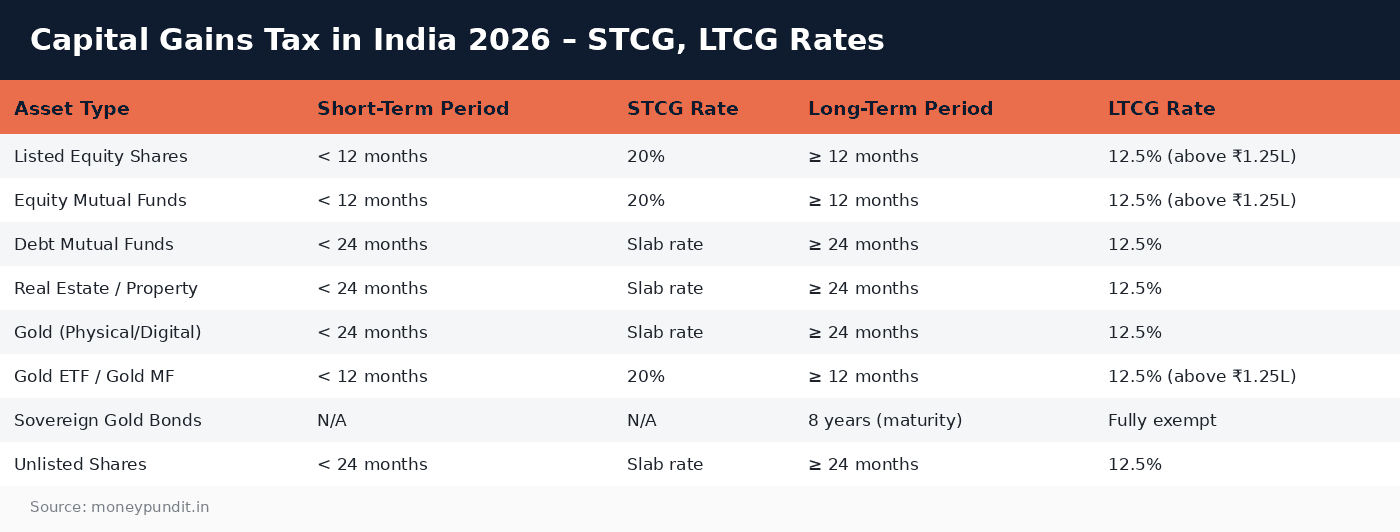
Capital Gains Tax Rates at a Glance (FY 2026-27)
| Asset Type | Short-Term Period | STCG Rate | Long-Term Period | LTCG Rate |
|---|---|---|---|---|
| Listed Equity Shares | < 12 months | 20% | ≥ 12 months | 12.5% (above ₹1.25L) |
| Equity Mutual Funds | < 12 months | 20% | ≥ 12 months | 12.5% (above ₹1.25L) |
| Debt Mutual Funds | < 24 months | Slab rate | ≥ 24 months | 12.5% |
| Real Estate / Property | < 24 months | Slab rate | ≥ 24 months | 12.5% |
| Gold (Physical/Digital) | < 24 months | Slab rate | ≥ 24 months | 12.5% |
| Gold ETF / Gold MF | < 12 months | 20% | ≥ 12 months | 12.5% (above ₹1.25L) |
| Sovereign Gold Bonds | N/A | N/A | 8 years (maturity) | Fully exempt |
| Unlisted Shares | < 24 months | Slab rate | ≥ 24 months | 12.5% |
Rates applicable from FY 2024-25 onwards following Union Budget 2024 changes. Surcharge and cess additional.
Understanding LTCG on Equity (Section 112A)
Long-term capital gains on listed equity shares and equity-oriented mutual funds exceeding ₹1.25 lakh in a financial year are taxed at 12.5%. The first ₹1.25 lakh of LTCG is completely tax-free. This is a valuable exemption that every equity investor should utilise. For a couple investing jointly, the combined exemption is ₹2.5 lakh per year.
Budget 2024 simplified the equity LTCG framework significantly. The earlier 10% rate was increased to 12.5%, but the exemption limit was also raised from ₹1 lakh to ₹1.25 lakh. The benefit of indexation was removed for all asset classes, making the calculation straightforward, simply the selling price minus the purchase price.
How to Calculate Capital Gains
For Equity and Equity Mutual Funds
Capital gain = Selling price – Purchase price – Brokerage/expenses. If you bought 100 shares of a company at ₹500 each (₹50,000) and sold them after 15 months at ₹700 each (₹70,000), your LTCG is ₹20,000. Since this is below the ₹1.25 lakh exemption, no tax is payable. If your total equity LTCG for the year is ₹3 lakh, you pay 12.5% on ₹1.75 lakh (₹3L – ₹1.25L) = ₹21,875. Since equity LTCG above ₹1.25 lakh is taxed at a flat 12.5% regardless of which fund you hold, it is worth minimising costs on the way in, our Best Index Funds in India guide compares expense ratios and tracking error across the top options.
For Debt Funds, Gold, and Property
Post Budget 2024, long-term capital gains on all assets are taxed at a flat 12.5% without indexation benefit. For debt funds held over 24 months, the calculation is: LTCG = Sale value – Purchase price. For property, the computation includes stamp duty, registration charges, and improvement costs as part of the purchase price.
Tax-Loss Harvesting Strategy
Tax-loss harvesting is a powerful strategy where you sell investments that are at a loss to offset gains from profitable investments, reducing your overall tax liability. Short-term losses can be set off against both short-term and long-term capital gains. Long-term losses can only be set off against long-term gains.
For example, if you have ₹3 lakh in LTCG from selling Fund A and ₹1 lakh in LTCG losses from Fund B, your net LTCG is ₹2 lakh. After the ₹1.25 lakh exemption, you pay tax on only ₹75,000 instead of ₹1.75 lakh. Saving ₹12,500 in taxes. Any losses not set off in the current year can be carried forward for 8 years.
Tax Harvesting to Utilise the ₹1.25 Lakh Exemption
Even if you don’t plan to exit your investments, you can book profits up to ₹1.25 lakh each year tax-free and immediately reinvest. This resets your purchase price to the current higher level, reducing future taxable gains. For instance, if your equity portfolio has ₹1.25 lakh in unrealised gains, sell and rebuy on the same day. The gains are tax-free, and your new cost basis is higher.
Capital Gains on Property
Section 54 Exemption
If you sell a residential property and use the LTCG to purchase another residential property within 2 years (or construct within 3 years), the capital gain is exempt from tax. The new property must be in India. If the new property costs less than the capital gain, only the proportionate gain is exempt. This provision is widely used by property sellers to defer or eliminate capital gains tax.
Section 54EC Exemption
Alternatively, you can invest the LTCG (up to ₹50 lakh) in specified bonds, NHAI or REC capital gains bonds, within 6 months of the sale date. These bonds have a 5-year lock-in and currently offer approximately 5% interest. While the return is modest, the tax saving on large property gains can be substantial.
Capital Gains for NRIs
NRIs face TDS on capital gains from Indian investments. For equity LTCG, TDS is 12.5% on gains above ₹1.25 lakh. For property LTCG, TDS is 12.5% on the entire gain (not the sale amount). NRIs can claim refunds by filing ITR if actual tax liability is lower than TDS deducted. DTAA (Double Taxation Avoidance Agreement) provisions may further reduce the tax burden depending on the country of residence.
Frequently Asked Questions
Do I need to pay capital gains tax if I reinvest the proceeds?
For most assets, yes: reinvesting does not exempt you from capital gains tax. The exception is residential property, where Section 54 provides exemption if you buy another property. For stocks and mutual funds, switching or reinvesting triggers capital gains tax on the sold units regardless of where the proceeds go.
How is tax calculated on SIP redemptions?
Each SIP instalment is treated as a separate purchase. When you redeem mutual fund units, the FIFO (First In First Out) method applies, the oldest units are sold first. If you have been doing SIP for 18 months and redeem all units, the first 6 months of SIP units qualify as long-term (held over 12 months) while the last 6 months are short-term. Each lot is taxed separately based on its holding period.
Is there any way to avoid capital gains tax legally?
Complete avoidance is difficult, but you can minimise it through: utilising the ₹1.25 lakh annual LTCG exemption, tax-loss harvesting, investing in tax-free instruments like PPF and SSY, holding SGBs until maturity (8 years), using Section 54/54EC for property gains, and timing your sales across financial years to spread gains and maximise exemptions.
Are capital gains included in total income for slab calculation?
Short-term capital gains taxed at slab rate (debt funds, property, gold sold before qualifying period) are added to your total income. However, STCG on equity (20%) and all LTCG (12.5%) are taxed at their special rates and do not increase your regular income tax slab. They are added to total income only for surcharge calculation purposes if your total income exceeds ₹50 lakh.
References: Amfiindia.com
Capital gains tax: Key Takeaways
Key points on capital gains tax:
- Long-term capital gains on listed equity shares and equity-oriented mutual funds exceeding ₹1.25 lakh in a financial year are taxed at 12.5%.
- Capital gain = Selling price – Purchase price – Brokerage/expenses.
- Tax-loss harvesting is a powerful strategy where you sell investments that are at a loss to offset gains from profitable investments, reducing your overall tax liability.
Verify the latest capital gains tax figures with AMFI before you act.