

Best mutual funds sip in brief: Conservative (Age 45+): 40% Large Cap + 30% Balanced Advantage + 20% Index Fund + 10% Debt Fund
The ‘best mutual fund for SIP’ changes depending on what you’re actually optimizing for, pure returns, consistency, or category diversification, which is why generic top-10 lists often mislead more than they help. Here’s a selection framework, plus current picks worth considering.
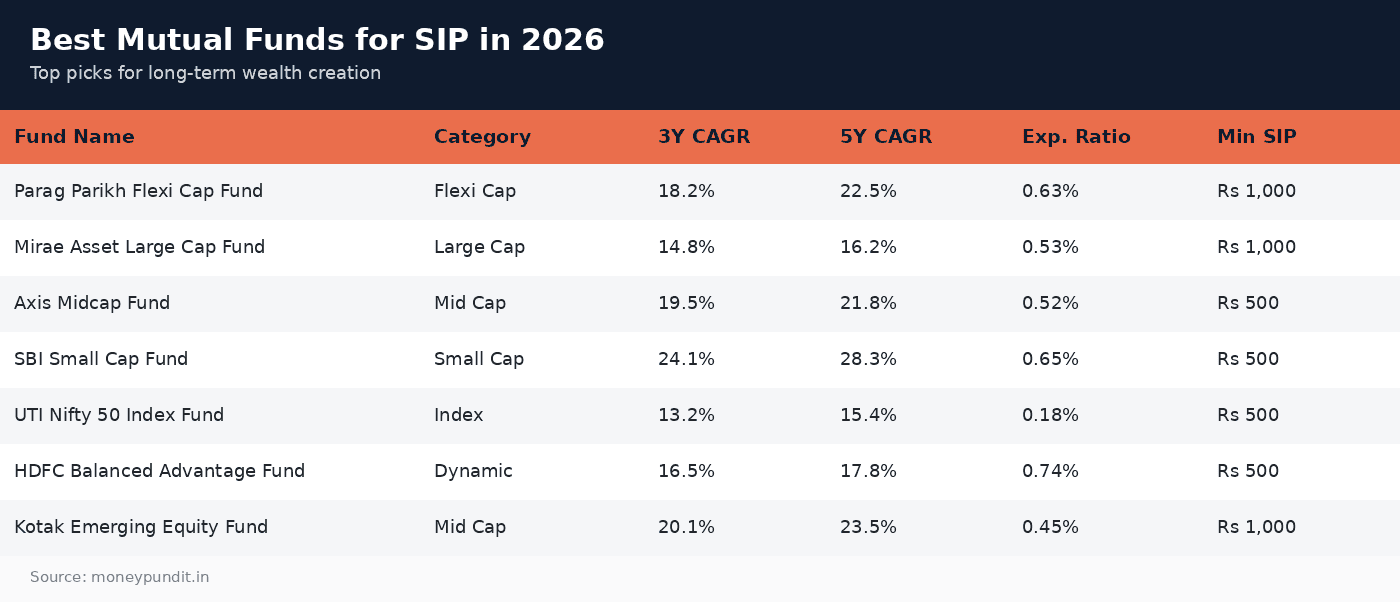
Best Mutual Funds for SIP Investment in 2026
Choosing the right mutual fund for your SIP can make the difference between average and exceptional wealth creation over the long term. We have analysed fund performance, consistency, risk-adjusted returns, and fund manager track record to bring you the top 10 mutual fund recommendations for SIP investors in 2026.
Selection Criteria
Our recommendations are based on: consistent performance across market cycles (not just recent bull runs), risk-adjusted returns using the Sharpe ratio, experienced fund managers with proven track records, reasonable expense ratios in the direct plan category, and fund size that is neither too small (liquidity risk) nor too large (alpha generation difficulty).
Top 10 Mutual Funds for SIP in 2026
| Fund Name | Category | 3Y CAGR | 5Y CAGR | Expense Ratio | Min SIP |
|---|---|---|---|---|---|
| Parag Parikh Flexi Cap Fund | Flexi Cap | 18.2% | 22.5% | 0.63% | Rs 1,000 |
| Mirae Asset Large Cap Fund | Large Cap | 14.8% | 16.2% | 0.53% | Rs 1,000 |
| Axis Midcap Fund | Mid Cap | 19.5% | 21.8% | 0.52% | Rs 500 |
| SBI Small Cap Fund | Small Cap | 24.1% | 28.3% | 0.65% | Rs 500 |
| UTI Nifty 50 Index Fund | Index | 13.2% | 15.4% | 0.18% | Rs 500 |
| HDFC Balanced Advantage Fund | Dynamic | 16.5% | 17.8% | 0.74% | Rs 500 |
| Kotak Emerging Equity Fund | Mid Cap | 20.1% | 23.5% | 0.45% | Rs 1,000 |
| Canara Robeco Equity Tax Saver | ELSS | 15.8% | 18.9% | 0.58% | Rs 500 |
| Motilal Oswal Midcap Fund | Mid Cap | 28.5% | 26.2% | 0.57% | Rs 500 |
| Nippon India Large Cap Fund | Large Cap | 16.2% | 17.5% | 0.68% | Rs 500 |
How to Build a SIP Portfolio
For a well-diversified SIP portfolio, consider the following allocation based on your risk profile:
Conservative (Age 45+): 40% Large Cap + 30% Balanced Advantage + 20% Index Fund + 10% Debt Fund
Moderate (Age 30-45): 30% Flexi Cap + 25% Mid Cap + 20% Large Cap + 15% ELSS + 10% Small Cap
Aggressive (Age 25-30): 30% Mid Cap + 25% Small Cap + 25% Flexi Cap + 20% ELSS
Common SIP Mistakes to Avoid
Stopping SIP During Market Crashes: This is the biggest mistake investors make. Market downturns are actually the best time for SIP as you accumulate more units at lower prices. Historically, investors who continued SIPs through the 2008 and 2020 crashes earned exceptional returns in the subsequent recovery.
Chasing Past Returns: Do not select funds solely based on last year’s returns. A fund that topped charts last year may underperform next year. Look at 5-year and 10-year rolling returns for a more reliable picture.
Too Many Funds: Having more than 5-7 funds in your portfolio leads to over-diversification, which dilutes returns. Three to five well-chosen funds across different categories is the sweet spot.
Frequently Asked Questions
When is the best date for SIP? Research shows that the SIP date has minimal impact on long-term returns. Choose any date that aligns with your salary credit date. The difference between the best and worst SIP dates over a 10-year period is typically less than 0.5% in total returns.
Direct vs Regular plan for SIP? Always choose the Direct plan. The difference in expense ratio (0.5-1% annually) compounds to a massive 15-25% difference in corpus over 20 years. Use platforms like Groww, Zerodha Coin, or Kuvera for commission-free direct plan investments.
Should I increase my SIP amount every year? Absolutely. A step-up SIP of even 10% annually can increase your final corpus by 50-60% compared to a fixed SIP over a 20-year period. Match your SIP increase with your annual salary increment.
How to Evaluate Mutual Funds for SIP Investment
Don’t just pick funds based on 1-year returns: that’s chasing momentum, not quality. Evaluate using these criteria: consistent performance across 3, 5, and 10-year periods (top quartile in each), performance during market downturns (how much the fund fell during crashes like March 2020), fund manager tenure (3+ years with the same manager), expense ratio (lower is better, especially for index funds), and AUM size (very large AUM in mid/small-cap funds can limit agility).
Compare against the fund’s benchmark and category average, a fund returning 14% sounds great, but not if its benchmark returned 16%. Rolling returns (3-year returns measured over every possible 3-year period) give a more comprehensive picture than point-to-point returns. A fund with consistent 12-14% rolling returns is better than one swinging between 5% and 25%. Check the portfolio overlap between your chosen funds. Use tools like Value Research or Morningstar to ensure your funds aren’t holding the same stocks.
Model SIP Portfolios by Risk Appetite and Goal
Conservative (5-7 year goals): 60% large-cap index fund + 20% balanced advantage/hybrid fund + 20% short-duration debt fund. Expected returns: 9-11% CAGR. Moderate (7-15 year goals): 40% large-cap + 30% flexi-cap + 20% mid-cap + 10% international fund. Expected: 11-13%. Aggressive (15+ year goals): 30% large-cap + 30% mid-cap + 25% small-cap + 15% sectoral/thematic. Expected: 13-16%, but with higher volatility.
Use our SIP Calculator to reverse-engineer: if your goal is ₹1 crore in 15 years, you need approximately ₹20,000/month at 12% returns. Increase SIP by 10% annually (step-up SIP) to account for income growth and inflation, this cuts the required starting amount significantly. For ELSS SIPs, align your monthly investment with the Section 80C limit (₹12,500/month = ₹1.5 lakh/year). Review and rebalance annually, but resist the urge to switch funds based on short-term underperformance, give every fund at least 3 years before evaluating.
Picking a fund from any list is only step one: the bigger driver of your outcome is starting the SIP, staying consistent through market cycles, and reviewing the fund once a year rather than chasing whichever name tops next quarter’s list.
References: Amfiindia.com
Frequently Asked Questions About Best mutual funds sip
What is the best mutual fund for SIP in 2026?
There is no single best fund. It depends on what you optimise for: pure returns, consistency across market cycles, or lower volatility. Recommendations should rest on consistent performance across market cycles, not just recent bull runs.
How should I split my SIP across fund categories?
A conservative investor aged 45+ might hold about 40% large cap, 30% balanced advantage, 20% index fund and 10% debt. A moderate investor aged 30-45 might hold 30% flexi cap, 25% mid cap, 20% large cap, 15% ELSS and 10% small cap.
Should I pick SIP funds based on recent returns?
No. Recent bull-run returns can mislead. Look at performance across full market cycles and risk-adjusted returns.
Is the SIP allocation a recommendation?
No. These allocations are illustrative examples by age and risk profile. Adjust them to your goals and consult a SEBI-registered adviser before investing.
Best mutual funds SIP: Key Takeaways
Key points on best mutual funds sip:
- Choosing the right mutual fund for your SIP can make the difference between average and exceptional wealth creation over the long term.
- Moderate (Age 30-45): 30% Flexi Cap + 25% Mid Cap + 20% Large Cap + 15% ELSS + 10% Small Cap
- Stopping SIP During Market Crashes: This is the biggest mistake investors make.
Verify the latest best mutual funds sip figures with AMFI before you act.