
Index funds copy a market index such as the Nifty 50, Sensex or Nifty Next 50 instead of trying to beat it, which keeps costs very low. The table below lists every index scheme in AMFI data, so you can compare returns and spot the cheapest fund for the index you want.
Index funds tracking the same benchmark can still show meaningfully different real-world returns once tracking error and expense ratio are factored in. The fund names look interchangeable, but the numbers rarely are. Here’s a live, daily-updated ranking of India’s top index funds, plus how to pick between them.
Index funds are mutual funds that replicate a market index like Nifty 50, Sensex, or Nifty Next 50 by holding the same stocks in the same proportion. They offer broad market exposure at extremely low costs, making them the simplest and most efficient way to participate in India’s equity market growth. The passive investing revolution in India has accelerated dramatically, with index fund AUM crossing ₹2 lakh crore in 2026.
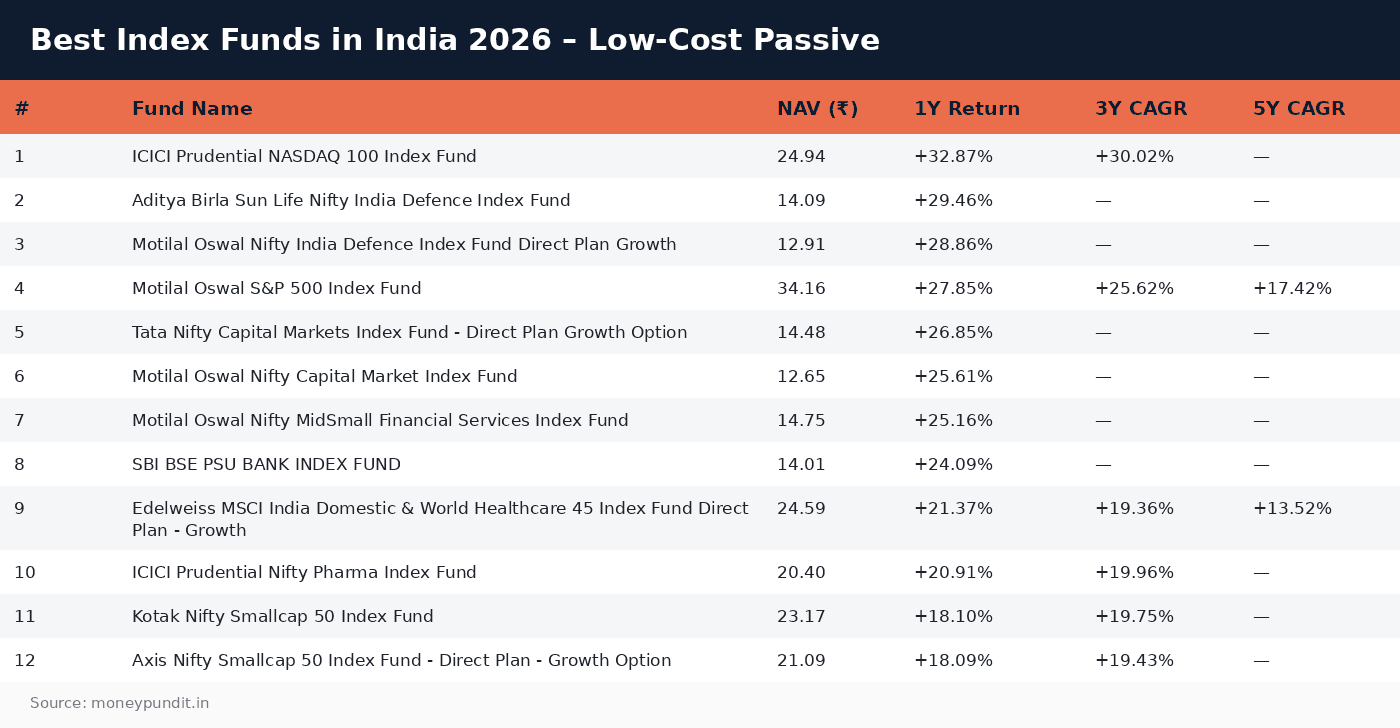
Top Index Funds in India for 2026
Live fund data below, refreshed daily from AMFI and mfapi.in:
| # | Fund Name | NAV (₹) | 1Y Return ▼ | 3Y CAGR | 5Y CAGR |
|---|---|---|---|---|---|
| 1 | ICICI Prudential NASDAQ 100 Index Fund | 25.31 | +31.83% | +32.93% | +20.38% |
| 2 | Motilal Oswal S&P 500 Index Fund | 34.33 | +26.25% | +28.15% | +18.44% |
| 3 | Tata Nifty Capital Markets Index Fund | 14.40 | +22.70% | — | — |
| 4 | Motilal Oswal Nifty Capital Market Index Fund | 12.57 | +21.70% | — | — |
| 5 | ICICI Prudential Nifty Pharma Index Fund | 20.19 | +20.05% | +20.03% | — |
| 6 | Edelweiss MSCI India Domestic & World Healthcare 45 Index Fund | 23.90 | +16.97% | +19.18% | +13.59% |
| 7 | Tata Nifty MidSmall Healthcare Index Fund | 14.68 | +16.18% | — | — |
| 8 | Motilal Oswal Nifty MidSmall Healthcare Index Fund | 12.07 | +15.79% | — | — |
| 9 | Aditya Birla Sun Life Nifty India Defence Index Fund | 13.24 | +15.43% | — | — |
| 10 | Motilal Oswal Nifty India Defence Index Fund | 12.11 | +15.25% | — | — |
| 11 | Axis Nifty Smallcap 50 Index Fund | 20.63 | +13.70% | +18.39% | — |
| 12 | Aditya Birla Sun Life Nifty Smallcap 50 Index Fund | 23.73 | +13.55% | +18.56% | +11.79% |
| 13 | Bandhan BSE Healthcare Index Fund | 11.26 | +13.51% | — | — |
| 14 | Kotak Nifty Smallcap 50 Index Fund | 22.62 | +13.19% | +18.42% | — |
| 15 | Motilal Oswal Nifty MidSmall Financial Services Index Fund | 13.96 | +12.82% | — | — |
| 16 | Motilal Oswal Nifty Microcap 250 Index Fund | 18.76 | +11.42% | +16.16% | — |
| 17 | DSP Nifty Healthcare Index Fund | 11.29 | +11.24% | — | — |
| 18 | Bandhan Nifty Alpha 50 Index Fund | 14.43 | +9.78% | — | — |
| 19 | HDFC CRISIL-IBX Financial Services 3-6 Months Debt Index Fund | 11.04 | +7.08% | — | — |
| 20 | Aditya Birla Sun Life Crisil-IBX Financial Services 3 to 6 months Debt Index Fund | 11.37 | +6.91% | — | — |
| 21 | Bandhan CRISIL-IBX Financial Services 3-6 Months Debt Index Fund | 11.17 | +6.90% | — | — |
| 22 | ICICI Prudential CRISIL-IBX Financial Services 3-6 Months Debt Index Fund | 11.15 | +6.90% | — | — |
| 23 | Navi Nifty Smallcap250 Momentum Quality 100 Index Fund | 12.08 | +6.81% | — | — |
| 24 | Axis CRISIL-IBX Financial Services 3-6 Months Debt Index Fund | 10.72 | +6.77% | — | — |
| 25 | Kotak CRISIL-IBX Financial Services 3-6 Months Debt Index Fund | 11.15 | +6.72% | — | — |
| 26 | Nippon India CRISIL - IBX AAA Financial Services - Dec 2026 Index Fund | 11.55 | +6.66% | — | — |
| 27 | Kotak CRISIL- IBX AAA Bond Financial Services Index - Dec 2026 Fund | 11.27 | +6.59% | — | — |
| 28 | Aditya Birla Sun Life Crisil-IBX AAA NBFC-HFC INDEX-Sep 2026 Fund | 11.55 | +6.56% | — | — |
| 29 | Kotak Nifty Alpha 50 Index Fund | 10.63 | +6.54% | — | — |
| 30 | Edelweiss CRISIL IBX AAA Bond NBFC HFC Jun 2027 Index Fund | 11.29 | +6.30% | — | — |
| 31 | Kotak CRISIL-IBX Financial Services 9 to 12 Months Debt Index Fund | 10.67 | +6.26% | — | — |
| 32 | Axis CRISIL-IBX AAA Bond NBFC - Jun 2027 Index Fund | 11.63 | +6.23% | — | — |
| 33 | Aditya Birla Sun Life Crisil-IBX Financial Services 9-12 Months Debt Index Fund | 11.11 | +6.23% | — | — |
| 34 | Nippon India Nifty AAA CPSE Bond Plus SDL - Apr 2027 Maturity 60:40 Index Fund | 13.24 | +6.18% | +7.52% | — |
| 35 | Mirae Asset CRISIL-IBX Financial Services 9-12 Months Debt Index Fund | 10.82 | +6.13% | — | — |
| 36 | Aditya Birla Sun Life Crisil-IBX AAA Financial Services Index-Sep 2027 Fund | 11.48 | +6.09% | — | — |
| 37 | Aditya Birla Sun Life Crisil IBX 60:40 SDL+AAA PSU-APR 2027 Index Fund | 13.24 | +6.01% | +7.48% | — |
| 38 | Axis CRISIL IBX SDL May 2027 Index Fund | 13.30 | +5.99% | +7.65% | — |
| 39 | Kotak CRISIL-IBX AAA Financial Services Index-Sep 2027 Fund | 11.65 | +5.97% | — | — |
| 40 | Edelweiss NIFTY PSU Bond Plus SDL Apr 2027 50:50 Index Fund | 13.48 | +5.88% | +7.53% | +6.13% |
| 41 | Kotak Nifty SDL Apr 2027 Top 12 Equal Weight Index Fund | 13.31 | +5.86% | +7.56% | — |
| 42 | UTI CRISIL SDL Maturity June 2027 Index Fund | 13.05 | +5.82% | +7.60% | — |
| 43 | Motilal Oswal Nifty Smallcap 250 Index Fund | 39.96 | +5.81% | +14.12% | +13.29% |
| 44 | Mirae Asset Nifty SDL Jun 2027 Index Fund | 13.31 | +5.80% | +7.61% | — |
| 45 | Aditya Birla Sun Life Nifty SDL Apr 2027 Index Fund | 13.39 | +5.80% | +7.44% | — |
| 46 | Edelweiss CRISIL IBX AAA Financial Services Bond - Jan 2028 Index Fund | 11.43 | +5.79% | — | — |
| 47 | ICICI Prudential Nifty SDL Sep 2027 Index Fund | 13.33 | +5.79% | +7.66% | — |
| 48 | SBI CPSE Bond Plus SDL Sep 2026 50:50 Index Fund | 13.26 | +5.79% | +7.24% | — |
| 49 | Nippon India CRISIL - IBX AAA Financial Services - Jan 2028 Index Fund | 11.50 | +5.74% | — | — |
| 50 | BANDHAN CRISIL IBX 90:10 SDL PLUS GILT - NOV 2026 INDEX FUND | 13.14 | +5.73% | +7.42% | — |
| 51 | Aditya Birla Sun Life Nifty SDL Plus PSU Bond SEP 2026 60:40 Index Fund | 13.36 | +5.72% | +7.25% | +5.99% |
| 52 | SBI CRISIL IBX SDL Index - September 2027 Fund | 13.32 | +5.72% | +7.61% | — |
| 53 | ICICI Prudential Nifty PSU Bond Plus SDL Sep 2027 40:60 Index Fund | 13.44 | +5.70% | +7.56% | +6.10% |
| 54 | Kotak Nifty SmallCap 250 Index Fund | 11.58 | +5.69% | — | — |
| 55 | BANDHAN CRISIL IBX 90:10 SDL PLUS GILT - SEPTEMBER 2027 INDEX FUND | 13.21 | +5.67% | +7.69% | — |
| 56 | Axis CRISIL-IBX AAA Bond NBFC-HFC - Jun 2027 Index Fund | 11.33 | +5.61% | — | — |
| 57 | Aditya Birla Sun Life Nifty SDL SEP 2027 Index Fund | 13.02 | +5.60% | +7.63% | — |
| 58 | HDFC Nifty SDL Oct 2026 Index Fund | 12.93 | +5.58% | +7.28% | — |
| 59 | Tata Nifty G-Sec Dec 2026 Index Fund | 12.92 | +5.57% | +7.31% | — |
| 60 | HDFC NIFTY SDL Plus G-Sec Jun 2027 40:60 Index Fund | 12.85 | +5.54% | +7.50% | — |
| 61 | Axis Crisil IBX 50:50 Gilt Plus SDL September 2027 Index Fund | 13.00 | +5.51% | +7.52% | — |
| 62 | ICICI Prudential Nifty SDL Sep 2026 Index Fund | 12.96 | +5.51% | +7.22% | — |
| 63 | Axis Nifty SDL September 2026 Debt Index Fund | 13.07 | +5.49% | +7.29% | — |
| 64 | HDFC Nifty G-Sec Dec 2026 Index Fund | 13.11 | +5.48% | +7.25% | — |
| 65 | Axis CRISIL-IBX AAA Bond Financial Services - Sep 2027 Index Fund | 11.38 | +5.47% | — | — |
| 66 | Kotak Nifty AAA Bond Financial Services Mar 2028 Index Fund | 10.71 | +5.47% | — | — |
| 67 | Edelweiss CRISIL IBX 50:50 Gilt Plus SDL June 2027 Index Fund | 13.30 | +5.46% | +7.50% | — |
| 68 | DSP Nifty SDL Plus G-Sec Sep 2027 50:50 Index Fund | 13.03 | +5.44% | +7.55% | — |
| 69 | Mirae Asset Nifty SDL June 2028 Index Fund | 12.92 | +5.39% | +7.70% | — |
| 70 | Edelweiss Nifty Smallcap 250 Index Fund | 18.60 | +5.39% | +13.58% | — |
| 71 | Nippon India Nifty AAA PSU Bond Plus SDL - Sep 2026 Maturity 50:50 Index Fund | 13.09 | +5.37% | +7.08% | — |
| 72 | Nippon India Nifty SDL Plus G-Sec - Jun 2028 Maturity 70:30 Index Fund | 13.20 | +5.32% | +7.61% | — |
| 73 | UTI NIFTY SDL Plus AAA PSU Bond Apr 2028- 75:25 Index Fund | 13.01 | +5.28% | +7.56% | — |
| 74 | Invesco India Nifty G-sec Jul 2027 Index Fund | 1,283.42 | +5.25% | +7.53% | — |
| 75 | Tata Nifty SDL Plus AAA PSU Bond Dec 2027 60 40 Index Fund | 13.41 | +5.25% | +7.51% | — |
| 76 | HSBC CRISIL IBX Gilt June 2027 Index Fund | 12.84 | +5.23% | +7.47% | — |
| 77 | BANDHAN CRISIL IBX GILT JUNE 2027 INDEX FUND | 13.97 | +5.23% | +7.50% | +6.03% |
| 78 | Nippon India Nifty G-Sec Sep 2027 Maturity Index Fund | 13.03 | +5.23% | +7.46% | — |
| 79 | Kotak Nifty SDL Plus AAA PSU Bond Jul 2028 60 - 40 Index Fund | 13.33 | +5.20% | +7.53% | — |
| 80 | Baroda BNP Paribas Nifty SDL December 2026 Index Fund | 12.88 | +5.19% | +7.23% | — |
| 81 | Axis CRISIL IBX 50:50 Gilt Plus SDL June 2028 Index Fund | 13.00 | +5.18% | +7.57% | — |
| 82 | HDFC Nifty G-Sec Jun 2027 Index Fund | 13.07 | +5.17% | +7.51% | — |
| 83 | HSBC CRISIL IBX 50:50 Gilt Plus SDL Apr 2028 Index Fund | 13.40 | +5.11% | +7.55% | — |
| 84 | Aditya Birla Sun Life Crisil IBX Gilt June 2027 Index Fund | 11.74 | +5.11% | — | — |
| 85 | Aditya Birla Sun Life Crisil IBX 50:50 Gilt Plus SDL Apr 2028 Index Fund | 13.41 | +5.08% | +7.58% | — |
| 86 | DSP Nifty SDL Plus G-Sec Jun 2028 30:70 Index Fund | 13.41 | +5.08% | +7.58% | — |
| 87 | BANDHAN CRISIL IBX GILT APRIL 2028 INDEX FUND | 14.03 | +5.02% | +7.60% | +6.14% |
| 88 | ICICI Prudential Nifty200 Value 30 Index Fund | 10.30 | +4.97% | — | — |
| 89 | ICICI Prudential Nifty SDL Dec 2028 Index Fund | 13.43 | +4.93% | +7.57% | — |
| 90 | Baroda BNP Paribas NIFTY SDL December 2028 Index Fund | 12.95 | +4.91% | +7.53% | — |
| 91 | Edelweiss CRISIL IBX 50:50 Gilt Plus SDL Sep 2028 Index Fund | 13.33 | +4.91% | +7.62% | — |
| 92 | Nippon India Nifty SDL Plus G-Sec - Jun 2029 Maturity 70:30 Index Fund | 12.97 | +4.81% | +7.60% | — |
| 93 | SBI BSE PSU BANK INDEX FUND | 13.13 | +4.81% | — | — |
| 94 | Aditya Birla Sun Life Crisil IBX Gilt Apr 2028 Index Fund | 12.73 | +4.75% | +7.19% | — |
| 95 | PGIM India CRISIL IBX Gilt Index - Apr 2028 Fund - Direct Plan | 12.92 | +4.72% | +7.33% | — |
| 96 | Axis Nifty500 Value 50 Index Fund | 10.73 | +4.53% | — | — |
| 97 | Kotak Nifty SDL Jul 2026 Index Fund | 12.81 | +4.49% | +6.81% | — |
| 98 | UTI Nifty 500 Value 50 Index Fund | 20.84 | +4.40% | +19.89% | — |
| 99 | Edelweiss CRISIL IBX 50:50 Gilt Plus SDL Short Duration Index Fund | 12.86 | +4.39% | +7.15% | — |
| 100 | Bandhan CRISIL-IBX 10:90 Gilt Plus SDL Index - Dec 2029 Fund | 11.02 | +4.38% | — | — |
| 101 | Nippon India Nifty G-Sec Oct 2028 Maturity Index Fund | 12.99 | +4.34% | +7.49% | — |
| 102 | Axis Nifty Midcap 50 Index Fund | 20.66 | +4.20% | +14.35% | — |
| 103 | UTI Nifty Midsmallcap 400 Momentum Quality 100 Index Fund | 11.48 | +4.17% | — | — |
| 104 | Aditya Birla Sun Life Crisil IBX Gilt -Apr 2029 Index Fund | 13.42 | +4.10% | +7.63% | — |
| 105 | Bandhan Nifty 500 Value 50 Index Fund | 10.60 | +4.07% | — | — |
| 106 | Kotak Nifty Midcap 50 Index Fund | 10.45 | +4.07% | — | — |
| 107 | Aditya Birla Sun Life CRISIL IBX SDL Jun 2032 Index Fund | 12.92 | +4.06% | +7.22% | — |
| 108 | HDFC Nifty G-Sec Apr 2029 Index Fund | 13.01 | +4.05% | +7.68% | — |
| 109 | Kotak Nifty SDL Apr 2032 Top 12 Equal Weight Index Fund | 13.36 | +4.05% | +7.16% | — |
| 110 | SBI CRISIL IBX Gilt Index - April 2029 Fund | 13.36 | +4.01% | +7.58% | — |
| 111 | Groww Nifty Smallcap 250 Index Fund | 11.91 | +3.98% | — | — |
| 112 | BANDHAN CRISIL IBX 90:10 SDL PLUS GILT - APRIL 2032 INDEX FUND | 13.09 | +3.96% | +7.29% | — |
| 113 | Tata Nifty G-Sec Dec 2029 Index Fund | 13.07 | +3.89% | +7.72% | — |
| 114 | Nippon India Nifty Smallcap 250 Index Fund | 35.35 | +3.77% | +12.51% | +13.11% |
| 115 | JioBlackRock Nifty Smallcap 250 Index Fund | 10.56 | +3.75% | — | — |
| 116 | BANDHAN Nifty Smallcap 250 Index Fund | 12.93 | +3.70% | — | — |
| 117 | HDFC NIFTY Smallcap 250 Index Fund | 19.41 | +3.62% | +12.66% | — |
| 118 | SBI Nifty Smallcap 250 Index Fund | 19.43 | +3.57% | +12.67% | — |
| 119 | ICICI Prudential Nifty Smallcap 250 Index Fund | 18.28 | +3.56% | +12.64% | — |
| 120 | Aditya Birla Sun Life BSE 500 Momentum 50 Index Fund | 10.60 | +3.51% | — | — |
| 121 | UTI CRISIL SDL Maturity April 2033 Index Fund | 12.91 | +3.45% | +6.92% | — |
| 122 | Kotak Nifty SDL Jul 2033 Index Fund | 12.84 | +3.37% | +6.82% | — |
| 123 | ICICI Prudential Nifty G-Sec Dec 2030 Index Fund | 13.31 | +3.34% | +7.58% | — |
| 124 | DSP CRISIL-IBX 50:50 Gilt Plus SDL - April 2033 Index Fund | 12.94 | +3.29% | +7.26% | — |
| 125 | Edelweiss Nifty PSU Bond Plus SDL Apr 2026 50:50 Index Fund | 13.72 | +3.24% | +6.24% | +5.46% |
| 126 | HDFC Nifty G-Sec July 2031 Index Fund | 13.19 | +3.24% | +7.70% | — |
| 127 | Aditya Birla Sun Life Crisil IBX Gilt April 2033 Index Fund | 12.02 | +3.10% | — | — |
| 128 | BANDHAN CRISIL IBX GILT APRIL 2026 INDEX FUND | 12.77 | +3.04% | +6.08% | — |
| 129 | BANDHAN CRISIL IBX GILT APRIL 2032 INDEX FUND | 12.96 | +3.03% | +7.64% | — |
| 130 | Kotak Nifty G-Sec July 2033 Index Fund | 12.29 | +2.99% | +7.28% | — |
| 131 | HDFC Nifty G-Sec Sep 2032 Index Fund | 13.06 | +2.96% | +7.50% | — |
| 132 | UTI Nifty India Manufacturing Index Fund | 11.79 | +2.93% | — | — |
| 133 | Invesco India Nifty G-sec Sep 2032 Index Fund | 1,278.98 | +2.91% | +7.61% | — |
| 134 | Navi Nifty India Manufacturing Index Fund | 18.45 | +2.89% | +17.05% | — |
| 135 | Axis Nifty500 Momentum 50 Index Fund | 10.98 | +2.81% | — | — |
| 136 | Nippon India Nifty G-Sec Jun 2036 Maturity Index Fund | 13.00 | +2.78% | +7.55% | — |
| 137 | SBI CRISIL IBX Gilt Index - June 2036 Fund | 13.29 | +2.78% | +7.45% | — |
| 138 | LIC MF Nifty Next 50 Index Fund | 56.65 | +2.76% | +16.66% | — |
| 139 | Edelweiss Nifty Next 50 Index Fund | 16.13 | +2.71% | +16.56% | — |
| 140 | HDFC Nifty G-Sec Jun 2036 Index Fund | 12.90 | +2.71% | +7.59% | — |
| 141 | Tata Nifty500 Multicap India Manufacturing 50:30:20 Index Fund | 11.69 | +2.67% | — | — |
| 142 | Edelweiss CRISIL IBX 50:50 Gilt Plus SDL April 2037 Index Fund | 13.21 | +2.66% | +7.10% | — |
| 143 | Mirae Asset CRISIL IBX Gilt Index - April 2033 Index Fund | 13.28 | +2.64% | +7.48% | — |
| 144 | DSP BSE SENSEX Next 30 Index Fund | 11.48 | +2.58% | — | — |
| 145 | DSP Nifty Next 50 Index Fund | 27.36 | +2.54% | +16.44% | +10.66% |
| 146 | Kotak Nifty Next 50 Index Fund | 20.23 | +2.54% | +16.67% | +10.65% |
| 147 | Aditya Birla Sun Life Nifty Next 50 Index Fund | 17.17 | +2.52% | +16.48% | — |
| 148 | UTI - Nifty Next 50 Index Fund | 25.62 | +2.49% | +16.65% | +10.49% |
| 149 | Bandhan Nifty 500 Momentum 50 Index Fund | 8.88 | +2.47% | — | — |
| 150 | Navi Nifty Next 50 Index Fund | 16.45 | +2.47% | +16.57% | — |
| 151 | Tata Nifty Next 50 Index Fund | 10.17 | +2.46% | — | — |
| 152 | Motilal Oswal Nifty Next 50 Index Fund | 24.79 | +2.44% | +16.46% | +10.63% |
| 153 | Bandhan Nifty Next 50 Index Fund | 12.17 | +2.43% | — | — |
| 154 | Groww Nifty Next 50 Index Fund | 10.23 | +2.40% | — | — |
| 155 | Motilal Oswal Nifty 500 Momentum 50 Index Fund | 8.23 | +2.38% | — | — |
| 156 | Motilal Oswal Nifty Midcap 150 Index Fund | 39.63 | +2.14% | +14.14% | +13.68% |
| 157 | Nippon India Nifty India Manufacturing Index Fund | 10.59 | +2.08% | — | — |
| 158 | Tata Nifty200 Alpha 30 Index Fund | 8.64 | +2.06% | — | — |
| 159 | Aditya Birla Sun Life Nifty Midcap 150 Index Fund | 24.70 | +1.94% | +14.01% | +13.58% |
| 160 | TATA CRISIL-IBX GILT INDEX - APRIL 2026 INDEX FUND | 12.67 | +1.93% | +5.75% | — |
| 161 | Tata Nifty Midcap 150 Index Fund | 10.39 | +1.91% | — | — |
| 162 | Kotak Nifty Midcap 150 Index Fund | 11.23 | +1.87% | — | — |
| 163 | Nippon India BSE Sensex Next 30 Index Fund | 10.32 | +1.86% | — | — |
| 164 | Bandhan Nifty Midcap 150 Index Fund | 9.94 | +1.83% | — | — |
| 165 | Nippon India Nifty 500 Momentum 50 Index Fund | 8.32 | +1.78% | — | — |
| 166 | Bajaj Finserv Nifty Next 50 Index Fund | 10.99 | +1.76% | — | — |
| 167 | UTI Nifty Midcap 150 Index Fund | 10.48 | +1.72% | — | — |
| 168 | JioBlackRock Nifty 8-13 yr G-Sec Index Fund | 10.19 | +1.67% | — | — |
| 169 | Axis Nifty Next 50 Index Fund | 17.13 | +1.63% | +16.04% | — |
| 170 | JioBlackRock Nifty Next 50 Index Fund | 10.29 | +1.62% | — | — |
| 171 | Kotak Nifty Commodities Index Fund | 11.24 | +1.56% | — | — |
| 172 | SBI Nifty Next 50 Index Fund | 19.14 | +1.48% | +16.02% | +10.60% |
| 173 | HDFC NIFTY Next 50 index Fund | 16.32 | +1.41% | +15.80% | — |
| 174 | ICICI Prudential Nifty Next 50 Index Fund | 64.13 | +1.33% | +15.83% | +10.47% |
| 175 | Nippon India Nifty Midcap 150 Index Fund | 25.30 | +1.33% | +13.27% | +13.89% |
| 176 | Edelweiss BSE Internet Economy Index Fund | 11.13 | +1.32% | — | — |
| 177 | ICICI Prudential Nifty Midcap 150 Index Fund | 19.54 | +1.29% | +13.21% | — |
| 178 | JioBlackRock Nifty Midcap 150 Index Fund | 10.29 | +1.28% | — | — |
| 179 | SBI Nifty Midcap 150 Index Fund | 19.03 | +1.27% | +13.24% | — |
| 180 | HSBC NIFTY NEXT 50 Index Fund | 30.26 | +1.18% | +15.71% | — |
| 181 | Kotak Nifty Midcap 150 Momentum 50 Index Fund | 9.21 | +1.17% | — | — |
| 182 | HDFC NIFTY Midcap 150 Index Fund | 18.65 | +1.16% | +13.15% | — |
| 183 | Edelweiss Nifty Midcap150 Momentum 50 Index Fund | 18.00 | +1.00% | +13.83% | — |
| 184 | Tata Nifty Midcap 150 Momentum 50 Index Fund | 17.90 | +0.80% | +13.55% | — |
| 185 | Baroda BNP Paribas Nifty Midcap 150 Index Fund | 10.50 | +0.72% | — | — |
| 186 | Edelweiss CRISIL PSU Plus SDL 50:50 Oct 2025 Index Fund | 12.39 | +0.38% | +4.94% | — |
| 187 | Aditya Birla Sun Life BSE 500 Quality 50 Index Fund | 10.34 | -0.65% | — | — |
| 188 | HDFC NIFTY 100 Equal Weight Index Fund | 16.62 | -0.96% | +12.98% | — |
| 189 | Nippon India Nifty 500 Equal Weight Index Fund | 9.43 | -1.19% | — | — |
| 190 | Sundaram Nifty 100 Equal Weight Fund | 184.22 | -1.26% | +12.53% | — |
| 191 | DSP Nifty Private Bank Index Fund | 11.26 | -1.30% | — | — |
| 192 | Kotak Nifty Financial Services Ex-Bank Index Fund | 15.74 | -1.33% | +13.17% | — |
| 193 | Axis Nifty Bank Index Fund | 11.48 | -1.34% | — | — |
| 194 | Kotak Nifty 100 Equal Weight Index Fund | 10.52 | -1.35% | — | — |
| 195 | Navi Nifty Bank Index Fund | 14.65 | -1.35% | +8.43% | — |
| 196 | Motilal Oswal Nifty Bank Index Fund | 20.65 | -1.40% | +8.39% | +8.39% |
| 197 | BANDHAN NIFTY BANK INDEX FUND | 10.91 | -1.45% | — | — |
| 198 | UTI Nifty Private Bank Index Fund | 10.15 | -1.48% | — | — |
| 199 | kotak BSE PSU Index Fund | 8.84 | -1.58% | — | — |
| 200 | DSP Nifty Bank Index Fund | 11.44 | -1.61% | — | — |
| 201 | Navi Nifty 500 Multicap 50:25:25 Index Fund | 9.75 | -1.63% | — | — |
| 202 | HDFC NIFTY500 Multicap 50:25:25 Index Fund | 9.69 | -1.64% | — | — |
| 203 | Zerodha ELSS Tax Saver Nifty LargeMidcap 250 Index Fund | 13.67 | -1.78% | — | — |
| 204 | Zerodha Nifty LargeMidcap 250 Index Fund | 13.64 | -1.86% | — | — |
| 205 | SBI Nifty Bank Index Fund | 11.14 | -2.00% | — | — |
| 206 | ICICI Prudential Nifty Bank Index Fund | 16.02 | -2.06% | +7.81% | — |
| 207 | Tata Nifty500 Multicap Infrastructure 50:30:20 Index Fund | 10.35 | -2.08% | — | — |
| 208 | Nippon India Nifty Bank Index Fund | 11.98 | -2.16% | — | — |
| 209 | Edelweiss NIFTY Large Midcap 250 Index Fund | 16.47 | -2.45% | +10.72% | — |
| 210 | Edelweiss Nifty500 Multicap Momentum Quality 50 Index Fund | 8.82 | -2.47% | — | — |
| 211 | Mirae Asset Nifty LargeMidcap 250 Index Fund | 10.01 | -2.65% | — | — |
| 212 | ICICI Prudential Nifty Private Bank Index Fund | 9.82 | -2.71% | — | — |
| 213 | DSP Nifty 50 Equal Weight Index Fund | 25.86 | -2.88% | +10.35% | +9.97% |
| 214 | UTI Nifty50 Equal Weight Index Fund | 14.32 | -2.91% | +10.17% | — |
| 215 | HDFC NIFTY LargeMidcap 250 Index Fund | 9.65 | -3.11% | — | — |
| 216 | Tata BSE Quality Index Fund | 10.75 | -3.12% | — | — |
| 217 | ICICI Prudential Nifty LargeMidcap 250 Index Fund | 11.85 | -3.15% | — | — |
| 218 | Axis Nifty500 Quality 50 Index Fund | 9.64 | -3.24% | — | — |
| 219 | UTI Nifty 200 Momentum 30 Index Fund | 20.41 | -3.24% | +9.72% | +8.50% |
| 220 | Mirae Asset Nifty Total Market Index Fund | 9.98 | -3.29% | — | — |
| 221 | Motilal Oswal BSE 1000 Index Fund | 9.62 | -3.30% | — | — |
| 222 | HDFC NIFTY200 Momentum 30 Index Fund | 9.86 | -3.48% | — | — |
| 223 | Aditya Birla Sun Life Nifty 50 Equal Weight index Fund | 17.93 | -3.57% | +10.19% | +9.61% |
| 224 | Kotak Nifty 50 Equal Weight Index Fund | 10.60 | -3.62% | — | — |
| 225 | Motilal Oswal Nifty 200 Momentum 30 Index Fund | 14.67 | -3.63% | +9.37% | — |
| 226 | Motilal Oswal Nifty 500 Index Fund | 25.84 | -3.76% | +9.57% | +8.26% |
| 227 | ANGEL ONE NIFTY TOTAL MARKET INDEX FUND | 11.31 | -3.94% | — | — |
| 228 | ICICI Prudential Nifty50 Equal Weight Index Fund | 16.13 | -3.96% | +9.90% | — |
| 229 | Axis Nifty 500 Index Fund | 9.71 | -3.98% | — | — |
| 230 | HDFC NIFTY50 Equal Weight Index Fund | 17.53 | -3.99% | +9.95% | +9.94% |
| 231 | SBI Nifty50 Equal Weight Index Fund | 11.54 | -4.02% | — | — |
| 232 | Kotak Nifty 200 Momentum 30 Index Fund | 14.06 | -4.04% | +8.86% | — |
| 233 | Tata BSE Select Business Groups Index Fund | 9.46 | -4.09% | — | — |
| 234 | ICICI Prudential Nifty 200 Momentum 30 Index Fund | 16.01 | -4.13% | +8.61% | — |
| 235 | HDFC BSE 500 Index Fund | 14.93 | -4.14% | +8.80% | — |
| 236 | Groww Nifty Total Market Index Fund | 13.35 | -4.19% | +10.13% | — |
| 237 | BANDHAN NIFTY TOTAL MARKET INDEX FUND | 9.76 | -4.23% | — | — |
| 238 | Nippon India Nifty 500 Quality 50 Index Fund | 10.42 | -4.28% | — | — |
| 239 | SBI Nifty200 Momentum 30 Index Fund | 9.33 | -4.29% | — | — |
| 240 | BANDHAN NIFTY200 MOMENTUM 30 INDEX FUND | 15.02 | -4.30% | +8.46% | — |
| 241 | Edelweiss Nifty 100 Quality 30 Index Fund | 14.14 | -4.43% | +7.52% | +6.69% |
| 242 | Nippon India Nifty Auto Index Fund | 10.90 | -4.47% | — | — |
| 243 | Edelweiss Nifty Alpha Low Volatility 30 Index Fund | 9.36 | -4.50% | — | — |
| 244 | DSP Nifty Midcap 150 Quality 50 Index Fund | 14.13 | -4.56% | +7.63% | — |
| 245 | Baroda BNP Paribas Nifty200 Momentum 30 Index Fund | 7.77 | -4.57% | — | — |
| 246 | UTI Nifty Alpha Low-Volatility 30 Index Fund | 9.07 | -4.59% | — | — |
| 247 | ICICI Prudential Nifty Auto Index Fund | 20.54 | -4.67% | +17.17% | — |
| 248 | SBI Nifty 500 Index Fund | 9.22 | -4.67% | — | — |
| 249 | UTI Nifty Midcap 150 Quality 50 Index Fund | 13.70 | -4.71% | +7.51% | — |
| 250 | Tata Nifty Auto Index Fund | 11.59 | -4.73% | — | — |
| 251 | Nippon India Nifty Realty Index Fund | 7.70 | -4.82% | — | — |
| 252 | ICICI Prudential Nifty 500 Index Fund | 9.98 | -4.94% | — | — |
| 253 | Nippon India Nifty Alpha Low Volatility 30 Index Fund | 14.99 | -4.95% | +8.57% | — |
| 254 | Bandhan Nifty Alpha Low Volatility 30 Index Fund | 9.52 | -5.25% | — | — |
| 255 | HDFC Nifty100 Quality 30 Index Fund | 10.40 | -5.38% | — | — |
| 256 | DSP Nifty Smallcap250 Quality 50 Index Fund | 10.84 | -6.05% | — | — |
| 257 | HDFC NIFTY Realty Index Fund | 9.32 | -6.09% | — | — |
| 258 | Tata Nifty Realty Index Fund | 8.53 | -6.18% | — | — |
| 259 | Nippon India Nifty 500 Low Volatility 50 Index Fund | 10.12 | -6.28% | — | — |
| 260 | Tata Nifty Financial Services Index Fund | 11.88 | -6.28% | — | — |
| 261 | Kotak NIFTY 100 Low Volatility 30 Index Fund | 10.17 | -6.83% | — | — |
| 262 | HDFC NIFTY100 Low Volatility 30 Index Fund | 9.75 | -6.85% | — | — |
| 263 | Aditya Birla Sun Life BSE India Infrastructure Index Fund | 8.56 | -6.91% | — | — |
| 264 | BANDHAN NIFTY 100 INDEX FUND | 14.28 | -6.93% | +7.82% | — |
| 265 | BANDHAN Nifty100 Low Volatility 30 Index Fund | 14.79 | -6.97% | +8.27% | — |
| 266 | SBI Nifty100 Low Volatility 30 Index Fund | 9.52 | -6.97% | — | — |
| 267 | Axis Nifty 100 Index Fund | 21.32 | -6.99% | +7.74% | +6.44% |
| 268 | HDFC NIFTY 100 Index Fund | 14.20 | -7.08% | +7.61% | — |
| 269 | Bandhan BSE India Sector Leaders Index Fund | 9.14 | -7.35% | — | — |
| 270 | KOTAK NIFTY 200 QUALITY 30 INDEX FUND | 9.41 | -7.52% | — | — |
| 271 | SBI Nifty200 Quality 30 Index Fund | 9.53 | -7.69% | — | — |
| 272 | ICICI Prudential Nifty200 Quality 30 Index Fund | 9.38 | -7.72% | — | — |
| 273 | Bandhan Nifty 200 Quality 30 Index Fund | 9.16 | -7.73% | — | — |
| 274 | UTI Nifty 200 Quality 30 Index Fund | 8.50 | -7.75% | — | — |
| 275 | Edelweiss Nifty 50 Index Fund | 13.50 | -8.27% | +6.09% | +6.06% |
| 276 | DSP Nifty 50 Index Fund | 22.46 | -8.40% | +6.07% | +6.08% |
| 277 | Motilal Oswal Nifty 50 Index Fund | 19.84 | -8.40% | +6.09% | +6.12% |
| 278 | Franklin India NSE Nifty 50 Index Fund | 194.52 | -8.45% | +6.03% | +6.03% |
| 279 | Navi Nifty 50 Index Fund | 15.02 | -8.85% | +6.08% | +5.83% |
| 280 | Axis Nifty 50 Index Fund | 13.83 | -8.88% | +6.06% | — |
| 281 | BANDHAN Nifty 50 Index Fund | 50.91 | -8.91% | +6.04% | +5.85% |
| 282 | UTI Nifty 50 Index Fund | 159.99 | -8.93% | +6.03% | +5.79% |
| 283 | Mirae Asset Nifty 50 Index Fund | 9.48 | -8.96% | — | — |
| 284 | 360 ONE ELSS Tax Saver Nifty 50 Index Fund | 12.92 | -8.97% | +5.96% | — |
| 285 | HDFC Nifty 50 Index Fund | 222.36 | -9.01% | +5.97% | +5.74% |
| 286 | DSP Nifty500 Flexicap Quality 30 Index Fund | 9.29 | -9.12% | — | — |
| 287 | Kotak Nifty 50 Index Fund | 15.11 | -9.15% | +5.65% | +6.00% |
| 288 | JioBlackRock Nifty 50 Index Fund | 9.22 | -9.17% | — | — |
| 289 | Nippon India Index Fund - Nifty 50 Plan | 41.98 | -9.17% | +5.74% | +6.05% |
| 290 | Groww Nifty 50 Index Fund | 9.12 | -9.18% | — | — |
| 291 | HSBC NIFTY 50 Index Fund | 26.92 | -9.23% | +5.68% | — |
| 292 | Aditya Birla Sun Life Nifty 50 Index Fund | 237.44 | -9.23% | +5.69% | +5.99% |
| 293 | Bajaj Finserv Nifty 50 Index Fund | 9.29 | -9.24% | — | — |
| 294 | Baroda BNP Paribas Nifty 50 Index Fund | 10.74 | -9.27% | — | — |
| 295 | ANGEL ONE NIFTY 50 INDEX FUND | 9.36 | -9.30% | — | — |
| 296 | LIC MF Nifty 50 Index Fund | 136.18 | -9.30% | +5.84% | +5.65% |
| 297 | SBI NIFTY INDEX FUND | 212.59 | -9.31% | +5.65% | +6.01% |
| 298 | UTI BSE Low Volatility Index Fund | 15.10 | -9.32% | +6.08% | — |
| 299 | Taurus Nifty 50 Index Fund | 46.00 | -9.50% | +5.29% | +5.20% |
| 300 | HDFC Nifty India Digital Index Fund | 8.46 | -9.61% | — | — |
| 301 | Motilal Oswal Nifty MidSmall India Consumption Index Fund | 9.18 | -9.83% | — | — |
| 302 | HDFC Nifty Top 20 Equal Weight Index Fund | 9.66 | -10.01% | — | — |
| 303 | SBI Nifty India Consumption Index Fund | 9.56 | -10.09% | — | — |
| 304 | Groww Nifty Non-Cyclical Consumer Index Fund | 9.82 | -10.18% | — | — |
| 305 | UTI BSE Housing Index Fund | 13.19 | -10.23% | +6.31% | — |
| 306 | UTI BSE Sensex Index Fund | 13.21 | -10.42% | +4.45% | — |
| 307 | NAVI BSE SENSEX INDEX FUND | 11.39 | -10.42% | +4.39% | — |
| 308 | HDFC BSE Sensex Index Fund | 699.10 | -10.48% | +4.44% | +4.88% |
| 309 | Kotak BSE Housing Index Fund | 12.28 | -10.49% | +5.96% | — |
| 310 | Axis BSE Sensex Index Fund | 10.29 | -10.52% | — | — |
| 311 | Zerodha Nifty 50 Index Fund | 9.10 | -10.73% | — | — |
| 312 | LIC MF BSE Sensex Index Fund | 147.35 | -10.75% | +4.18% | +4.69% |
| 313 | Nippon India Index Fund - BSE Sensex Plan | 39.75 | -10.78% | +4.07% | +5.13% |
| 314 | Kotak BSE Sensex Index Fund | 9.76 | -10.85% | — | — |
| 315 | SBI BSE Sensex Index Fund | 12.06 | -10.89% | +4.00% | — |
| 316 | ICICI Prudential Nifty50 Value 20 Index Fund | 9.61 | -11.67% | — | — |
| 317 | Nippon India Nifty 50 Value 20 Index Fund | 16.77 | -11.74% | +3.83% | +5.78% |
| 318 | DSP Nifty Top 10 Equal Weight Index Fund | 8.61 | -12.60% | — | — |
| 319 | ICICI Prudential Nifty Top 15 Equal Weight Index Fund | 8.90 | -12.96% | — | — |
| 320 | Kotak Nifty Top 10 Equal Weight Index Fund | 8.72 | -13.09% | — | — |
| 321 | Kotak Nifty India Tourism Index Fund | 8.06 | -13.53% | — | — |
| 322 | Tata Nifty India Tourism Index Fund | 8.56 | -13.64% | — | — |
| 323 | ICICI Prudential Nifty IT Index Fund | 10.60 | -16.97% | -2.68% | — |
| 324 | Nippon India Nifty IT Index Fund | 8.19 | -17.02% | — | — |
| 325 | SBI Nifty IT Index Fund | 7.55 | -17.06% | — | — |
| 326 | DSP Nifty IT Index Fund | 7.84 | -17.30% | — | — |
| 327 | Axis Nifty IT Index Fund | 10.49 | -19.81% | -3.29% | — |
| 328 | Navi NiftyIT Index Fund | 8.91 | -19.84% | — | — |
| 329 | Bandhan Nifty IT Index Fund | 10.15 | -20.00% | -3.00% | — |
| 330 | Groww Nifty India Railways PSU Index Fund | 7.15 | -26.58% | — | — |
| 331 | SBI Crisil - IBX SDL Index - June 2034 Index Fund | 9.86 | — | — | — |
| 332 | Tata CRISIL-IBX Financial Services 3-6 Months Debt Index Fund | 10.04 | — | — | — |
| 333 | Axis BSE India Sector Leaders Index Fund | 9.07 | — | — | — |
| 334 | Axis Nifty Energy Index Fund | 9.47 | — | — | — |
| 335 | Axis Nifty India Defence Index Fund | 10.25 | — | — | — |
| 336 | Axis Nifty50 Equal Weight Index Fund | 9.48 | — | — | — |
| 337 | Axis Nifty500 Low Volatility 50 Index Fund | 9.80 | — | — | — |
| 338 | Edelweiss Nifty REITs & Realty Index Fund | 9.50 | — | — | — |
| 339 | Groww Nifty Midcap 150 Index Fund | 9.77 | — | — | — |
| 340 | Groww Nifty Private Bank Index Fund | 10.18 | — | — | — |
| 341 | Groww Nifty PSU Bank Index Fund | 9.66 | — | — | — |
| 342 | Groww Nifty Smallcap 250 Momentum Quality 100 Index Fund | 10.47 | — | — | — |
| 343 | HDFC BSE REITS and Commercial Real Estate Index Fund | 9.70 | — | — | — |
| 344 | HDFC Nifty Auto Index Fund | 9.31 | — | — | — |
| 345 | Invesco India BSE Sensex Index Fund | 9.57 | — | — | — |
| 346 | Invesco India Nifty Bank Index Fund | 10.26 | — | — | — |
| 347 | Invesco India Nifty Chemical Index Fund | 9.97 | — | — | — |
| 348 | Invesco India Nifty India Defence Index Fund | 9.94 | — | — | — |
| 349 | Kotak Nifty Bank Index Fund | 9.61 | — | — | — |
| 350 | Kotak Nifty Capital Markets Index Fund | 10.28 | — | — | — |
| 351 | Kotak Nifty200 Value 30 Index Fund | 9.01 | — | — | — |
| 352 | Mirae Asset BSE Information Technology Index Fund | 10.51 | — | — | — |
| 353 | Navi Nifty Reits & Realty Index fund | 9.87 | — | — | — |
| 354 | UTI BSE India Sector Leaders Index Fund | 9.77 | — | — | — |
| 355 | UTI Nifty500 Shariah Index Fund | 9.65 | — | — | — |
| 356 | Mirae Asset Nifty200 Momentum 30 Plus 8-13yr G-Sec 75:25 Index Fund | 9.80 | — | — | — |
| 357 | ANGEL ONE NIFTY TOTAL MARKET MOMENTUM QUALITY 50 INDEX FUND | 9.92 | — | — | — |
| 358 | Choice Nifty 50 Index Fund | 9.79 | — | — | — |
| 359 | Choice Nifty Next 50 Index Fund | 10.74 | — | — | — |
| 360 | DSP Nifty 500 Index Fund | 9.22 | — | — | — |
| 361 | DSP Nifty Midcap 150 Index Fund | 9.97 | — | — | — |
| 362 | DSP Nifty Smallcap 250 Index Fund | 10.95 | — | — | — |
| 363 | Edelweiss Nifty LargeMidcap250 Plus 8-13yr G-Sec 70:30 Index Fund | 10.36 | — | — | — |
| 364 | HDFC BSE India Sector Leaders Index Fund | 8.97 | — | — | — |
| 365 | HDFC CRISIL-IBX Financial Services 9-12 Months Debt Index Fund | 10.41 | — | — | — |
| 366 | HDFC Nifty India Consumption Index Fund | 9.22 | — | — | — |
| 367 | Kotak Nifty Alpha Low Volatility 30 Index Fund | 9.48 | — | — | — |
| 368 | Kotak Nifty500 Momentum 50 Index Fund | 10.04 | — | — | — |
| 369 | Motilal Oswal BSE Clean Environment Index Fund | 8.71 | — | — | — |
| 370 | Navi Nifty Midsmallcap 400 Index Fund | 10.34 | — | — | — |
| 371 | Nippon India CRISIL-IBX Financial Services 3-6 Months Debt Index Fund | 10.45 | — | — | — |
| 372 | Nippon India CRISIL-IBX Financial Services 9-12 Months Debt Index Fund | 10.42 | — | — | — |
| 373 | SBI CRISIL-IBX 10:90 Gilt + SDL Index - Dec 2029 Index Fund | 10.25 | — | — | — |
| 374 | SBI CRISIL-IBX Financial Services 3-6 Months Debt Index Fund | 10.33 | — | — | — |
| 375 | SBI CRISIL-IBX Financial Services 9-12 Months Debt Index Fund | 10.31 | — | — | — |
| 376 | SBI Nifty G-sec Jul 2031 Index Fund | 10.15 | — | — | — |
| 377 | Tata BSE Multicap Consumption 50:30:20 Index Fund | 9.20 | — | — | — |
| 378 | Zerodha BSE SENSEX Index Fund | 8.81 | — | — | — |
| 379 | Zerodha Nifty LargeMidcap250 Plus 8-13 Yr G-Sec 70:30 Index Fund | 9.77 | — | — | — |
| 380 | Zerodha Nifty MidSmallcap400 50:50 Index Fund | 10.93 | — | — | — |
| 381 | Zerodha Nifty Short Duration G-Sec Index Fund | 1,026.40 | — | — | — |
Data sourced from AMFI & mfapi.in. Returns are annualised CAGR. Past performance doesn't guarantee future results. Last updated: 14 Oct 2026
Why Choose Index Funds?
Ultra-Low Costs
The expense ratio of index funds typically ranges from 0.05% to 0.30%, compared to 0.50-1.50% for actively managed funds. This cost difference compounds significantly over time. On a ₹50 lakh portfolio over 20 years, a 1% lower expense ratio translates to roughly ₹15-20 lakh in additional wealth. Money that stays in your pocket instead of going to the fund house.
No Fund Manager Risk
Active fund performance depends heavily on the fund manager’s skill, decisions, and tenure. When a star fund manager leaves, the fund’s performance often suffers. Index funds eliminate this dependency entirely. The fund simply mirrors the index mechanically, so you get pure market returns regardless of who manages the fund.
Transparency
You always know exactly what an index fund holds: the same stocks as the underlying index, in the same weights. There are no surprises from concentrated bets, style drift, or hidden portfolio changes. This transparency makes index funds the most predictable equity investment available.
Popular Index Choices Explained
Nifty 50
The Nifty 50 represents India’s 50 largest companies by market capitalisation, covering approximately 65% of the total market cap of the National Stock Exchange. It includes blue-chip names like Reliance, TCS, HDFC Bank, Infosys, and Bharti Airtel. A Nifty 50 index fund gives you exposure to the backbone of the Indian economy. Historically, the Nifty 50 has delivered around 12-13% CAGR over 15-20 year periods.
Nifty Next 50
The Nifty Next 50 comprises companies ranked 51-100 by market cap. These are tomorrow’s Nifty 50 companies, large businesses on the cusp of becoming mega-caps. The Nifty Next 50 has historically delivered slightly higher returns than the Nifty 50 with moderately higher volatility, making it an excellent complement to a Nifty 50 core holding.
Nifty Midcap 150
For investors wanting mid-cap exposure through passive investing, the Nifty Midcap 150 Index Fund covers companies ranked 101-250. This index has delivered significantly higher returns than the Nifty 50 over long periods, though with substantially higher volatility. It is best suited for aggressive investors with 7+ year horizons.
Sensex
The BSE Sensex tracks the top 30 companies on the Bombay Stock Exchange. While it is the oldest and most followed index in India, the Nifty 50 offers broader diversification with 50 stocks. For index fund investing, Nifty 50 funds are generally preferred over Sensex funds due to this wider coverage.
Index Fund vs ETF – Key Differences
| Feature | Index Fund | ETF |
|---|---|---|
| Buying Method | Through AMC or MF platform | Stock exchange via demat account |
| SIP Available | Yes | Not directly (manual buying needed) |
| Expense Ratio | Slightly higher (0.10-0.30%) | Lower (0.05-0.15%) |
| Liquidity | NAV-based (end of day) | Real-time market price |
| Impact Cost | None | Bid-ask spread applies |
| Demat Required | No | Yes |
| Best For | SIP investors | Active traders, large lumpsum |
For most retail investors doing SIPs, index mutual funds are more convenient than ETFs. The slightly higher expense ratio is offset by the ease of SIP automation and no need for a demat account or dealing with market bid-ask spreads. Planning your SIP amount first makes this comparison easier. Use our SIP Calculator to estimate your monthly investment and expected corpus before choosing an index fund.
How to Select the Best Index Fund
Tracking Error
The most critical metric for comparing index funds tracking the same benchmark. Tracking error measures how closely the fund mirrors its target index. A tracking error below 0.10% is excellent. Higher tracking errors mean the fund is deviating more from the index, resulting in returns that differ from what you expect.
Expense Ratio
Lower is always better for index funds since they all track the same benchmark. Even a 0.10% difference in expense ratio matters when compounded over decades. Compare direct plan expense ratios, as regular plans add distributor commissions that significantly increase costs.
AUM Size
Larger index funds tend to have lower tracking errors because they can more efficiently replicate the index with their larger asset base. Funds with AUM above ₹5,000 crore generally deliver better index replication than very small funds.
Building a Portfolio with Index Funds
A simple yet effective portfolio can be constructed entirely with index funds. A popular approach is the 60:40 split, 60% in Nifty 50 Index Fund and 40% in Nifty Next 50 Index Fund. This gives you exposure to the top 100 Indian companies at an average expense ratio below 0.25%. For more aggressive investors, adding a 20% allocation to a Nifty Midcap 150 Index Fund creates a comprehensive three-fund portfolio covering the entire Indian equity market spectrum.
Authoritative Resources
Research best index funds India 2026 through these official sources:
- AMFI India: Official index fund NAVs and AUM data
- NSE India: Nifty 50, Nifty Next 50, Nifty Midcap 150 benchmark data
- SEBI: Index fund and ETF regulatory framework
- Value Research: Independent tracking error analysis and fund comparisons
- BSE India: Sensex and S&P BSE index benchmarks
Frequently Asked Questions
Do index funds beat active funds?
In the large cap category, yes: over 70% of active large cap funds have underperformed the Nifty 50 over 5-year periods. In mid and small cap categories, active funds still have an edge, though this gap is narrowing. For most investors, index funds offer the best probability of achieving market returns at the lowest cost.
Can I lose money in index funds?
Yes, in the short term. Index funds carry full market risk. During the 2020 COVID crash, the Nifty 50 fell 38% in a month. However, no index fund investor has lost money over any 10-year holding period in Indian market history. Time in the market is crucial for index fund success.
Which is better: Nifty 50 or Sensex index fund?
Nifty 50 offers broader diversification with 50 stocks compared to Sensex’s 30. The returns are very similar over long periods, but Nifty 50 funds are more popular, have larger AUM, and offer better competition-driven low expense ratios. For most investors, a Nifty 50 index fund is the better choice.
References: Amfiindia.com
Related reading: ETF vs Mutual Fund: Which Should You Choose?
Index Funds: Key Takeaways
Pick the index first, then the fund. For two funds tracking the same index, the one with the lower expense ratio and smaller tracking error usually wins, and direct plans cost less than regular plans. Index funds tracking an equity index are taxed under equity rules: 20% on units sold within 12 months and 12.5% on gains above Rs 1.25 lakh a year after that. Compare other categories on the mutual fund categories hub, see large cap funds as the active alternative, estimate returns with the SIP calculator and read scheme documents on AMFI and SEBI before you invest. Mutual fund investments are subject to market risks.