

Mutual fund vs fixed deposit in brief: If your FD earns 7% interest, and you are in the 30% tax bracket, your post-tax return drops to 4.9%.
The mutual fund vs fixed deposit debate is one of the most common dilemmas Indian investors face. While FDs have been the traditional go-to investment for generations, mutual funds have gained massive popularity over the past decade. Both serve different purposes and understanding their fundamental differences is key to making the right choice for your financial goals.
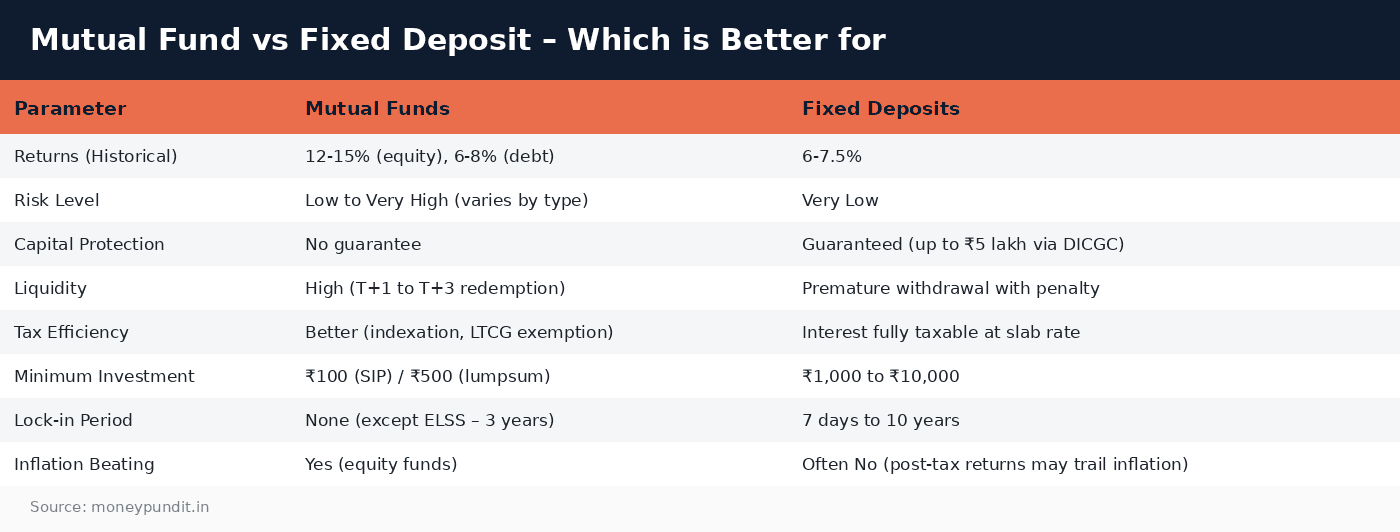
Mutual Fund Vs Fixed Deposit: Mutual Fund vs FD – Quick Comparison
| Parameter | Mutual Funds | Fixed Deposits |
|---|---|---|
| Returns (Historical) | 12-15% (equity), 6-8% (debt) | 6-7.5% |
| Risk Level | Low to Very High (varies by type) | Very Low |
| Capital Protection | No guarantee | Guaranteed (up to ₹5 lakh via DICGC) |
| Liquidity | High (T+1 to T+3 redemption) | Premature withdrawal with penalty |
| Tax Efficiency | Better (indexation, LTCG exemption) | Interest fully taxable at slab rate |
| Minimum Investment | ₹100 (SIP) / ₹500 (lumpsum) | ₹1,000 to ₹10,000 |
| Lock-in Period | None (except ELSS – 3 years) | 7 days to 10 years |
| Inflation Beating | Yes (equity funds) | Often No (post-tax returns may trail inflation) |
Understanding Fixed Deposits
Fixed deposits are the simplest investment product available. You deposit a lump sum with a bank or NBFC for a predetermined period at a fixed interest rate. At maturity, you receive your principal along with the accumulated interest. The certainty of returns and capital protection makes FDs immensely popular. Indian banks hold over ₹200 lakh crore in fixed deposits.
However, FDs have a significant drawback that many investors overlook: the real return after adjusting for taxes and inflation. If your FD earns 7% interest, and you are in the 30% tax bracket, your post-tax return drops to 4.9%. With inflation averaging 5-6% in India, your purchasing power may actually be declining despite earning interest on your FD.
Understanding Mutual Funds
Mutual funds pool money from multiple investors and invest it in a diversified portfolio of stocks, bonds, government securities, or a combination thereof. Professional fund managers make investment decisions based on research and market analysis. The returns are market-linked, meaning they can be higher than FDs in good years but may also be negative during market downturns.
The diversity within mutual funds is vast. Equity mutual funds invest primarily in stocks and have delivered 12-15% CAGR over 10-15 year periods. Debt mutual funds invest in bonds and government securities, offering 6-8% returns with lower volatility. Hybrid funds combine both, offering moderate returns with reduced risk.
When to Choose Mutual Funds
Long-Term Wealth Creation
If your investment horizon is 5 years or more, equity mutual funds have historically outperformed FDs by a significant margin. A ₹10,000 monthly SIP in a diversified equity fund growing at 12% CAGR would grow to approximately ₹23.2 lakh in 10 years. The same amount in an FD at 7% would reach approximately ₹17.3 lakh, a difference of nearly ₹6 lakh.
Tax-Efficient Investing
Mutual funds offer several tax advantages. Equity fund long-term capital gains up to ₹1.25 lakh per year are completely tax-free. Even beyond this threshold, the 12.5% LTCG tax is significantly lower than the 30% tax on FD interest for high-income earners. Debt fund gains with indexation benefit also provide better post-tax returns than FDs for investors in higher tax brackets.
Beating Inflation
The primary purpose of investing is to grow wealth in real terms. After accounting for inflation. Equity mutual funds have consistently beaten inflation over long periods. FDs, especially after taxes, often fail to keep pace with rising prices, making them wealth-preserving at best and wealth-eroding at worst for long-term goals.
When to Choose Fixed Deposits
Short-Term Goals (Less Than 3 Years)
For goals within 1-3 years, like saving for a vacation, wedding, or car down payment, FDs provide certainty. You know exactly how much you will receive at maturity, which is essential for planning. Equity mutual fund returns over such short periods are unpredictable and can even be negative.
Emergency Fund
A portion of your emergency fund can be kept in FDs, especially sweep-in FDs linked to your savings account. While liquid mutual funds also serve this purpose, the guaranteed nature of FDs provides peace of mind during emergencies.
Senior Citizens and Conservative Investors
Retirees who depend on regular income from their investments may prefer FDs for the predictable interest payments. Senior citizen FDs also offer 0.25-0.50% higher interest rates, and the interest income up to ₹50,000 is exempt from TDS under Section 80TTB.
The Balanced Approach
The mutual fund vs FD choice need not be binary. A well-structured portfolio often includes both. Consider allocating your long-term goals (retirement, children’s education, wealth building) to equity and hybrid mutual funds. Keep your short-term goals, emergency fund, and a comfort allocation in FDs. This approach gives you the growth potential of mutual funds while maintaining the security blanket of guaranteed FD returns.
Frequently Asked Questions
Are mutual funds safe compared to FDs?
Mutual funds carry market risk, meaning your capital is not guaranteed. However, debt mutual funds investing in government securities carry very low credit risk. Equity mutual funds, while volatile in the short term, have never delivered negative returns over any 10-year period in Indian market history. FDs up to ₹5 lakh per bank are insured by DICGC, making them virtually risk-free.
Can I get monthly income from mutual funds like FD interest?
Yes, through Systematic Withdrawal Plans (SWP). You can set up a monthly withdrawal from your mutual fund investment, which is more tax-efficient than FD interest. With SWP, only the capital gains portion is taxed, not the entire withdrawn amount, unlike FDs where the full interest is taxable.
What about debt mutual funds vs FDs?
Debt mutual funds can offer similar or slightly better returns than FDs with better tax efficiency, especially for investors in the 20% and 30% tax brackets. However, they carry credit risk (the issuer may default) and interest rate risk (NAV falls when interest rates rise). For investors seeking absolute safety, FDs remain the better choice.
Should I break my FD to invest in mutual funds?
Generally, no. Breaking an FD incurs a premature withdrawal penalty (typically 0.5-1% lower interest rate). Instead, redirect your new investments towards mutual funds while letting existing FDs mature. Once they mature, you can then decide how to reallocate based on your goals and risk appetite.
Fixed deposits and mutual funds aren’t rivals so much as tools for different jobs, FDs protect capital you can’t afford to lose, mutual funds grow capital you can afford to leave alone. Most Indian portfolios end up needing both.
References: Amfiindia.com
Mutual fund vs fixed deposit: Key Takeaways
Key points on mutual fund vs fixed deposit:
- Fixed deposits are the simplest investment product available.
- Mutual funds pool money from multiple investors and invest it in a diversified portfolio of stocks, bonds, government securities, or a combination thereof.
- If your investment horizon is 5 years or more, equity mutual funds have historically outperformed FDs by a significant margin.
Verify the latest mutual fund vs fixed deposit figures with AMFI before you act.