

What is nav mutual in brief: A ₹10 NAV fund and a ₹1,000 NAV fund tracking the same index will earn you the exact same percentage return.
A ₹10 NAV fund and a ₹1,000 NAV fund tracking the same index will earn you the exact same percentage return. NAV is just a price per unit, not a value indicator, which is one of the most persistent misunderstandings among new mutual fund investors. Here’s how NAV is actually calculated and why a ‘cheap’ NAV means nothing.
Net Asset Value (NAV) is the per-unit price of a mutual fund, calculated at the end of each business day. It represents the market value of all securities held by the fund minus liabilities, divided by the total number of units outstanding. Despite being the most visible number for any mutual fund, NAV is also the most misunderstood. Many investors wrongly believe that a fund with a low NAV is “cheaper” or a better buy than one with a high NAV.
How NAV is Calculated
NAV = (Total Market Value of All Securities + Cash and Receivables – Liabilities and Expenses) ÷ Total Number of Outstanding Units
For example, if a mutual fund holds stocks worth ₹500 crore, has cash of ₹20 crore, liabilities of ₹5 crore, and has 10 crore outstanding units, the NAV = (500 + 20 – 5) ÷ 10 = ₹51.50 per unit. NAV is calculated at the close of every trading day based on the closing market prices of all holdings.
Does a Lower NAV Mean Better Value?
This is the biggest misconception in mutual fund investing. A fund with NAV ₹20 is NOT cheaper or better value than a fund with NAV ₹500. NAV simply reflects the fund’s historical starting point and growth over time. Consider this: if you invest ₹1 lakh in a fund with NAV ₹20 (you get 5,000 units) and another fund with NAV ₹500 (you get 200 units), and both grow 15% in a year. Your investment in both becomes ₹1,15,000 regardless of the NAV or number of units. The absolute number of units does not matter; what matters is the percentage return.
A high NAV fund simply means it has been operating for a long time or has performed well historically. A fund launched 20 years ago with NAV ₹10 that is now at ₹800 has delivered excellent returns. A new fund launched today at NAV ₹10 has no track record at all. The high NAV fund is almost certainly the better choice despite being “expensive” by the faulty logic of NAV comparison.
When NAV Matters and When It Doesn’t
| NAV Matters For | NAV Doesn’t Matter For |
|---|---|
| Calculating units purchased with your investment | Comparing two funds’ attractiveness |
| Determining current value of your investment | Deciding which fund to invest in |
| Tracking fund performance over time | Judging if a fund is expensive or cheap |
| Calculating capital gains on redemption | Timing your investment entry point |
NAV and New Fund Offers (NFOs)
New Fund Offers (NFOs) are launched at ₹10 NAV, and many investors prefer NFOs thinking they are getting a “bargain” compared to an existing fund with NAV ₹200 or ₹500. This is completely illogical. The ₹10 NFO has no track record, no proven fund manager performance in that specific mandate, and often invests in the same stocks as existing funds with proven histories. There is zero advantage in buying a fund at ₹10 NAV versus ₹500 NAV. Your future returns depend entirely on what the fund manager does going forward, not the starting NAV.
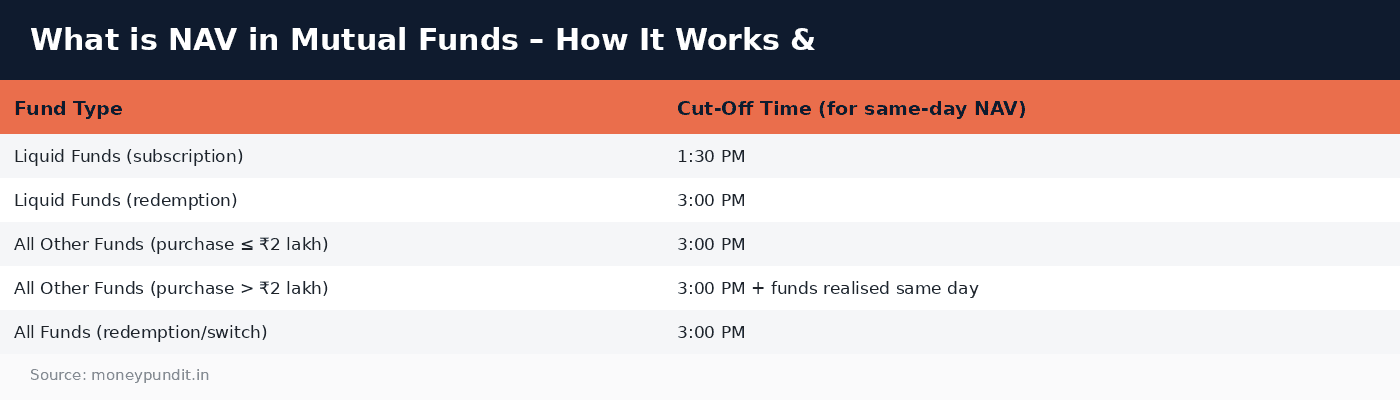
NAV Cut-Off Timings
| Fund Type | Cut-Off Time (for same-day NAV) |
|---|---|
| Liquid Funds (subscription) | 1:30 PM |
| Liquid Funds (redemption) | 3:00 PM |
| All Other Funds (purchase ≤ ₹2 lakh) | 3:00 PM |
| All Other Funds (purchase > ₹2 lakh) | 3:00 PM + funds realised same day |
| All Funds (redemption/switch) | 3:00 PM |
If you submit a purchase request and payment before the cut-off time, you get that day’s NAV. If submitted after cut-off, you get the next business day’s NAV. For SIPs, the NAV allotted is the one on the SIP debit date (assuming the payment is processed by cut-off time).
Impact of Dividends on NAV
When a mutual fund declares a dividend (now called IDCW: Income Distribution cum Capital Withdrawal), the NAV drops by the dividend amount on the ex-dividend date. If a fund has NAV ₹50 and declares ₹5 dividend, the NAV falls to ₹45 post-dividend. You receive the ₹5 as cash but your units are now worth ₹5 less each. This is not free income. It is simply returning your own money to you. Growth option is almost always better for wealth creation, as it avoids this taxation-inefficient distribution and lets the full amount continue compounding.
How to Track NAV
NAV is published daily on the fund house’s website, AMFI website (amfiindia.com), and all mutual fund tracking platforms (Value Research, Morningstar, ET Money, Groww, etc.). For open-ended funds, NAV is published by 9-10 PM on each business day. For liquid and overnight funds, NAV is available by 11 PM. You can also check your fund’s NAV history to see performance over different time periods and calculate your actual returns including SIP-adjusted XIRR.
Frequently Asked Questions
Should I wait for NAV to drop before investing?
Trying to time NAV is equivalent to timing the market: which even professional investors cannot do consistently. Since NAV reflects the underlying portfolio value, a “drop” in NAV means the stocks held have fallen in value. There’s no guarantee they will fall or that you will successfully buy at the bottom. Regular SIP investing removes this timing anxiety entirely.
Why do two similar funds have very different NAVs?
NAVs differ because of launch dates and historical performance. A fund launched in 2005 at ₹10 that delivered 15% CAGR now has NAV ~₹160. Another launched in 2015 at ₹10 with similar 15% CAGR now has NAV ~₹40. Both delivered the same annual returns, the NAV difference is irrelevant for future performance assessment.
What is the difference between NAV and market price of an ETF?
Mutual fund units are always bought/sold at NAV (end-of-day calculated price). ETF units trade on stock exchanges at market prices that fluctuate throughout the day and may differ slightly from the underlying NAV. This difference (premium or discount to NAV) is usually tiny for liquid ETFs but can be significant for thinly-traded ones. This is why mutual funds are simpler for most investors. You always get the fair NAV price.
Does NAV include the expense ratio deduction?
Yes, the expense ratio is already deducted before the NAV is published. When you see a fund’s NAV of ₹100, that is the net value after all fees and expenses have been deducted. This means the returns you calculate from NAV changes are already net-of-fee returns. No further deduction is needed.
A fund’s NAV is just an accounting number, not a valuation signal, two funds tracking the same index perform identically regardless of whether one trades at ₹50 or ₹500 per unit.
References: Amfiindia.com
What is NAV mutual: Key Takeaways
Key points on what is nav mutual:
- NAV = (Total Market Value of All Securities + Cash and Receivables – Liabilities and Expenses) ÷ Total Number of Outstanding Units
- A fund with NAV ₹20 is NOT cheaper or better value than a fund with NAV ₹500.
- New Fund Offers (NFOs) are launched at ₹10 NAV, and many investors prefer NFOs thinking they are getting a “bargain” compared to an existing fund with NAV ₹200 or ₹500.
Verify the latest what is nav mutual figures with AMFI before you act.