
Index funds vs active in brief: With most large-cap fund managers failing to beat the Nifty 50 consistently, passive investing through index funds has become the smart default for many investors.
Over a 5-year period, more than 70% of actively managed large-cap funds in India have failed to beat their benchmark index, a statistic that surprises most investors who assume paying for active management guarantees better returns. Here’s when index funds win, and the specific situations where active management still earns its fee.
The index fund revolution is reshaping Indian investing. With most large-cap fund managers failing to beat the Nifty 50 consistently, passive investing through index funds has become the smart default for many investors. But active funds still dominate in the mid-cap and small-cap space. Here’s a data-driven comparison to help you decide.
What Are Index Funds?
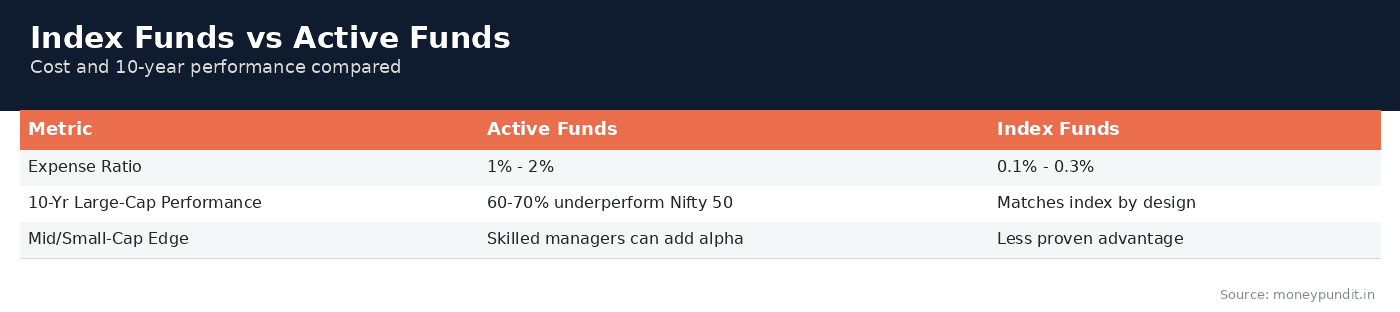
Index funds passively replicate a market index like Nifty 50, Sensex, or Nifty Next 50 by holding all constituent stocks in the same proportion. They don’t try to beat the market, they aim to match it. Their biggest advantage is extremely low expense ratios (0.1-0.3% vs 1-2% for active funds), which compounds into a significant wealth difference over decades.
The Case for Index Funds
Over the last 10 years, approximately 60-70% of active large-cap funds have underperformed the Nifty 50 Total Return Index after accounting for fees. This means most investors picking active large-cap funds would have been better off with a simple index fund. The math is straightforward: lower fees = higher returns when the fund manager doesn’t add enough alpha to justify the cost.
When Active Funds Still Win
In mid-cap and small-cap categories, skilled active fund managers can still add significant value because these segments are less efficiently priced. The best active mid-cap and small-cap funds have outperformed their benchmarks by 3-5% CAGR over 10 years, more than justifying their higher expense ratios. Active management also shines in hybrid and balanced advantage categories.
The Recommended Approach
Use index funds for large-cap exposure (core 50-60% of equity portfolio) and active funds for mid-cap, small-cap, and international exposure (remaining 40-50%). This hybrid approach gives you cost efficiency where it matters most while capturing alpha where skilled managers can deliver it.
Which index fund should I start with?
Start with a Nifty 50 Index Fund from any major AMC (UTI, HDFC, ICICI, SBI) with low tracking error. Once you invest ₹1 lakh+, consider adding a Nifty Next 50 Index Fund for broader market coverage. Together, Nifty 50 + Nifty Next 50 gives you exposure to India’s top 100 companies at minimal cost.
Understanding the Core Difference
Index funds passively replicate a market index like the Nifty 50 or Sensex, holding the same stocks in the same proportions. There is no stock picking, the fund simply mirrors the index. Active funds, on the other hand, employ fund managers and research teams who analyse companies, time their entries and exits, and aim to beat the benchmark through superior stock selection and portfolio construction.
This fundamental difference drives everything else: the costs, the returns, the consistency, and the suitability for different types of investors. In India, the active vs passive debate has intensified since 2020, with index fund AUM growing from roughly ₹10,000 crore to over ₹2 lakh crore, as more investors question whether actively managed funds justify their higher fees.
Cost Comparison: The Expense Ratio Gap
The most tangible difference is cost. Index funds charge 0.1-0.3% annual expense ratio (direct plans), while active funds charge 0.8-1.8%. On a ₹10 lakh portfolio over 20 years at 12% gross return, this 1% difference compounds to approximately ₹6-8 lakh in lost returns, money that stays in your pocket with an index fund. This is not a trivial sum; it can mean the difference between retiring comfortably or needing to work extra years.
Performance Reality Check
SEBI’s semi-annual report consistently shows that 60-70% of active large cap funds fail to beat the Nifty 50 over 5-year rolling periods after expenses. The numbers improve slightly for mid-cap and small-cap categories, where 40-50% of active funds outperform, because smaller companies are less researched and offer more alpha opportunities. The challenge for investors is identifying the winning 30-40% in advance. Past performance is a poor predictor of future results.
However, the top active fund managers in India have generated meaningful alpha. Funds like Parag Parikh Flexi Cap, HDFC Mid-Cap Opportunities, and SBI Small Cap have consistently beaten their benchmarks over 10+ year periods by 2-5% annually. The question is whether you can identify such funds beforehand and stick with them through periods of inevitable underperformance.
When to Choose Index Funds
Index funds are the better choice when: you want guaranteed market-matching returns without the risk of underperformance, you prefer simplicity and lower decision-making burden, you’re investing in the large-cap space where alpha generation is hardest, or you want the lowest possible costs. For most investors building long-term wealth through monthly SIPs, a Nifty 50 index fund as the core holding (40-60% of equity portfolio) is hard to beat.
When Active Funds Make Sense
Active funds justify their fees when: you’re investing in mid-cap or small-cap segments where fund manager skill has more room to add value, you’ve identified a fund with a proven long-term track record and a stable, experienced manager, or you want sector-specific or thematic exposure that no index tracks. A practical “core and satellite” approach works well: 50-60% in index funds for cost-efficient core exposure, and 30-40% in carefully selected active mid-cap or small-cap funds for alpha potential. Track your actual returns using our mutual fund returns calculator and switch to index if your active fund consistently underperforms over 3+ years.
References: Amfiindia.com
Source: amfiindia.com
Index funds vs active: Key Takeaways
Key points on index funds vs active:
- Index funds passively replicate a market index like Nifty 50, Sensex, or Nifty Next 50 by holding all constituent stocks in the same proportion.
- Over the last 10 years, approximately 60-70% of active large-cap funds have underperformed the Nifty 50 Total Return Index after accounting for fees.
- In mid-cap and small-cap categories, skilled active fund managers can still add significant value because these segments are less efficiently priced.
Verify the latest index funds vs active figures with AMFI before you act.