
How to build mutual fund portfolio in brief: Owning 15 different mutual funds doesn’t make a portfolio diversified.
Owning 15 different mutual funds doesn’t make a portfolio diversified. It usually just means owning the same large-cap stocks eight different times through overlapping funds. Here are model portfolios by risk profile, built on actual construction principles rather than fund-count.
Building a well-structured mutual fund portfolio is the most important investment decision you will make, yet most Indian investors end up with a random collection of funds without any coherent strategy. The result is excessive overlap, poor diversification, and suboptimal returns. This guide provides ready-to-use model portfolios for different risk profiles, along with principles to construct your own.
Principles of Mutual Fund Portfolio Construction
Core-Satellite Approach
The most effective portfolio structure uses a core-satellite model. The core (60-70% of portfolio) consists of stable, diversified funds that provide broad market exposure, large cap index funds, flexi cap funds, or balanced advantage funds. The satellite (30-40%) consists of higher-risk, higher-return potential funds, mid cap, small cap, sectoral, or international funds. The core provides stability; the satellites provide additional growth.
Limit the Number of Funds
More funds do not mean better diversification. After 5-7 well-chosen funds, additional funds create excessive overlap (many funds hold the same stocks) and make monitoring difficult. A portfolio of 4-6 funds across different categories provides optimal diversification without redundancy.
Model Portfolios by Risk Profile
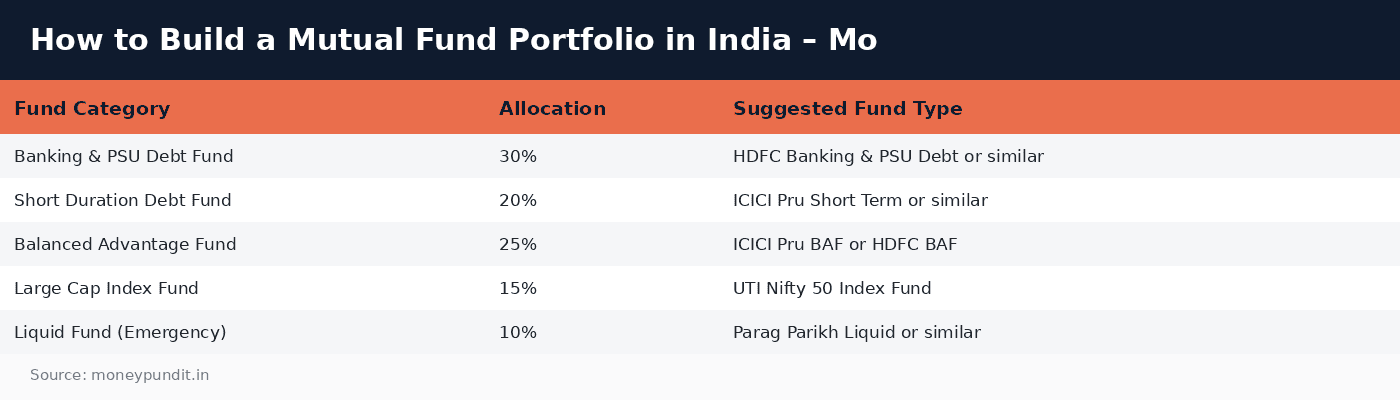
Conservative Portfolio (Low Risk) – Capital Preservation Focus
| Fund Category | Allocation | Suggested Fund Type |
|---|---|---|
| Banking & PSU Debt Fund | 30% | HDFC Banking & PSU Debt or similar |
| Short Duration Debt Fund | 20% | ICICI Pru Short Term or similar |
| Balanced Advantage Fund | 25% | ICICI Pru BAF or HDFC BAF |
| Large Cap Index Fund | 15% | UTI Nifty 50 Index Fund |
| Liquid Fund (Emergency) | 10% | Parag Parikh Liquid or similar |
Expected returns: 7-9% CAGR. Suitable for retirees, short-term goals (1-3 years), or very conservative investors.
Moderate Portfolio (Medium Risk) – Balanced Growth
| Fund Category | Allocation | Suggested Fund Type |
|---|---|---|
| Flexi Cap Fund | 30% | Parag Parikh Flexi Cap or similar |
| Nifty 50 Index Fund | 25% | UTI Nifty 50 Index Fund |
| Mid Cap Fund | 15% | Kotak Emerging Equity or similar |
| Short Duration Debt Fund | 20% | HDFC Short Term Debt or similar |
| International Fund | 10% | Motilal Oswal Nasdaq 100 FOF |
Expected returns: 10-12% CAGR. Suitable for investors with 5-7 year horizon and moderate risk tolerance.
Aggressive Portfolio (High Risk) – Maximum Growth
| Fund Category | Allocation | Suggested Fund Type |
|---|---|---|
| Flexi Cap Fund | 25% | Parag Parikh Flexi Cap or HDFC Flexi Cap |
| Mid Cap Fund | 25% | Motilal Oswal Midcap or Kotak Emerging |
| Small Cap Fund | 20% | Quant Small Cap or Nippon India Small Cap |
| Nifty Next 50 Index Fund | 15% | Motilal Oswal Nifty Next 50 Index |
| International Fund | 15% | Motilal Oswal S&P 500 Index or Nasdaq 100 |
Expected returns: 13-16% CAGR. Suitable for young investors (25-35 years) with 10+ year horizon and high risk tolerance.
Common Portfolio Mistakes
Owning Too Many Similar Funds
Having 3 large cap funds or 4 flexi cap funds from different AMCs does not improve diversification. It increases overlap. Top holdings across these funds are often 60-70% common. Choose one fund per category and move on.
Ignoring Asset Allocation
Your equity-to-debt ratio should match your risk tolerance and time horizon, not market sentiment. Do not go 100% equity when markets are euphoric or 100% debt when markets crash. Maintain your target allocation and rebalance annually if any asset class drifts more than 5-10% from target.
Chasing Past Performance
Investing in last year’s top-performing fund is the most common and most costly mistake. Fund performance is cyclical. Last year’s top quartile fund is often in the bottom quartile next year. Focus on consistent performance across 3, 5, and 10-year periods rather than a single spectacular year.
Rebalancing Your Portfolio
Review your portfolio annually and rebalance if any allocation has drifted more than 5% from your target. If your 60% equity / 40% debt portfolio has become 70% equity / 30% debt after a bull run, sell some equity funds and buy debt funds (or redirect new SIPs) to restore the original allocation. Rebalancing forces you to sell high and buy low. The opposite of what emotions would dictate.
Frequently Asked Questions
Can I build a portfolio with just 2-3 funds?
Absolutely. A minimalist but effective portfolio: one Nifty 50 Index Fund (50-60%) + one Nifty Next 50 or Mid Cap Fund (20-30%) + one Debt Fund (10-20%). This three-fund portfolio gives you broad market coverage at minimal cost and complexity. For even simpler: a single Flexi Cap fund + a Debt fund covers most needs.
Should I include international funds in my portfolio?
A 10-15% allocation to international funds (US index funds like S&P 500 or Nasdaq 100) provides geographic diversification, exposure to global tech leaders, and currency depreciation protection. When the Indian market underperforms, US or global markets may outperform, reducing overall portfolio volatility.
How often should I review my mutual fund portfolio?
Review once every 6-12 months. Check if any fund has consistently underperformed its benchmark and category peers over 2-3 years. Verify that your asset allocation is still aligned with your goals. Avoid checking daily or weekly, frequent monitoring leads to emotional decisions and unnecessary churning.
What is the right equity-to-debt ratio for me?
A common rule of thumb: equity allocation = 100 minus your age. A 30-year-old would have 70% equity and 30% debt. However, this is just a starting point. Your actual allocation should consider your income stability, financial responsibilities, investment horizon, and most importantly, your ability to tolerate seeing 30-40% portfolio drops without panicking.
A good mutual fund portfolio is boring by design: 3 to 5 funds across genuinely different categories, reviewed once a year, not chased every time last quarter’s topper changes.
References: Amfiindia.com
How to build mutual fund portfolio: Key Takeaways
Key points on how to build mutual fund portfolio:
- The most effective portfolio structure uses a core-satellite model.
- Suitable for retirees, short-term goals (1-3 years), or very conservative investors.
- Having 3 large cap funds or 4 flexi cap funds from different AMCs does not improve diversification.
Verify the latest how to build mutual fund portfolio figures with AMFI before you act.