

Best dividend stocks in brief: A high dividend yield can be a sign of a genuinely shareholder-friendly company, or a warning sign that the stock price has crashed and the market doesn’t expect the dividend to last.
A high dividend yield can be a sign of a genuinely shareholder-friendly company, or a warning sign that the stock price has crashed and the market doesn’t expect the dividend to last. Here’s how to tell the difference, and which Indian stocks currently offer sustainable yields.
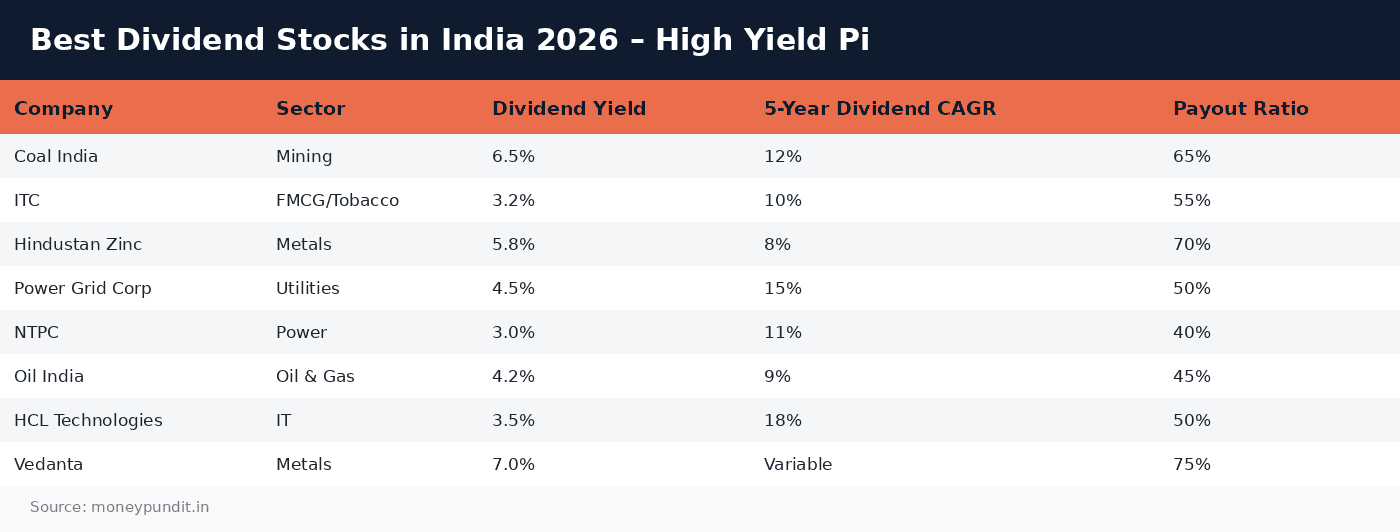
Top Dividend Stocks in India 2026
| Company | Sector | Dividend Yield | 5-Year Dividend CAGR | Payout Ratio |
|---|---|---|---|---|
| Coal India | Mining | 6.5% | 12% | 65% |
| ITC | FMCG/Tobacco | 3.2% | 10% | 55% |
| Hindustan Zinc | Metals | 5.8% | 8% | 70% |
| Power Grid Corp | Utilities | 4.5% | 15% | 50% |
| NTPC | Power | 3.0% | 11% | 40% |
| Oil India | Oil & Gas | 4.2% | 9% | 45% |
| HCL Technologies | IT | 3.5% | 18% | 50% |
| Vedanta | Metals | 7.0% | Variable | 75% |
Dividend yields and data as of April 2026. Yields fluctuate with stock price changes.
Understanding Dividend Yield
Dividend yield is calculated as the annual dividend per share divided by the current stock price, expressed as a percentage. A stock trading at ₹500 that pays ₹20 in annual dividends has a 4% dividend yield. This metric helps compare the income-generating potential of different stocks. However, a very high yield (above 8-10%) can be a warning sign. It may indicate the stock price has fallen sharply due to business problems, and the dividend may be cut in the future.
Key Metrics for Dividend Investing
Dividend Payout Ratio
This is the percentage of net profit paid out as dividends. A payout ratio of 30-60% is generally healthy. It means the company retains enough profit for reinvestment while rewarding shareholders. A ratio consistently above 80% may be unsustainable, as the company is paying out most of its profits and has little buffer for growth or downturns.
Dividend Growth Rate
A company that increases its dividend by 10-15% annually is more valuable than one with a stagnant high yield. Dividend growth indicates business health and management’s confidence in future earnings. Over time, a stock with a 2% yield growing at 15% per year will generate more income than a stock with a static 5% yield.
Free Cash Flow
Dividends should ideally be paid from free cash flow (operating cash flow minus capital expenditure), not from debt or one-time asset sales. Companies with strong, consistent free cash flow can sustain and grow dividends through business cycles. Check whether the company’s free cash flow comfortably covers the dividend payment.
Sector-Wise Dividend Analysis
PSU Stocks
Government-owned companies like Coal India, NTPC, Power Grid, and IOC are among the highest dividend payers. The government mandates PSUs to pay minimum 30% of net profit or 5% of net worth as dividends. While yields are attractive (3-7%), PSU stocks often have limited capital appreciation potential due to government interference, bureaucratic management, and policy uncertainty.
IT Companies
IT majors like TCS, Infosys, HCL Tech, and Wipro have emerged as consistent dividend payers with growing distributions. Their asset-light business models generate strong free cash flow, and limited reinvestment needs allow generous shareholder returns. IT dividends have grown 12-18% annually over the past 5 years, and these companies also do regular buybacks, providing additional returns.
FMCG Companies
Hindustan Unilever, ITC, Nestle India, and Britannia offer moderate yields (1.5-3.5%) but exceptional dividend growth and consistency. These companies have recession-resistant businesses with pricing power, making their dividends highly reliable even during economic downturns.
Dividend Tax in India
Since FY 2020-21, dividends are taxable in the hands of the recipient at their income tax slab rate. TDS of 10% is deducted by the company on dividends exceeding ₹5,000 per year per company. For high-income investors in the 30% tax bracket, the post-tax yield of a 4% dividend stock drops to 2.8%, a significant reduction. This tax change has made growth stocks relatively more attractive compared to dividend stocks for investors in higher tax brackets. If you also hold equity or property investments, compare this against the Capital Gains Tax rules to see which income stream is more tax-efficient for your bracket.
Building a Dividend Portfolio
Diversify Across Sectors
Don’t concentrate all your dividend investments in one sector. A diversified approach, combining PSU energy stocks, IT companies, FMCG companies, and financial stocks, reduces the risk of sector-specific dividend cuts. If oil prices crash and ONGC cuts its dividend, your IT and FMCG holdings continue paying.
Reinvest Dividends (DRIP Strategy)
If you don’t need the income immediately, reinvest dividends to buy more shares. This creates a compounding effect where your share count grows, generating even more dividends in future years. Over 15-20 years, dividend reinvestment can double or triple your total returns compared to simply spending the dividends.
Focus on Dividend Growth, Not Just Yield
A company increasing its dividend by 15% annually will double its payout in 5 years. Starting with a modest 2.5% yield that grows to 5% in 5 years (on your original purchase price) is more valuable than a static 4% yield. Seek companies with a track record of consistent dividend increases and the financial strength to continue growing.
Frequently Asked Questions
Are dividend stocks better than mutual funds?
For most retail investors, equity mutual funds are more practical than building a dividend stock portfolio. Mutual funds provide professional management, instant diversification, and SIP convenience. Dividend stocks require research, monitoring, and larger capital for meaningful diversification. However, experienced investors who enjoy stock analysis may prefer the direct ownership and higher yields of individual dividend stocks.
When is dividend declared and paid?
Companies declare dividends at board meetings, typically alongside quarterly or annual results. The key dates are: declaration date (board announces dividend), record date (you must hold shares by this date to receive the dividend), ex-dividend date (stock trades without dividend rights, usually one day before record date), and payment date (dividend is credited to your bank account, typically within 30 days of record date).
Can dividends be cut or stopped?
Yes, dividends are not guaranteed. Companies can reduce or eliminate dividends during periods of low profitability, cash flow constraints, or when they need to conserve cash for growth. This is why analysing the sustainability of dividends through payout ratios, free cash flow, and debt levels is critical before investing.
References: Amfiindia.com
Best dividend stocks: Key Takeaways
Key points on best dividend stocks:
- Dividend yield is calculated as the annual dividend per share divided by the current stock price, expressed as a percentage.
- A company that increases its dividend by 10-15% annually is more valuable than one with a stagnant high yield.
- Government-owned companies like Coal India, NTPC, Power Grid, and IOC are among the highest dividend payers.
Verify the latest best dividend stocks figures with SEBI before you act.