
Nifty 50 index fund in brief: Picking individual stocks to try to beat the Nifty 50 sounds appealing until you check the numbers.
Picking individual stocks to try to beat the Nifty 50 sounds appealing until you check the numbers. Most retail stock pickers underperform the index they were trying to beat, after accounting for the time and mistakes involved. Here’s an honest comparison of the two approaches.
The debate between index fund investing and individual stock picking is one of the most important investment decisions you will make. Index funds offer simplicity and market returns, while direct stocks offer the potential for outperformance but require significant skill and time. Here is an objective comparison to help you decide.
Nifty 50 Index Fund: Set It and Forget It
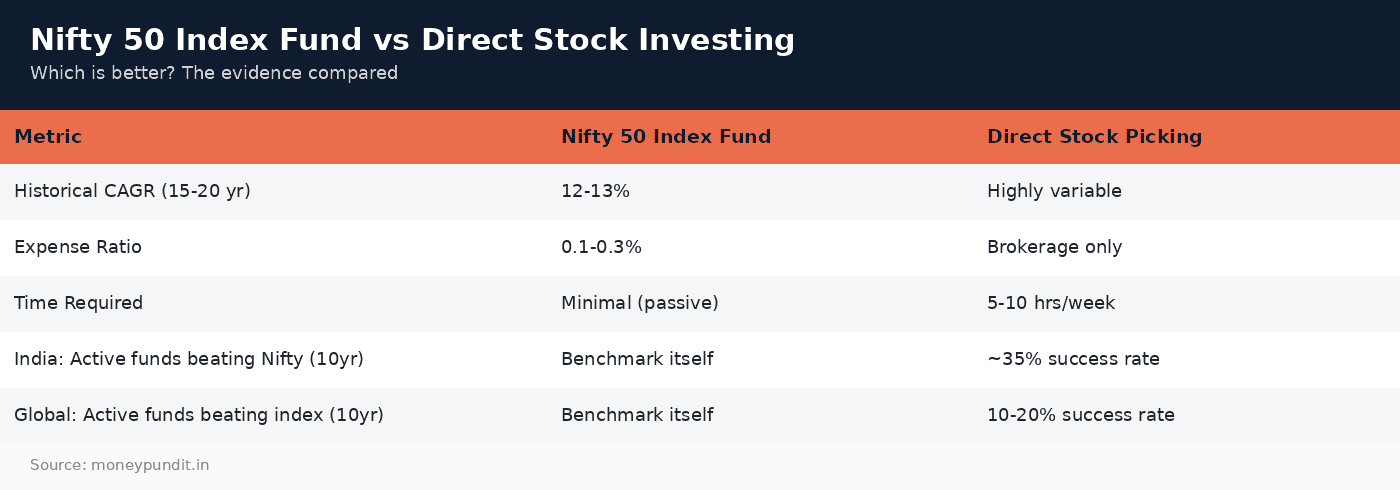
A Nifty 50 index fund automatically invests in India’s 50 largest companies in proportion to their market capitalization. It rebalances automatically when companies enter or exit the index. Historical Nifty 50 returns: approximately 12-13% CAGR over 15-20 year periods. Expense ratios are ultra-low at 0.1-0.3%. You get instant diversification across all major sectors. No research, no stock selection, no timing decisions required. Warren Buffett himself recommends index funds for most investors.
Direct Stock Investing: The Active Approach
Direct stock investing means selecting individual companies to invest in based on your own research and analysis. Potential to significantly outperform the index, top stock pickers have generated 15-25% CAGR. Flexibility to overweight sectors or themes you believe in. No expense ratio (only one-time brokerage on trades). Greater sense of control and engagement with your investments. However, stock picking requires 5-10 hours weekly for research and monitoring, and most individual investors underperform the index over long periods.
The Evidence: Who Wins?
Global data shows that over 10-year periods, 80-90% of actively managed funds underperform their benchmark index. Individual investors fare even worse due to emotional decision-making, information disadvantages, and higher trading costs. In India, the percentage of active funds outperforming Nifty 50 has declined from ~60% to ~35% over the past decade as the market becomes more efficient. If professional fund managers struggle to beat the index, the odds are stacked against individual investors.
The Smart Combination Approach
Many successful investors use a core-satellite strategy: 60-70% in Nifty 50 and Nifty Next 50 index funds (core, reliable market returns) and 30-40% in 5-10 individually selected high-conviction stocks (satellite, potential outperformance). This approach captures market returns while allowing you to express your stock-picking views with a smaller, manageable portion of your portfolio.
Should beginners start with index funds or stocks?
Beginners should absolutely start with index funds. After gaining market experience and learning fundamental analysis over 1-2 years, gradually allocate a small portion (10-20%) to individual stocks. This approach builds knowledge without risking significant capital on uninformed decisions.
What about Nifty Next 50 or Nifty Midcap 150 index funds?
These broader index funds offer higher growth potential with higher volatility. Nifty Next 50 captures the next tier of large companies. Nifty Midcap 150 captures mid-sized growth companies. A combination of Nifty 50 (60%) + Nifty Next 50 (25%) + Nifty Midcap 150 (15%) provides excellent diversified equity exposure through pure index investing.
Why Index Funds Have Gained Massive Popularity
Nifty 50 index funds simply replicate the Nifty 50 index: India’s benchmark comprising the 50 largest companies by market capitalisation, including Reliance, TCS, HDFC Bank, Infosys, and ITC. By investing in one fund, you get instant diversification across 50 blue-chip stocks spanning 13 sectors. The Nifty 50 has delivered approximately 12-13% CAGR over the past 20 years, outperforming the majority of actively managed large-cap mutual funds after accounting for their higher expense ratios.
The key advantages: ultra-low expense ratios (0.1-0.2% for index funds vs 1-1.5% for active funds), no fund manager risk (the index methodology is rule-based), transparent holdings (you always know exactly what you own), and no underperformance risk relative to the benchmark. SEBI’s 2018 mandate requiring large-cap funds to invest 80% in the top 100 stocks has made it increasingly difficult for active fund managers to beat the index, further strengthening the case for index investing.
When Direct Stock Investing Makes Sense
Direct stock investing offers the potential for significantly higher returns. Individual stocks can deliver 20-50%+ annually, something an index fund by design cannot. It also provides complete control over your portfolio: you choose which companies to own, when to buy and sell, and can concentrate in high-conviction ideas. There are no annual expense ratios eating into your returns (only brokerage on transactions).
However, direct investing demands substantial time, knowledge, and emotional discipline. You need to understand fundamental analysis, read annual reports, track quarterly results, monitor industry developments, and make buy/sell decisions without emotional bias. Research shows that over 80% of individual stock traders underperform the index over 5-year periods, the minority who outperform tend to be those who treat investing as a serious discipline rather than casual stock-picking.
The Practical Approach: Core-Satellite Strategy
Most successful investors combine both approaches using a core-satellite strategy. The “core” (60-80% of equity allocation) goes into Nifty 50 or broader index funds through SIPs: this ensures market-matching returns with minimal effort. The “satellite” (20-40%) is allocated to direct stocks based on your own research and conviction. This is where you aim to outperform.
Start with 100% index funds if you’re a beginner and gradually introduce direct stocks as you build knowledge and experience. Never allocate more than 5-10% of your total portfolio to any single stock. Use our SIP Calculator to plan your index fund investments, and the CAGR Calculator to track the performance of your direct stock picks against the Nifty 50 benchmark. If your direct stock portfolio consistently underperforms the index over 2-3 years, consider increasing your index fund allocation, there’s no shame in matching the market, especially when most professionals can’t beat it.
References: Amfiindia.com
Source: amfiindia.com
Frequently Asked Questions
Is a Nifty 50 index fund better than picking stocks?
For most investors, yes. An index fund gives low-cost diversification and removes stock-selection risk, and many active managers struggle to beat the index consistently over long periods.
What are the risks of a Nifty 50 index fund?
It carries market risk: the fund falls when the index falls, and it is concentrated in 50 large companies and a few sectors.
How much does it cost to invest in a Nifty 50 index fund?
Direct plans typically have very low expense ratios, often well under 0.5%. Check the current expense ratio and tracking error of the scheme before investing.
Nifty 50 index fund: Key Takeaways
Key points on nifty 50 index fund:
- A Nifty 50 index fund automatically invests in India’s 50 largest companies in proportion to their market capitalization.
- Direct stock investing means selecting individual companies to invest in based on your own research and analysis.
- Global data shows that over 10-year periods, 80-90% of actively managed funds underperform their benchmark index.
Verify the latest nifty 50 index fund figures with AMFI before you act.