

Hybrid mutual funds in brief: Conservative hybrid funds maintain 75-90% in debt and 10-25% in equity, suitable for low-risk investors seeking modest growth.
Hybrid mutual funds invest in a mix of equity and debt instruments, offering the growth potential of stocks with the stability of bonds. These funds are ideal for investors who want a single-fund solution for diversified investing without managing multiple fund categories.
Types of Hybrid Funds
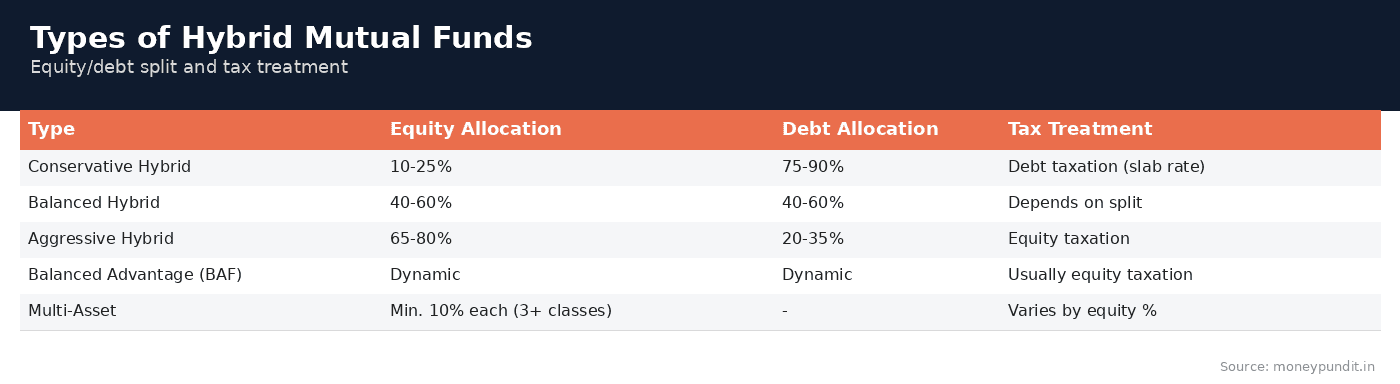
Conservative hybrid funds maintain 75-90% in debt and 10-25% in equity, suitable for low-risk investors seeking modest growth. Balanced hybrid funds invest 40-60% each in equity and debt, not allowed to use arbitrage. Aggressive hybrid funds keep 65-80% in equity and 20-35% in debt, qualifying for equity taxation. Dynamic asset allocation or balanced advantage funds (BAFs) dynamically shift between equity and debt based on market valuations, typically using models like P/E ratio or P/B ratio to determine allocation. Multi-asset funds invest in at least three asset classes (equity, debt, gold/commodities) with minimum 10% in each.
Balanced Advantage Funds: The Smart Choice
BAFs have gained immense popularity in India, with combined AUM exceeding ₹2.5 lakh crore. Funds like ICICI Prudential Balanced Advantage, HDFC Balanced Advantage, and Edelweiss Balanced Advantage use proprietary models to automatically increase equity when markets are cheap and shift to debt when markets are expensive. This automatic rebalancing removes emotional decision-making from investing.
Tax Treatment of Hybrid Funds
Taxation depends on the equity-debt split. Funds with 65% or more equity allocation (aggressive hybrid, most BAFs) get equity taxation: 12.5% LTCG above ₹1.25 lakh for holdings over 1 year, and 20% STCG for holdings under 1 year. Funds with less than 65% equity (conservative hybrid) follow debt taxation at slab rates regardless of holding period.
Who Should Invest in Hybrid Funds
First-time investors who find pure equity too volatile, retirees wanting growth with stability, investors looking for automatic rebalancing, those saving for medium-term goals of 3-5 years, and anyone who wants a simplified one-fund portfolio. SIP in a balanced advantage fund is an excellent starting point for new investors entering the market.
Are hybrid funds safe?
Hybrid funds are less volatile than pure equity funds but not risk-free. The debt component provides cushioning during market falls, but NAVs can still decline in severe downturns.
Which is better: balanced advantage fund or aggressive hybrid fund?
BAFs automatically adjust equity allocation based on valuations, making them better for uncertain markets. Aggressive hybrid funds maintain a fixed high-equity allocation, suitable for investors with higher risk tolerance and longer time horizons.
Types of Hybrid Mutual Funds in India
SEBI classifies hybrid funds into six categories based on their equity-debt allocation. Aggressive Hybrid Funds (65-80% equity, 20-35% debt) are the most popular, offering equity-like returns with automatic rebalancing and equity tax treatment. Conservative Hybrid Funds (10-25% equity, 75-90% debt) suit risk-averse investors wanting a slight equity kicker over pure debt. Balanced Advantage Funds dynamically shift between equity and debt based on market valuations, the most sophisticated category that automates the buy-low-sell-high principle.
Multi-Asset Allocation Funds must invest minimum 10% each in at least three asset classes (typically equity, debt, and gold), providing the broadest diversification. Equity Savings Funds use a combination of equity, arbitrage, and debt to deliver moderate returns with very low volatility. Arbitrage Funds exploit price differences between cash and futures markets: practically risk-free and tax-efficient, returning 6-7.5% with equity fund taxation.
Why Hybrid Funds Are Perfect for New Investors
If you’re transitioning from fixed deposits to mutual funds, hybrid funds offer a comfortable middle ground. The debt component cushions against sharp equity market falls, while the equity component delivers growth that beats inflation. During the 2020 market crash, aggressive hybrid funds fell only 20-25% compared to pure equity funds falling 35-40%, and they recovered faster because the debt portion provided stable returns throughout.
Hybrid funds also provide built-in rebalancing that individual investors rarely execute on their own. When equity rises too much, the fund manager sells equity and buys debt; when equity falls, they sell debt and buy equity. This automatic “buy low, sell high” across asset classes happens inside the fund without triggering capital gains tax, a significant advantage over managing separate equity and debt funds yourself.
How to Choose the Right Hybrid Category
Match the category to your risk tolerance and time horizon. For 3-5 year goals (car, vacation, wedding): balanced advantage or equity savings funds. For 5-7+ year goals with moderate risk tolerance: aggressive hybrid funds. For retirement income: balanced advantage funds work excellently for SWP withdrawals. For parking surplus cash while deciding on equity: arbitrage funds (beat savings account returns with equity taxation). Start a SIP in your chosen category and let the fund handle the asset allocation decisions for you.
Key Principle: Successful long-term investing is about consistency, not complexity. Automate your investments through SIPs, review periodically rather than reacting to daily market news, and increase contributions with every salary hike. Use our SIP Calculator to set realistic targets and track your wealth-building journey over time.
Hybrid funds trade some upside for a smoother ride: a reasonable compromise if market swings keep you from staying invested through a pure-equity fund’s worst months.
References: Amfiindia.com
Source: amfiindia.com
Hybrid mutual funds: Key Takeaways
Key points on hybrid mutual funds:
- Balanced hybrid funds invest 40-60% each in equity and debt, not allowed to use arbitrage.
- BAFs have gained immense popularity in India, with combined AUM exceeding ₹2.5 lakh crore.
- Funds with less than 65% equity (conservative hybrid) follow debt taxation at slab rates regardless of holding period.
Verify the latest hybrid mutual funds figures with AMFI before you act.