

Senior citizen savings scheme in brief: With quarterly interest payouts, 80C tax benefits, and sovereign guarantee, SCSS is a cornerstone of retirement income planning in India.
Senior Citizens Savings Scheme pays one of the highest guaranteed interest rates of any government-backed instrument, with interest paid out quarterly, a genuine income stream rather than a lump sum at maturity, which matters a lot for retirees living off their savings. Here’s how SCSS actually works.
Compare SCSS with bank deposits in our senior citizen FD rates for October 2026.
The Senior Citizen Savings Scheme (SCSS) is a government-backed investment designed specifically for retirees, offering one of the highest guaranteed interest rates among post-retirement savings options. With quarterly interest payouts, 80C tax benefits, and sovereign guarantee, SCSS is a cornerstone of retirement income planning in India.
SCSS Key Features
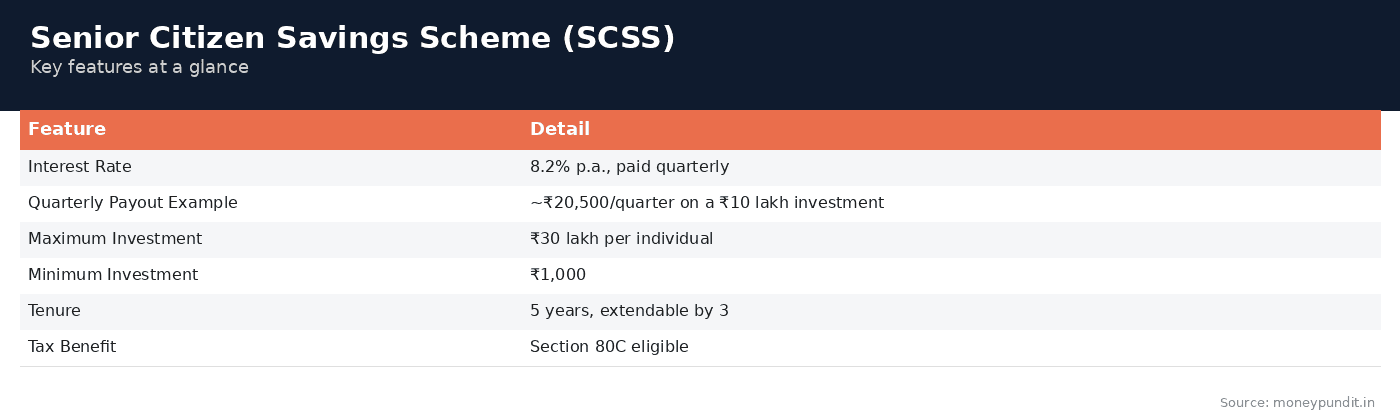
Open to Indian residents aged 60 and above (55 for those who have taken voluntary retirement). Current interest rate is 8.2% per annum, paid quarterly, this translates to approximately ₹20,500 per quarter on ₹10 lakh investment. Maximum investment limit is ₹30 lakh per individual (increased from ₹15 lakh in 2023). Minimum investment is ₹1,000. Account tenure is 5 years, extendable once for 3 years. Deposits qualify for Section 80C deduction. Available at post offices and authorized banks.
Why SCSS is the Best Retirement Investment
The 8.2% rate is the highest among government guaranteed instruments. Quarterly payouts provide regular income matching pensioner needs. Government backing means zero credit risk. 80C tax benefit reduces effective cost. Compared to FDs (6.5-7.5%), PPF (7.1% but 15-year lock-in), and RBI bonds (7.75% but no premature withdrawal), SCSS offers the best combination of high rate, regular income, and reasonable liquidity for retirees.
Tax Implications for SCSS
SCSS interest is fully taxable at your income slab rate. TDS of 10% is deducted if annual interest exceeds ₹50,000 (the enhanced threshold for senior citizens under 80TTB). If you are in the 20% or 30% bracket, SCSS returns are significantly reduced after tax. To minimize this, senior citizens can submit Form 15H to avoid TDS if their total income is below the taxable threshold (₹3 lakh under old regime, ₹3.5 lakh under new regime with enhanced limit for senior citizens).
SCSS Investment Strategy for Retirees
Invest the maximum ₹30 lakh for both spouses if both are eligible, total ₹60 lakh in SCSS earning ₹4.92 lakh annual interest (₹41,000 monthly). Combine with PMVVY (Pradhan Mantri Vaya Vandana Yojana) if still available, and RBI Floating Rate Bonds for diversified guaranteed income. Stagger investments to take advantage of potential rate revisions across quarters. Reinvest interest income into liquid funds or FDs for additional growth.
Can I withdraw SCSS before 5 years?
Premature withdrawal is allowed after 1 year with 1.5% penalty on the deposit amount. After 2 years, the penalty reduces to 1%. Before 1 year, withdrawal is not permitted. These penalties are relatively mild, preserving reasonable liquidity for retirees.
SCSS Features and Current Interest Rate
The Senior Citizen Savings Scheme offers 8.2% annual interest (as of 2026), paid quarterly: the highest among all government-backed fixed-income instruments. The scheme is available to individuals aged 60 and above (55 for retired defence/VRS personnel), with a minimum investment of ₹1,000 and maximum of ₹30 lakh (per individual, ₹60 lakh for a couple investing separately). The maturity period is 5 years, extendable by 3 years. Investment qualifies for Section 80C deduction up to ₹1.5 lakh.
Why SCSS Is the Best Choice for Retirees
For retirees seeking regular income, SCSS outperforms all alternatives in the fixed-income category. Bank FDs for senior citizens offer 7-8%, but interest is paid at maturity or annually: SCSS pays quarterly, better matching monthly expense needs. PPF offers 7.1% but has a 15-year lock-in with no quarterly payouts. Post office Monthly Income Scheme (MIS) pays monthly but at only 7.4%. SCSS at 8.2% quarterly combines the highest rate with regular income.
For a senior citizen investing the maximum ₹30 lakh in SCSS, the quarterly interest is approximately ₹61,500 (before TDS), roughly ₹20,500 per month. Combined with a pension, this creates a predictable income stream for essential expenses while the principal remains safe and government-guaranteed.
Tax Treatment and TDS on SCSS
SCSS interest is fully taxable at your income tax slab rate. TDS is deducted at 10% if annual interest exceeds ₹50,000 (the higher threshold for senior citizens). If your total income including SCSS interest is below the taxable limit (₹3 lakh under old regime, ₹5 lakh effective under new regime after rebate), submit Form 15H to the post office/bank to avoid TDS deduction.
Despite the tax on interest, SCSS remains attractive because the pre-tax rate of 8.2% is high enough that even after 20-30% tax, the post-tax return (5.7-6.6%) exceeds the post-tax return on most bank FDs. Senior citizens should also claim the Section 80C deduction on the SCSS investment, the Section 80TTB deduction of ₹50,000 on interest income, and use our income tax calculator to optimise their tax outgo in retirement.
SCSS in Your Overall Retirement Portfolio
SCSS should form the safe-income anchor of a retirement portfolio. A recommended allocation: ₹30 lakh in SCSS (guaranteed income), ₹15 lakh in PPF (tax-free growth), and the remainder in a combination of balanced advantage funds (for growth + SWP income) and short-duration debt funds (for liquidity). This provides a mix of guaranteed and market-linked income that beats inflation over a 20-25 year retirement.
References: Rbi.org.in
Source: rbi.org.in
Senior citizen savings scheme: Key Takeaways
Key points on senior citizen savings scheme:
- Current interest rate is 8.2% per annum, paid quarterly, this translates to approximately ₹20,500 per quarter on ₹10 lakh investment.
- The 8.2% rate is the highest among government guaranteed instruments.
- TDS of 10% is deducted if annual interest exceeds ₹50,000 (the enhanced threshold for senior citizens under 80TTB).
Verify the latest senior citizen savings scheme figures with RBI before you act.