

Atal pension yojana apy in brief: Atal Pension Yojana (APY) is a government-backed pension scheme aimed at providing guaranteed monthly pension to workers in the unorganised sector after they turn 60.
Atal Pension Yojana guarantees a fixed monthly pension of up to ₹5,000 for life, backed by the government, for a contribution as low as a few hundred rupees a month, but enrollment closes once you cross age 40, and income-tax payers were barred from joining starting FY2022-23. Here’s how it works and who’s still eligible.
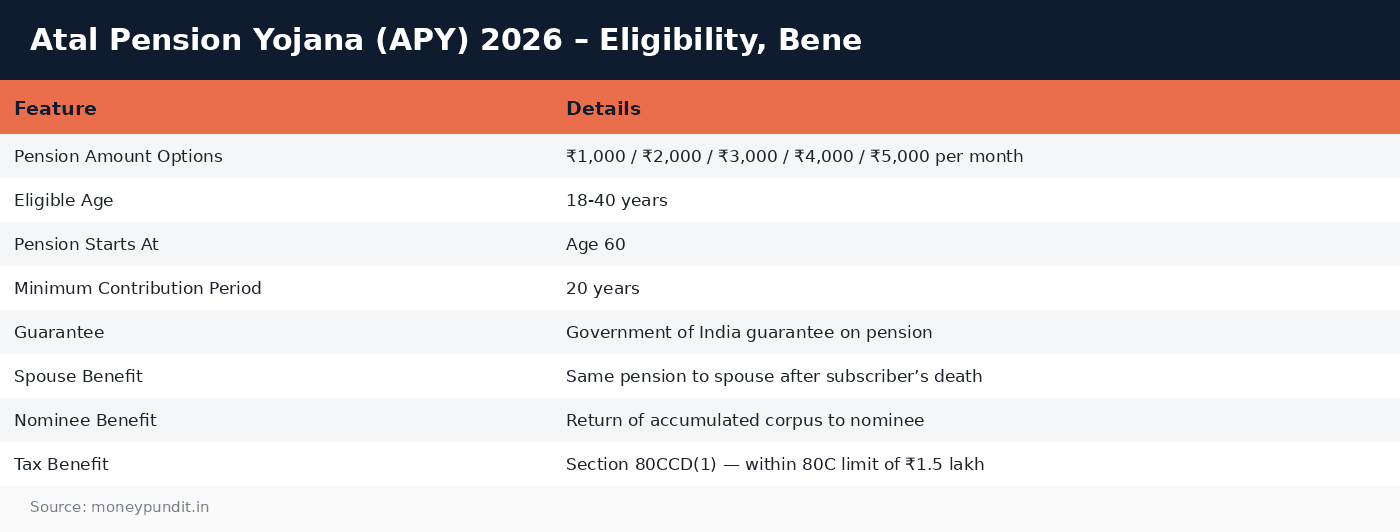
Atal Pension Yojana (APY) is a government-backed pension scheme aimed at providing guaranteed monthly pension to workers in the unorganised sector after they turn 60. Launched in 2015, APY offers fixed pension amounts of ₹1,000 to ₹5,000 per month at retirement, with the contribution amount depending on your age at enrolment. With over 5.5 crore subscribers, APY has become one of India’s most popular social security schemes.
APY Key Features
| Feature | Details |
|---|---|
| Pension Amount Options | ₹1,000 / ₹2,000 / ₹3,000 / ₹4,000 / ₹5,000 per month |
| Eligible Age | 18-40 years |
| Pension Starts At | Age 60 |
| Minimum Contribution Period | 20 years |
| Guarantee | Government of India guarantee on pension |
| Spouse Benefit | Same pension to spouse after subscriber’s death |
| Nominee Benefit | Return of accumulated corpus to nominee |
| Tax Benefit | Section 80CCD(1): within 80C limit of ₹1.5 lakh |
Monthly Contribution Chart
| Entry Age | ₹1,000/month pension | ₹2,000/month pension | ₹3,000/month pension | ₹5,000/month pension |
|---|---|---|---|---|
| 18 years | ₹42 | ₹84 | ₹126 | ₹210 |
| 25 years | ₹76 | ₹151 | ₹226 | ₹376 |
| 30 years | ₹116 | ₹231 | ₹347 | ₹577 |
| 35 years | ₹181 | ₹362 | ₹543 | ₹902 |
| 40 years | ₹291 | ₹582 | ₹873 | ₹1,454 |
The earlier you enrol, the lower your monthly contribution. An 18-year-old pays just ₹210/month for the maximum ₹5,000/month pension, while a 40-year-old pays ₹1,454/month for the same benefit. This is because the younger subscriber has 42 years of contribution and compounding, while the 40-year-old has only 20 years.
How APY Works
Your monthly contributions are invested by the Pension Fund Regulatory and Development Authority (PFRDA) in a mix of government securities and bonds. At age 60, you start receiving the chosen pension amount every month for life. After your death, your spouse receives the same pension amount for their lifetime. After both the subscriber and spouse pass away, the accumulated corpus (approximately ₹1.7 lakh for ₹1,000 pension to ₹8.5 lakh for ₹5,000 pension) is returned to the nominee.
Eligibility Criteria
Any Indian citizen between 18-40 years who has a savings bank account can enrol in APY. You must not be an income tax payer (this condition was added from October 2022: existing subscribers who later become taxpayers can continue but new tax-paying individuals cannot join). Each individual can have only one APY account. NRIs and existing government pension scheme members are not eligible.
How to Enrol in APY
Through Bank
Visit any bank where you have a savings account. Fill the APY registration form, choose your pension amount, and provide Aadhaar and mobile number. The bank sets up auto-debit for monthly contributions from your savings account. Most major banks including SBI, PNB, Bank of Baroda, and private banks offer APY registration at branches.
Online Enrolment
Several banks offer APY registration through net banking and mobile apps. SBI YONO, Bank of Baroda’s mobile app, and other platforms allow you to complete the entire registration digitally using Aadhaar OTP verification. The process takes 10-15 minutes.
APY vs NPS: Which is Better?
| Feature | APY | NPS |
|---|---|---|
| Maximum Pension | ₹5,000/month (fixed) | Market-linked (potentially much higher) |
| Guaranteed Returns | Yes (govt. guarantee) | No (market-linked) |
| Contribution Flexibility | Fixed based on pension chosen | Any amount ≥ ₹1,000/year |
| Maximum Age Limit | 40 years to join | 65 years to join |
| Tax Benefit | Within 80C limit | Additional ₹50,000 under 80CCD(1B) |
| Best For | Low-income, unorganised sector | Salaried/self-employed, higher income |
APY is ideal for workers in the unorganised sector who want guaranteed pension without market risk. NPS is better for salaried and self-employed individuals who can tolerate market fluctuations and want a potentially larger retirement corpus. If you can afford it, subscribing to both APY and NPS provides a base guaranteed pension plus market-linked growth.
Premature Exit and Default Rules
Voluntary Exit Before 60
Voluntary exit before age 60 is allowed only under exceptional circumstances. In such cases, only the accumulated contributions with actual returns (net of charges) are refunded, not the guaranteed pension corpus. The exit amount may be less than total contributions in unfavorable market conditions.
Death Before 60
If the subscriber dies before turning 60, the spouse can either continue contributing to receive the pension at 60, or exit and receive the accumulated corpus. If there is no spouse, the nominee receives the accumulated corpus.
Default in Contributions
If you miss contributions, penalty charges apply: ₹1/month for contributions up to ₹100, ₹2/month for ₹101-500, ₹5/month for ₹501-1000, and ₹10/month for contributions above ₹1,000. After 6 consecutive months of non-payment, the account is frozen. After 12 months, it is deactivated. After 24 months, it is closed and only the accumulated amount (minus charges) is returned.
Frequently Asked Questions
Can I increase my pension amount later?
Yes, you can switch to a higher or lower pension slab once per year. If you initially chose ₹1,000/month pension and later want to upgrade to ₹5,000/month, you can do so by contacting your bank. Your monthly contribution will be recalculated based on your current age and the new pension amount.
Is APY worth it for salaried employees?
For salaried employees already contributing to EPF and NPS, APY’s ₹5,000/month maximum pension is modest. However, the guaranteed nature and low cost make it a useful addition to your retirement safety net. At ₹210-₹1,454/month (depending on age), it is an affordable guaranteed pension that supplements your market-linked investments.
What happens to the pension after both subscriber and spouse die?
The accumulated corpus at the time of the second death (subscriber or spouse, whoever dies later) is returned to the nominee. For the ₹5,000/month pension plan, this corpus is approximately ₹8.5 lakh. The pension payments stop after both deaths, and the corpus is paid as a lumpsum to the nominee.
Can I have both APY and EPF?
Yes, you can have both APY and EPF simultaneously. They are independent schemes managed by different authorities (PFRDA for APY, EPFO for EPF). However, remember that APY is now restricted to non-income-tax payers for new enrolments, so many EPF subscribers may not be eligible to join APY going forward.
Atal pension yojana apy: Key Takeaways
Key points on atal pension yojana apy:
- An 18-year-old pays just ₹210/month for the maximum ₹5,000/month pension, while a 40-year-old pays ₹1,454/month for the same benefit.
- Your monthly contributions are invested by the Pension Fund Regulatory and Development Authority (PFRDA) in a mix of government securities and bonds.
- Any Indian citizen between 18-40 years who has a savings bank account can enrol in APY.
Verify the latest atal pension yojana apy figures with NPS Trust before you act.