
Intraday trading in brief: Roughly 9 out of 10 individual intraday traders in India lose money in a given year, according to SEBI’s own study, yet the promise of quick profits keeps pulling new traders in every market cycle.
Roughly 9 out of 10 individual intraday traders in India lose money in a given year, according to SEBI’s own study, yet the promise of quick profits keeps pulling new traders in every market cycle. Here’s an honest comparison of intraday trading against long-term investing, and why the math favors patience.
Intraday trading and long-term investing are fundamentally different approaches to the stock market, each with distinct risk profiles, skill requirements, and tax implications. Understanding the reality of both helps you choose the approach that matches your goals, temperament, and available time.
Intraday Trading: High Frequency, High Risk
Intraday trading involves buying and selling stocks within the same trading day, aiming to profit from short-term price movements. Positions are squared off before market close. You never hold stocks overnight. Traders use technical analysis, chart patterns, and momentum indicators to make rapid decisions. Leverage (margin trading) allows you to trade 5-10x your capital, amplifying both profits and losses. Trading requires full attention during market hours (9:15 AM – 3:30 PM) and significant emotional discipline.
The Uncomfortable Truth About Day Trading
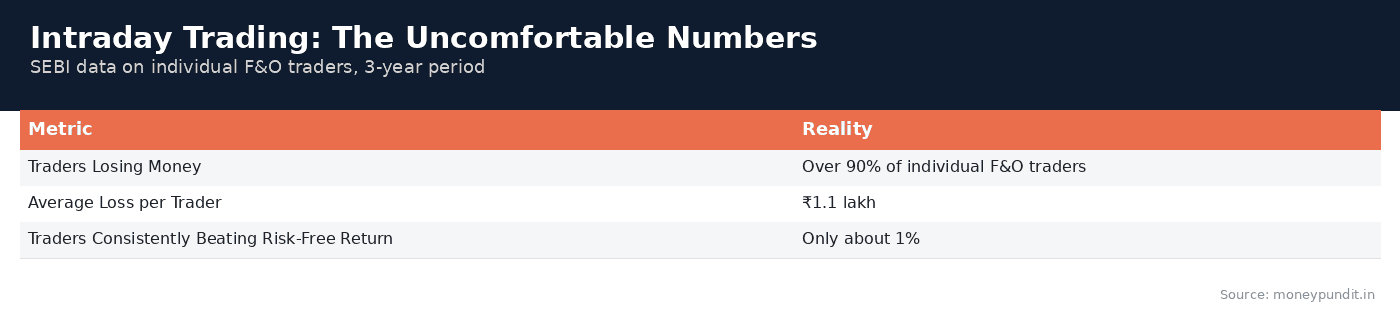
SEBI data reveals that over 90% of individual F&O traders in India lost money over a 3-year period. The average loss was ₹1.1 lakh per trader. Only 1% of traders consistently made more than the risk-free rate of return. Transaction costs (brokerage, STT, GST, slippage) eat into margins significantly. The psychological toll of watching screens all day and making rapid decisions under pressure leads to burnout and poor judgment over time.
Long-Term Investing: Slow and Steady
Long-term investing means buying quality stocks or mutual funds and holding them for years or decades. Returns come from company earnings growth and compounding rather than short-term price fluctuations. Requires initial research to select good businesses but minimal ongoing time (a few hours per month for portfolio review). Historical data shows that staying invested in Nifty 50 for any 10-year period has never resulted in a loss. Time in the market beats timing the market.
Tax Implications
Intraday profits are classified as speculative business income and taxed at your slab rate. F&O profits are non-speculative business income, also taxed at slab rate. Both require ITR-3 filing with detailed transaction records. Long-term stock investments (held over 12 months) enjoy 12.5% LTCG tax with ₹1.25 lakh annual exemption, significantly more tax-efficient. The tax difference alone makes long-term investing 10-15% more profitable on pre-tax returns.
The Recommended Path
For 90% of people, long-term investing through SIPs in index funds and carefully selected stocks is the appropriate approach. If you are interested in trading, start with a small percentage (5-10%) of your portfolio while keeping the majority in long-term investments. Paper trade for 3-6 months before using real money. Never trade with money you need or borrowed funds. Treat trading as a skill that takes years to develop, not a get-rich-quick scheme.
Can I be both a trader and an investor?
Yes: many successful market participants maintain a long-term investment portfolio (core, 80-90%) alongside a smaller trading account (satellite, 10-20%). Keep these separate to avoid letting trading emotions affect investment decisions. Different demat accounts for each approach can help maintain this discipline.
The Fundamental Difference in Approach
Intraday trading and long-term investing are completely different activities that require different skills, tools, and temperaments. Intraday traders buy and sell stocks within the same trading day, profiting from small price movements. They never hold positions overnight. Long-term investors buy quality stocks or mutual funds and hold for years, benefiting from business growth and compounding. Data consistently shows that over 90% of intraday traders lose money, while the majority of long-term investors in diversified portfolios generate positive returns over 7+ year horizons.
The risk profiles are drastically different. Intraday trading with margin (borrowed money) amplifies both gains and losses, a 2% adverse move with 5x margin means a 10% loss on your capital in a single day. Long-term investing in a diversified equity portfolio has never delivered negative returns over any 10-year period in Indian market history. The Nifty 50 has delivered ~12-13% CAGR over 20 years, turning ₹10 lakh into ₹90+ lakh without any active trading.
What Intraday Trading Actually Requires
Successful intraday trading demands: full-time attention during market hours (9:15 AM – 3:30 PM), strong knowledge of technical analysis (chart patterns, indicators, volume analysis), fast and reliable internet with a robust trading platform, strict risk management (never risking more than 1-2% of capital per trade), and, critically, emotional discipline to cut losses quickly without hesitation.
The costs of intraday trading add up: brokerage (₹20 per order × 10-20 trades daily = ₹200-₹400/day), STT and GST, and the opportunity cost of your time. To merely break even after costs, you need to generate ₹8,000-₹10,000 monthly in profits, that’s the minimum before you earn anything. Most beginners underestimate these friction costs and the psychological toll of watching money fluctuate in real-time.
The Case for Long-Term Investing
Long-term investing works because you’re partnering with businesses that grow over time. When you buy shares of a well-run company, you benefit from revenue growth, profit expansion, dividend payments, and share buybacks, none of which matter in intraday trading where you’re simply betting on price direction. Warren Buffett’s famous quote applies: “The stock market is a device for transferring money from the impatient to the patient.”
For most people, the optimal strategy is clear: invest through monthly SIPs in diversified mutual funds or index funds, continue working at your career (which likely generates far more reliable income than trading), and let compounding build wealth over 15-25 years. If you’re still interested in trading after understanding the risks, allocate no more than 5-10% of your investable capital to it, treat it as high-risk speculation, not a wealth-building strategy. Track your trading returns honestly using our CAGR Calculator and compare against a simple Nifty 50 SIP: if the index beats your trading returns (which is statistically likely), redirect that capital into long-term investments.
References: Amfiindia.com
Source: amfiindia.com
Intraday trading: Key Takeaways
Key points on intraday trading:
- Intraday trading involves buying and selling stocks within the same trading day, aiming to profit from short-term price movements.
- SEBI data reveals that over 90% of individual F&O traders in India lost money over a 3-year period.
- Long-term investing means buying quality stocks or mutual funds and holding them for years or decades.
Verify the latest intraday trading figures with SEBI before you act.