
Fd vs debt mutual funds in brief: If you’re parking money for 1–5 years, understanding the difference can meaningfully improve your after-tax returns.
An FD locks in a fixed rate for the full tenure regardless of what happens to interest rates later, while a debt mutual fund’s return moves with the market, a difference that matters a lot depending on whether rates are rising or falling when you invest. Here’s when each one wins.
Fixed Deposits are India’s most beloved investment. Safe, predictable, and backed by the bank. Debt mutual funds are their less-understood cousin, slightly more complex, but potentially more efficient. If you’re parking money for 1–5 years, understanding the difference can meaningfully improve your after-tax returns.
The FD Case
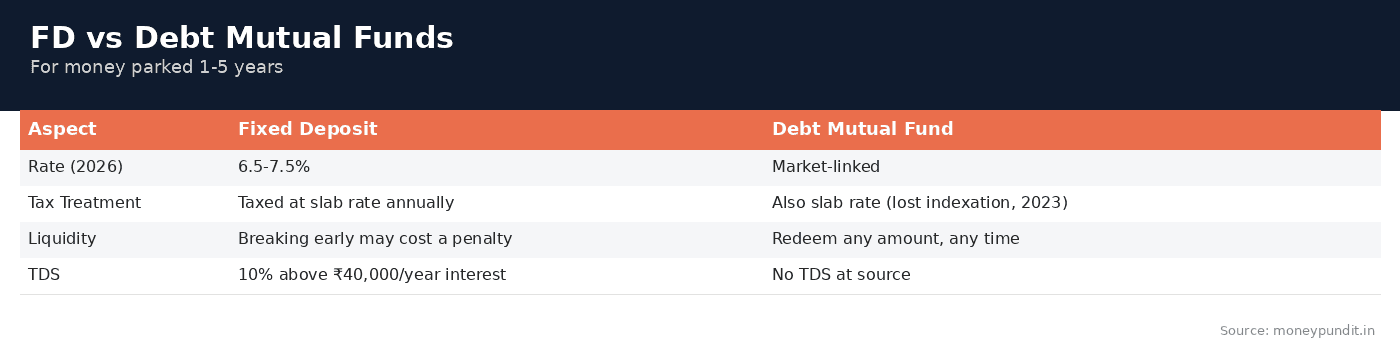
Bank FDs currently offer 6.5–7.5% per annum on 1–3 year tenures (2026 rates vary by bank). They’re simple, insured up to ₹5 lakh per bank per depositor by DICGC, and completely predictable. You know exactly what you’ll get at maturity.
The tax treatment, however, is harsh. FD interest is added to your income every year and taxed at your slab rate, up to 30% for high earners. On a 7% FD, a person in the 30% bracket earns an effective 4.9% post-tax. TDS is deducted at 10% if interest exceeds ₹50,000 per year.
The Debt Mutual Fund Case
After the 2023 tax amendment, debt mutual funds lost their indexation benefit and are now taxed as per your income slab, just like FDs. This significantly reduced their tax advantage for most investors.
However, debt funds still have some advantages: liquidity (you can redeem any amount any time, unlike breaking an FD), no TDS deduction at source, and flexibility to choose between short-duration, medium-duration, and dynamic bond funds based on your interest rate view.
When to Choose FD
Choose an FD when you need guaranteed capital protection, a fixed and predictable return, or when the amount is within ₹5 lakh (covered by deposit insurance). FDs are also better for senior citizens who get an extra 0.25–0.50% interest rate benefit from most banks.
When to Choose Debt Funds
Debt mutual funds may work better when you need high liquidity without penalty (breaking an FD before maturity costs 0.5–1% in interest), when you want to invest in a staggered manner, or when you’re investing via a systematic transfer plan (STP) from a liquid fund into equity.
A Practical Approach for 2026
For most conservative investors, a combination works well: use FDs for fixed short-term goals (1–3 years) and use liquid/overnight funds as an emergency fund substitute. The tax treatment is now similar enough that the choice comes down to liquidity needs and simplicity preference.
How FDs and Debt Mutual Funds Actually Work
A fixed deposit is a simple lending arrangement: you lend money to a bank for a fixed period, and the bank pays you a predetermined interest rate. Your principal is guaranteed (up to ₹5 lakh by DICGC insurance), and the interest rate doesn’t change during the tenure. Debt mutual funds, however, pool money from thousands of investors and invest in a portfolio of government bonds, corporate bonds, treasury bills, and money market instruments. The fund’s NAV fluctuates daily based on bond prices and interest rate movements.
Returns Comparison: What the Numbers Say
Bank FDs currently offer 6.5-7.5% for general citizens and 7-8% for senior citizens. Debt mutual funds, depending on the category, deliver returns that vary: liquid funds (6-7%), short-duration funds (7-8.5%), corporate bond funds (7.5-9%), and dynamic bond funds (7-10%). The key difference is that FD returns are guaranteed and fixed, while debt fund returns are market-linked and variable. In a falling interest rate environment, debt funds outperform FDs significantly as existing bonds appreciate in value. In rising rate environments, FDs hold up better.
Tax Treatment: The 2023 Game Changer
Before April 2023, debt mutual funds had a massive tax advantage, gains held over 3 years qualified for LTCG at 20% with indexation benefit, effectively reducing tax to 5-8% for long holders. The 2023 budget eliminated this benefit; now debt fund gains are taxed at your income tax slab rate regardless of holding period, the same as FD interest. This levelled the playing field significantly.
However, debt funds still have two tax edges. First, no TDS: FDs deduct TDS at 10% when annual interest exceeds ₹50,000 (₹1,00,000 for seniors), creating cash flow friction. Debt funds have zero TDS; you pay tax only when you redeem. Second, tax timing control: you choose when to book gains, allowing you to time redemptions in a low-income year for lower tax rates. Use our income tax calculator to compare both scenarios for your bracket.
Liquidity and Flexibility
Debt mutual funds win decisively on liquidity. You can redeem anytime (liquid funds give next-day credit, others within 2-3 business days), usually with zero exit load after 15-30 days. FD premature withdrawal typically costs 0.5-1% penalty on the interest rate, and some banks reduce the rate to the applicable tenure rate (which can be much lower). If you might need the money before maturity, debt funds offer far better flexibility.
When to Choose What
Choose FDs when: you want absolute capital safety with zero NAV fluctuation, you’re in a low tax bracket (under 20%), you need a specific maturity date, or you’re a senior citizen getting the higher rate. Choose debt mutual funds when: you want better liquidity and no TDS complications, you have a 1-3 year horizon (short-duration funds), you want to park your emergency fund or surplus cash (liquid funds), or you’re running an STP into equity. For most working professionals with adequate emergency funds, a combination works best. Keep 3 months’ expenses in a liquid fund for emergencies and the rest in FDs or short-duration debt funds based on your horizon.
There’s no permanent winner between FD and debt funds: check where interest rates are heading before choosing, and don’t assume the debt fund’s historical average return will repeat in every rate cycle.
References: Amfiindia.com
Source: amfiindia.com
Frequently Asked Questions
Are debt mutual funds safer than FDs?
Bank FDs have a fixed rate and deposit insurance up to the limit. Debt funds are market-linked and carry interest-rate and credit risk, so returns are not guaranteed.
How are FD and debt fund returns taxed?
FD interest is taxed at your slab rate each year. Debt fund gains are also taxed at your slab rate under current rules, but only when you redeem.
Which is better for a short horizon?
For a horizon under a year, FDs or liquid funds are the usual choices, depending on how much volatility and liquidity you need.
FD vs debt mutual funds: Key Takeaways
Key points on fd vs debt mutual funds:
- Bank FDs currently offer 6.5–7.5% per annum on 1–3 year tenures (2026 rates vary by bank).
- After the 2023 tax amendment, debt mutual funds lost their indexation benefit and are now taxed as per your income slab, just like FDs.
- Choose an FD when you need guaranteed capital protection, a fixed and predictable return, or when the amount is within ₹5 lakh (covered by deposit insurance).
Verify the latest fd vs debt mutual funds figures with AMFI before you act.