

Sukanya samriddhi yojana ssy in brief: If you invest the maximum ₹1,50,000 per year for 15 years at 8.2% interest, the account continues to earn interest for 6 more years (total 21 years from opening).
Sukanya Samriddhi Yojana currently pays one of the highest guaranteed, tax-free interest rates of any government savings scheme in India, but it’s only open for a daughter under 10, and the account matures over 21 years, both details that catch many parents off guard. Here’s how much it can accumulate and who’s eligible to open one.
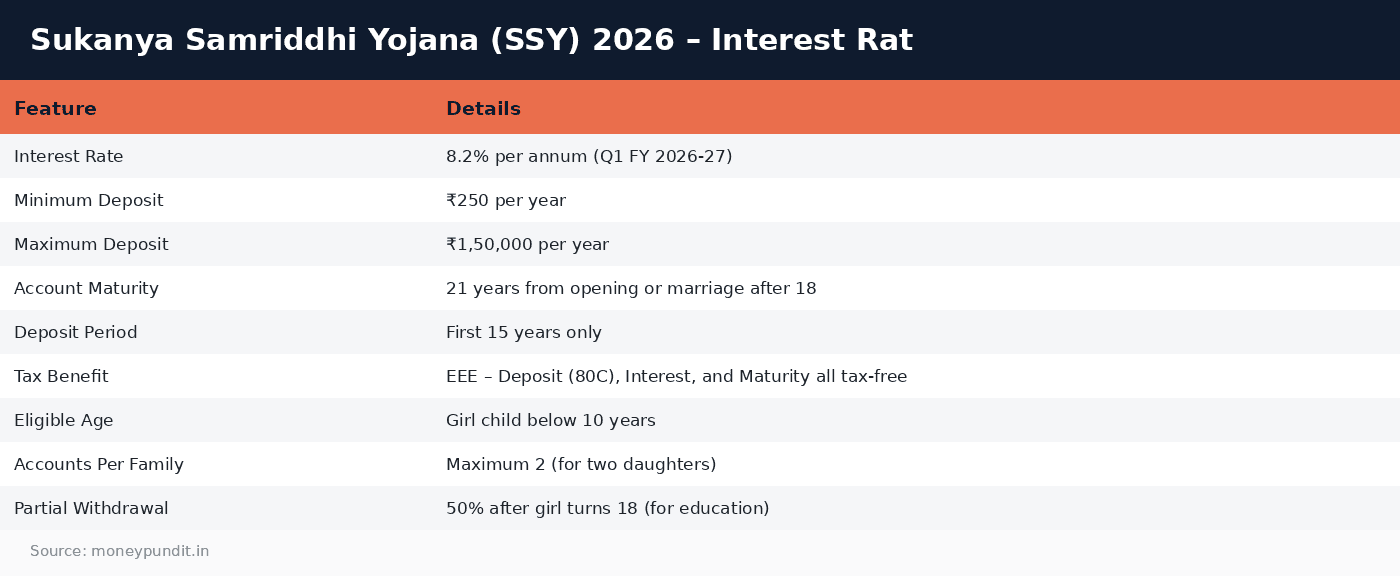
Sukanya Samriddhi Yojana (SSY) is a government-backed savings scheme launched under the Beti Bachao Beti Padhao initiative to secure the financial future of the girl child. It offers one of the highest interest rates among government small savings schemes at 8.2% per annum, along with complete tax exemption under the EEE (Exempt-Exempt-Exempt) category. For parents with daughters, SSY is among the best risk-free investment options available.
SSY Key Features
| Feature | Details |
|---|---|
| Interest Rate | 8.2% per annum (Q1 FY 2026-27) |
| Minimum Deposit | ₹250 per year |
| Maximum Deposit | ₹1,50,000 per year |
| Account Maturity | 21 years from opening or marriage after 18 |
| Deposit Period | First 15 years only |
| Tax Benefit | EEE – Deposit (80C), Interest, and Maturity all tax-free |
| Eligible Age | Girl child below 10 years |
| Accounts Per Family | Maximum 2 (for two daughters) |
| Partial Withdrawal | 50% after girl turns 18 (for education) |
How Much Can You Accumulate?
If you invest the maximum ₹1,50,000 per year for 15 years at 8.2% interest, the account continues to earn interest for 6 more years (total 21 years from opening). Your total investment would be ₹22.5 lakh, and the maturity amount would be approximately ₹69.3 lakh, with nearly ₹46.8 lakh earned as tax-free interest. Even a modest investment of ₹5,000 per month (₹60,000 per year) for 15 years would grow to approximately ₹27.7 lakh at maturity.
Who Can Open an SSY Account?
Any parent or legal guardian can open an SSY account for a girl child who is below 10 years of age at the time of account opening. A maximum of two SSY accounts can be opened per family, one for each daughter. In the case of twins or triplets, a third account may be permitted with appropriate birth certificates. The account can be opened at any post office or authorised bank including SBI, Bank of Baroda, PNB, ICICI Bank, HDFC Bank, and others.
SSY Deposit and Maturity Timeline
Understanding the unique timeline of SSY is crucial. You must make deposits for the first 15 years from the date of account opening. After 15 years, no further deposits are required, but the existing balance continues to earn interest at the prevailing rate for the remaining 6 years until the account matures (21 years from opening). If you open the account when your daughter is 5 years old, deposits run until she is 20, and the account matures when she turns 26.
Partial Withdrawal Rules
Once the girl child turns 18, a partial withdrawal of up to 50% of the balance at the end of the preceding financial year is allowed for higher education purposes. The withdrawal requires proof of admission to a recognised educational institution such as an admission letter or fee receipt. This provision makes SSY a practical tool for funding college or professional education expenses.
Premature Closure Conditions
SSY accounts can be prematurely closed under specific circumstances: if the girl child gets married after turning 18 (one month before the wedding date), in case of the account holder’s death (the balance is paid to the guardian with interest up to the date of death), or under extreme compassionate grounds such as life-threatening illness of the account holder or death of the guardian. Premature closure for marriage is the most common scenario, and the full maturity amount including interest until the closure date is paid out.
SSY vs Other Investment Options for Girl Child
| Feature | SSY | PPF | ELSS (Mutual Fund) | FD |
|---|---|---|---|---|
| Interest/Returns | 8.2% | 7.1% | 12-15% (historical) | 6.5-7.5% |
| Risk | Zero | Zero | High (market-linked) | Low |
| Tax Status | EEE (fully exempt) | EEE (fully exempt) | LTCG taxable above ₹1.25L | Interest fully taxable |
| Lock-in | 21 years | 15 years | 3 years | 5 years (tax saver) |
| Best For | Long-term girl child fund | General long-term saving | Wealth creation + 80C | Short-term safety |
SSY Investment Strategy
Start Early
Opening an SSY account as soon as your daughter is born maximises the compounding period. A ₹1.5 lakh annual investment starting at birth gives 21 full years of compounding, resulting in the highest possible maturity amount. Delaying by even 5 years significantly reduces the final corpus because both the deposit period and the interest-earning period shorten.
Invest Before the 5th of Each Month
Like PPF, SSY interest is calculated on the minimum balance between the 5th and the end of each month. Depositing before the 5th ensures your contribution earns interest for that entire month. If you invest a lumpsum annually, do it before April 5th to capture maximum interest for the financial year.
Combine with Equity for Higher Returns
While SSY at 8.2% is excellent for risk-free returns, parents with a longer horizon (15+ years) can allocate ₹1.5 lakh to SSY for the guaranteed, tax-free component and additionally invest in equity mutual fund SIPs for the growth component. This blended approach provides the safety of SSY with the wealth-creation potential of equities, maximising the corpus available when the daughter needs it for education or marriage.
Frequently Asked Questions
What happens if I miss the minimum deposit in a year?
If you fail to deposit the minimum ₹250 in any financial year, the account becomes a “default account.” To revive it, you must pay ₹250 for each year of default plus a penalty of ₹50 per default year. The account continues to earn interest during the default period, but you cannot make withdrawals or claim 80C benefits until it is regularised.
Can an NRI open an SSY account?
NRIs cannot open new SSY accounts. If a parent who opened an SSY account later becomes an NRI, the account can continue until maturity. However, some post offices and banks may create complications, so it is advisable to open the account at a major bank with clear NRI policies.
Can the girl child operate the account herself?
Yes, once the girl child turns 18, she can operate the account independently. She can make deposits, request withdrawals for education, and manage the account without the guardian’s involvement. This transfer of control happens automatically upon providing age proof to the bank or post office.
Is SSY better than PPF for a girl child?
Yes, for a girl child specifically, SSY is better than PPF. The interest rate is higher (8.2% vs 7.1%), both enjoy EEE tax status, and SSY is purpose-built for the girl child’s future needs with education withdrawal provisions. The only downside is the longer lock-in (21 years vs 15 years for PPF), but for a newborn, this aligns perfectly with the timeline for education and marriage expenses.
References: Amfiindia.com
Sukanya samriddhi yojana SSY: Key Takeaways
Key points on sukanya samriddhi yojana ssy:
- Your total investment would be ₹22.5 lakh, and the maturity amount would be approximately ₹69.3 lakh, with nearly ₹46.8 lakh earned as tax-free interest.
- A maximum of two SSY accounts can be opened per family, one for each daughter.
- You must make deposits for the first 15 years from the date of account opening.
Verify the latest sukanya samriddhi yojana ssy figures with RBI before you act.