
Personal loan India interest rates in 2026 start near 8.75% at the cheapest banks and run past 30% at some NBFCs, a gap most borrowers never negotiate on. Here’s how current rates, eligibility, and bank comparisons actually work.
A personal loan is an unsecured loan that requires no collateral, making it the quickest way to access funds for medical emergencies, weddings, travel, home renovation, or debt consolidation. With digital lending platforms offering instant approval and same-day disbursal, personal loans have become one of the most popular credit products in India. However, the convenience comes at a cost. Interest rates are significantly higher than secured loans like home or car loans.
Personal Loan India Interest Rates 2026: Bank-Wise Comparison
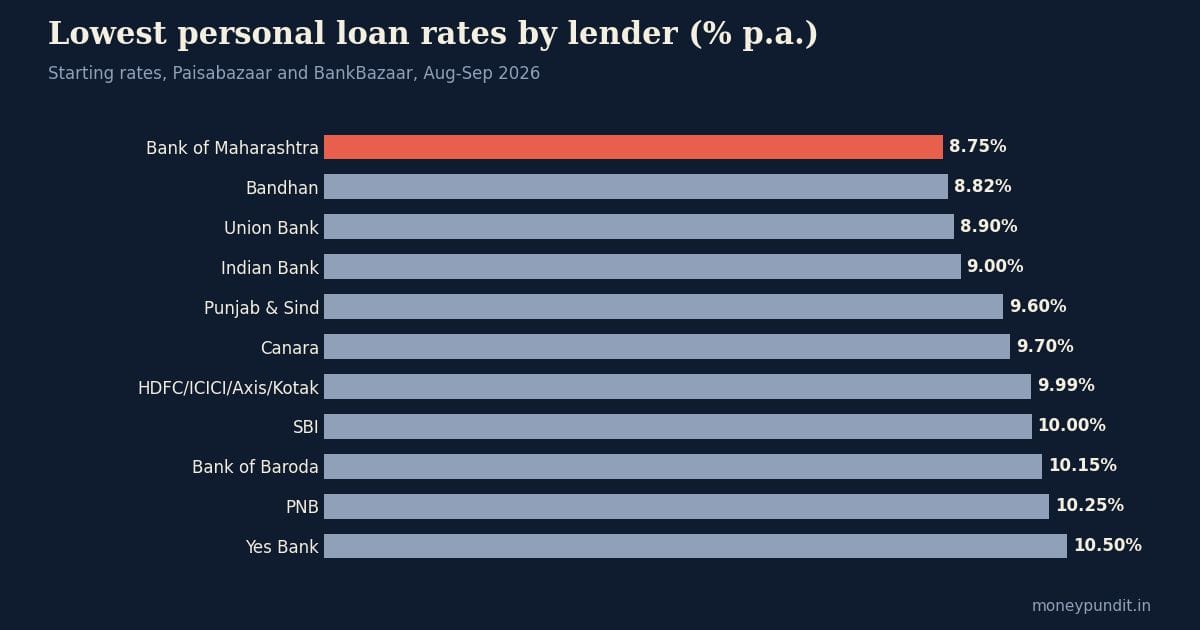
These personal loan India interest rates are the starting (best-profile) rates advertised by 32 lenders. Your actual rate depends on your CIBIL score, income and employer category, and can be several points higher. All figures predate the RBI repo rate hike to 5.50% on 7 October 2026, so expect lenders to reprice over the coming weeks (RBI).
Private banks: personal loan India interest rates and fees
| Bank | Interest rate (p.a.) | Processing fee |
|---|---|---|
| Axis Bank | 9.99% onwards | Up to 2% |
| Bandhan Bank | 8.82% onwards | Up to 3% |
| Federal Bank | 12.00% – 22.50% | Up to 2% |
| HDFC Bank | 9.99% onwards | Up to ₹6,500 |
| ICICI Bank | 9.99% onwards | Up to 2% |
| IDFC FIRST Bank | 9.99% onwards | Up to 3.5% |
| IndusInd Bank | 10.50% onwards | Up to 3% |
| Jammu & Kashmir Bank | 11.55% – 13.35% | Up to 1% |
| Kotak Mahindra Bank | 9.99% onwards | Up to 5% |
| Yes Bank | 10.50% onwards | Up to 2.5% |
Source: Paisabazaar, updated 21 September 2026.
Public sector banks: personal loan India interest rates and fees
| Bank | Interest rate (p.a.) | Processing fee |
|---|---|---|
| State Bank of India | 10.00% onwards | Up to 1.5% |
| Punjab National Bank | 10.25% – 16.80% | Up to 1% |
| Bank of Baroda | 10.15% onwards | Up to 2% |
| Canara Bank | 9.70% – 15.15% | Up to 0.5% |
| Union Bank of India | 8.90% – 12.65% | Up to 1% |
| Bank of India | 10.85% – 16.15% | 0.5% – 1% |
| Indian Bank | 9.00% – 15.25% | Up to 1% |
| Punjab & Sind Bank | 9.60% onwards | 0.5% – 1% |
| Bank of Maharashtra | 8.75% onwards (BankBazaar, 4 Aug 2026) | Not stated |
Source: Paisabazaar, updated 21 September 2026; Bank of Maharashtra from BankBazaar, 4 August 2026 (single source). Gap: Central Bank of India, Indian Overseas Bank and UCO Bank are not listed by these sources, so check their sites directly.
NBFCs and fintech lenders: personal loan India interest rates
| Lender | Interest rate |
|---|---|
| Bajaj Finance | 10% – 30% |
| Tata Capital | 10.99% onwards |
| DMI Finance | 11.99% onwards |
| Dhani | 13.99% onwards |
| Moneyview | 14% onwards |
| KreditBee | 17% onwards |
| Hero FinCorp | 17% onwards |
| Kissht | 18% onwards |
| mPokket | Up to 36% |
| Cashe | 2.79% per month |
| Home Credit | 1.6% per month |
| MoneyTap | 1.08% per month |
| Paysense | 1.4% per month |
Source: Paisabazaar, updated 21 September 2026. NBFC rates are far wider than bank rates and processing fees vary by borrower.
How to read personal loan India interest rates
“Onwards” means the lowest rate for borrowers with a CIBIL score of roughly 750 and above and a stable salary; a weaker profile pays more. Public sector banks are cheapest on interest, with Union Bank, Indian Bank and Bank of Maharashtra under 9.25%. Private banks charge more in fees: Kotak is up to 5% and IDFC FIRST up to 3.5%, against HDFC’s flat fee of up to ₹6,500. NBFC rates start near 10% at Bajaj Finance and Tata Capital but climb past 30% at small-ticket lenders. Compare the all-in cost of personal loan India interest rates, rate plus fee, before you apply, and test the EMI with the EMI calculator.
Secured borrowing is cheaper: see home loan interest rates, car loan rates and gold loan rates before settling on an unsecured loan.
Eligibility Criteria
For Salaried Individuals
Most banks require a minimum monthly income of ₹15,000-₹25,000, age between 21-60 years, and at least 1-2 years of work experience with 6 months at the current employer. Employees of listed companies, MNCs, and government organisations typically get lower interest rates and higher loan amounts. A CIBIL score of 750 or above significantly improves your chances of approval at competitive rates.
For Self-Employed
Self-employed individuals need to demonstrate business continuity of at least 2-3 years, minimum annual income of ₹2-5 lakh (varies by lender), and file income tax returns regularly. The documentation requirements are stricter. You will need ITRs for 2-3 years, bank statements showing regular cash flows, and business proof. Interest rates for self-employed borrowers are generally 1-2% higher than for salaried applicants.
How to Get the Lowest Interest Rate
Maintain a High CIBIL Score
Your credit score is the single most influential factor in determining your personal loan interest rate. A score of 750+ can get you rates 3-5% lower than someone with a score of 650. Before applying for a personal loan, check your CIBIL score and address any issues. Pay outstanding credit card dues, correct errors in your credit report, and avoid making multiple loan inquiries in a short period.
Compare Across Multiple Lenders
Interest rates vary significantly between banks and NBFCs. Use online loan aggregators to compare offers without multiple hard inquiries on your credit report. Many platforms provide pre-approved offers based on soft credit pulls, allowing you to shop around without affecting your CIBIL score.
Negotiate Using Existing Relationships
If you have a salary account, fixed deposits, or existing loans with a bank, leverage these relationships for better rates. Banks often offer preferential rates to existing customers with good track records. Pre-approved personal loan offers from your salary account bank are typically 1-2% cheaper than fresh applications.
Choose the Right Tenure
While longer tenures mean smaller EMIs, they significantly increase the total interest paid. A ₹5 lakh loan at 12% for 5 years costs ₹1.67 lakh in interest, while the same loan for 3 years costs only ₹99,000 in interest, a saving of ₹68,000. Choose the shortest tenure where the EMI is comfortably within 40% of your monthly income.
Personal Loan vs Other Borrowing Options
| Feature | Personal Loan | Credit Card EMI | Gold Loan | Loan Against FD |
|---|---|---|---|---|
| Interest Rate | 10-24% | 13-18% | 7-12% | 1-2% above FD rate |
| Collateral | None | None | Gold jewellery | Fixed deposit |
| Processing Time | 1-3 days | Instant | 30 minutes | Same day |
| Max Amount | ₹50 lakh | Credit limit | 75% of gold value | 90% of FD value |
| Tax Benefit | None | None | None | None |
Before taking a personal loan, consider cheaper alternatives. A loan against your fixed deposit costs just 1-2% above the FD rate (effectively 8-9%). A gold loan offers 7-12% rates with quick disbursal. These secured options are significantly cheaper than personal loans because the collateral reduces the lender’s risk.
Hidden Charges to Watch Out For
The advertised interest rate is not the only cost of a personal loan. Processing fees (1-3% of loan amount), prepayment or foreclosure charges (2-5% of outstanding principal), late payment penalties (1-2% per month on overdue EMI), and bounce charges (₹500-₹1,000 per bounced EMI) add up. Always ask for the total cost of the loan, some lenders deduct processing fees from the disbursed amount, meaning you receive less than the sanctioned amount but pay interest on the full amount.
When to Avoid Personal Loans
Personal loans should be a last resort, not a first choice. Avoid taking personal loans for discretionary expenses like vacations or gadgets. These are depreciating purchases that you should save for instead. Never take a personal loan to invest in the stock market or mutual funds. The interest cost will likely exceed your investment returns, and market downturns could leave you paying EMIs on a shrinking investment. Also avoid personal loans for weddings beyond what is absolutely necessary. Starting married life with high-interest debt creates unnecessary financial stress.
Frequently Asked Questions
Can I prepay my personal loan early?
Yes, most lenders allow prepayment after a minimum period (usually 6-12 months). RBI has mandated that floating-rate personal loans must have zero prepayment charges. For fixed-rate personal loans, banks can charge up to 2-5% of the outstanding principal. Always check the prepayment terms before signing the loan agreement.
Does applying for a personal loan affect my CIBIL score?
Yes, each loan application triggers a “hard inquiry” on your credit report, which temporarily reduces your score by 5-10 points. Multiple applications in a short period signal credit hunger and can significantly impact your score. Apply only after comparing offers through soft-inquiry-based platforms and when you are reasonably certain of approval.
Can I get a personal loan with a low CIBIL score?
Getting a personal loan with a CIBIL score below 650 is difficult but not impossible. Some NBFCs and fintech lenders cater to lower credit scores, but at significantly higher interest rates (18-30%). A better approach is to improve your credit score over 3-6 months and then apply. Alternatively, consider secured loan options like gold loans or loans against FDs, which have less stringent credit score requirements.
Is personal loan interest tax-deductible?
Personal loan interest is generally not tax-deductible. However, if you use the personal loan for specific purposes like home renovation (Section 24b deduction on interest, capped at ₹30,000 for renovation), or for business purposes (deductible as business expense), partial tax benefits may apply. You need documentation proving the end use of the loan funds.
References: Amfiindia.com
What is the lowest personal loan interest rate in India in 2026?
Among the lenders we track, Bank of Maharashtra starts at 8.75% (BankBazaar, 4 August 2026), followed by Bandhan Bank at 8.82% and Union Bank of India at 8.90% (Paisabazaar, 21 September 2026). These are best-profile rates; the personal loan India interest rates you are offered depend on your credit score.
How will the RBI repo hike change personal loan India interest rates?
The RBI raised the repo rate to 5.50% on 7 October 2026. Most personal loans carry a fixed rate, so existing loans usually do not change, but lenders may raise quoted rates on new loans as they reprice. The rates above predate the hike.
Which bank charges the lowest processing fee on a personal loan?
Canara Bank charges up to 0.5%, Bank of India and Punjab & Sind Bank 0.5% to 1%, and HDFC Bank a flat fee of up to ₹6,500. Kotak Mahindra Bank (up to 5%) and IDFC FIRST Bank (up to 3.5%) are the costliest among major banks.
Are NBFC personal loans costlier than bank personal loans?
Usually yes. Bank personal loan India interest rates start near 9% to 10%, while NBFC rates range from about 10% at Bajaj Finance and Tata Capital to 36% at mPokket. Some lenders quote a monthly rate, such as Cashe at 2.79% per month, which is far higher on an annual basis.
Related Resources
Lenders weigh this heavily when approving your loan: see why your Debt-to-Income Ratio matters and how to improve it.
Funding a course? Compare education loan India interest rates across 25+ lenders.
Related guide: Read our guide on how to close a personal loan account in India.