
Car loan vs paying in brief: A car loan at 9-10% interest on a depreciating asset is a very different decision from a home loan at a similar rate on an appreciating one, yet many buyers finance a car the same way they’d finance a house.
A car loan at 9-10% interest on a depreciating asset is a very different decision from a home loan at a similar rate on an appreciating one, yet many buyers finance a car the same way they’d finance a house. Here’s the real math on financing versus paying cash for your next car.
Buying a car is one of the biggest financial decisions after a home. While paying cash avoids interest costs, car loans preserve liquidity and can be financially smart if the freed-up capital is invested wisely. Understanding the true cost comparison helps you make the right choice for your situation.
Current Car Loan Rates
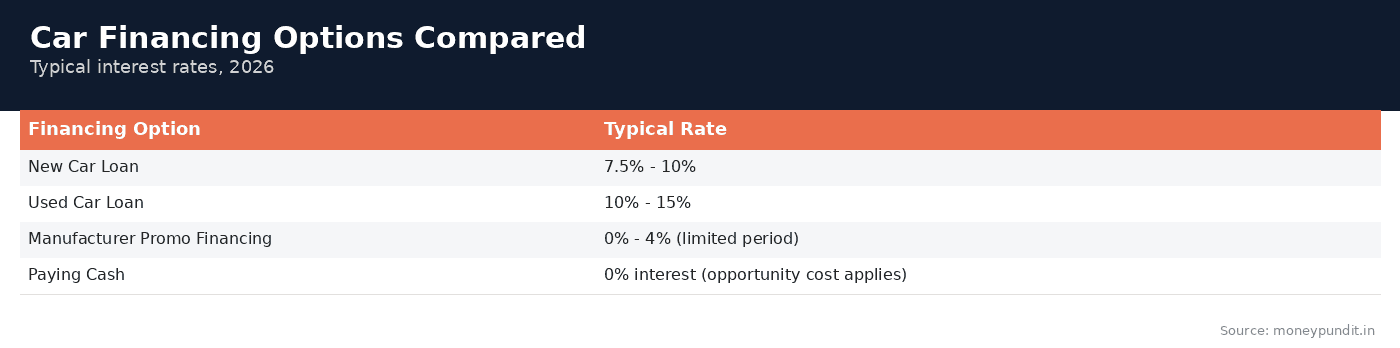
New car loans range from 7.5-10% depending on the bank, your credit score, and the car model. Used car loans are higher at 10-15%. Manufacturer financing often offers promotional rates of 0-4% for limited periods, but verify these against the ex-showroom price discount you lose. Tenure options: 1-7 years, with 3-5 years being the sweet spot. Processing fees range from ₹2,000-₹10,000 or 0.5% of loan amount.
The Case for Paying Cash
Zero interest cost: a ₹10 lakh car loan at 9% for 5 years costs ₹2.4 lakh in interest. No monthly EMI obligation freeing up cash flow. Full ownership from day one (no hypothecation). Better negotiating position with dealers for cash buyers. Peace of mind without ongoing debt on a depreciating asset. If you have the cash and it does not deplete your emergency fund or investments, paying outright is the simpler choice.
The Case for Financing
Preserve liquidity: keep your ₹10 lakh invested in equity SIPs earning 12% while paying 9% on the car loan. Net benefit: approximately 3% annual spread, or ₹30,000 per year on ₹10 lakh. Maintain emergency fund intact. Spread the cost over time matching your income flow. Build credit history (helpful for future home loan applications). Take advantage of 0% or low-interest manufacturer schemes when genuinely available without inflated pricing.
Down Payment Strategy
Even if financing, make a substantial down payment (40-50%) to reduce interest cost and keep EMI manageable. Never finance 100%, the car depreciates 15-20% the moment you drive it out, and you are immediately underwater on the loan. A ₹12 lakh car should have ₹5-6 lakh down payment with ₹6-7 lakh financed. This keeps the loan amount below the car’s depreciated value at all times.
Total Cost of Car Ownership
Beyond the purchase price, budget for: insurance (₹15,000-₹50,000 annually), fuel (₹5,000-₹15,000 monthly), maintenance and servicing (₹10,000-₹30,000 annually), parking and tolls, and depreciation. A ₹10 lakh car costs approximately ₹3-4 lakh annually to own including depreciation. If total car ownership exceeds 20% of your annual income, you are spending too much on transportation.
When should I buy a used car instead?
A 2-3 year old used car with single ownership, full service history, and low mileage offers 30-40% savings over a new car while still having years of reliable use ahead. For budget-conscious buyers, a certified pre-owned car from an authorized dealer provides the best value. The steepest depreciation occurs in years 1-3, and buying used lets someone else absorb that cost.
The True Cost of a Car Loan
A car loan at 8-9% interest over 5-7 years adds significantly to your vehicle’s total cost. For a ₹10 lakh car financed at 8.5% for 5 years, the total repayment is approximately ₹12.3 lakh, you’re paying ₹2.3 lakh (23%) extra in interest. Extend the tenure to 7 years and the interest balloons to ₹3.3 lakh. Use our Car Loan EMI Calculator to compute the exact EMI and total interest for any loan amount and tenure combination.
Beyond interest, car loans come with processing fees (1-2% of loan amount), mandatory comprehensive insurance for the loan tenure (which you might otherwise skip after a few years), and the risk of being “underwater”. Owing more on the loan than the car is worth, since cars depreciate 15-20% in the first year and 10-15% annually thereafter. A ₹10 lakh car is worth roughly ₹5.5-6 lakh after 3 years, but you might still owe ₹6.5 lakh on a 5-year loan.
When Paying Cash Is the Better Choice
Pay cash for your car if you have the funds available without depleting your emergency fund or disrupting investment goals. The guaranteed “return” of avoiding 8.5% interest is better than most debt instruments and comparable to equity returns on a risk-adjusted basis. Paying cash also gives you stronger negotiation leverage, dealers often offer ₹20,000-₹50,000 additional discount for cash purchases since they don’t earn the finance commission.
The best approach: buy a car you can afford to pay cash for but strategically use financing. If you have ₹10 lakh for a car, consider buying a ₹7-8 lakh car with cash and investing the remaining ₹2-3 lakh in a SIP. Alternatively, if your investment returns consistently exceed the car loan rate (common with equity over 5+ years), taking the loan and staying invested mathematically optimises your net worth.
Smart Car Financing Strategies
If you decide on a car loan, follow these rules: make the largest down payment you can (at least 20-30% to reduce interest outgo and avoid being underwater), choose the shortest tenure affordable (3-4 years, not 7), compare loan rates from your bank, the manufacturer’s finance arm, and NBFCs. Rate differences of 1-2% are common. Pre-approved loans from your existing bank often offer the best rates.
Consider a used car for 40-60% savings: a 2-3 year old certified pre-owned vehicle from a manufacturer’s programme provides most of the new-car experience at a fraction of the cost and depreciation hit. The first owner absorbs the steepest depreciation (30-40% in 2-3 years), giving the second owner much better value. Whether buying new or used, ensure your total transportation cost (EMI + insurance + fuel + maintenance) stays under 15% of your monthly take-home pay. Use our Loan Prepayment Calculator to see how making even small extra payments can dramatically reduce your car loan interest and tenure.
References: Amfiindia.com
Source: amfiindia.com
Car loan vs paying: Key Takeaways
Key points on car loan vs paying:
- New car loans range from 7.5-10% depending on the bank, your credit score, and the car model.
- Zero interest cost: a ₹10 lakh car loan at 9% for 5 years costs ₹2.4 lakh in interest.
- Preserve liquidity: keep your ₹10 lakh invested in equity SIPs earning 12% while paying 9% on the car loan.
Verify the latest car loan vs paying figures with RBI before you act.