

Stamp duty registration charges in brief: Stamp duty alone can add 5-8% to a property’s cost depending on the state, and a surprising number of buyers budget for the property price without ever pricing in this additional cost until closing.
Stamp duty alone can add 5-8% to a property’s cost depending on the state, and a surprising number of buyers budget for the property price without ever pricing in this additional cost until closing. Here’s a state-by-state breakdown of stamp duty and registration charges.
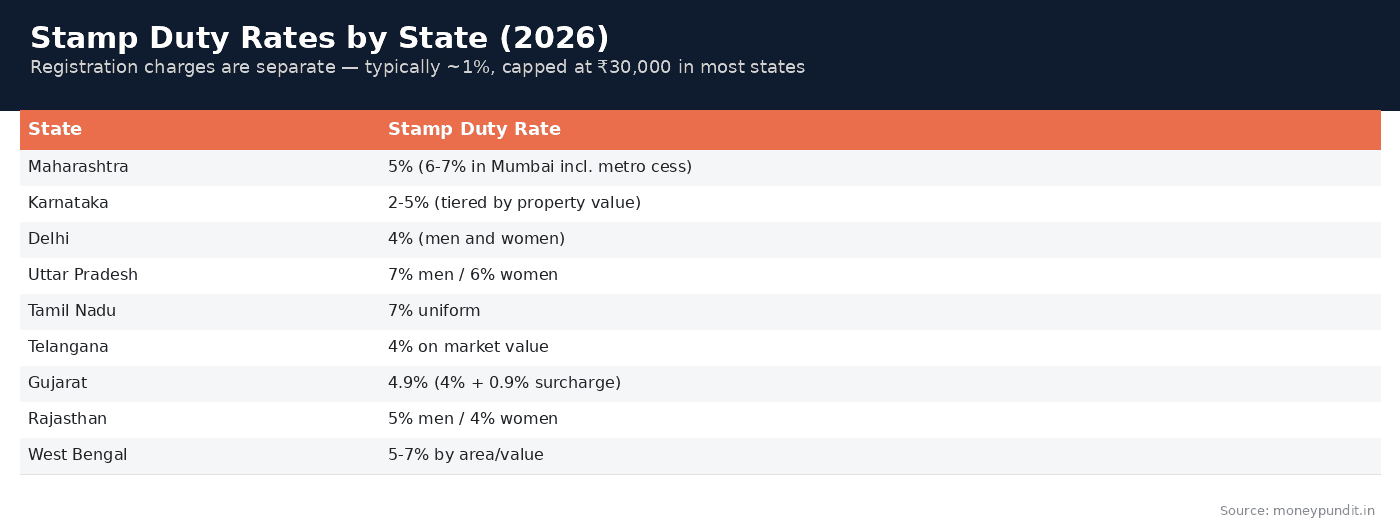
Stamp duty and registration charges are mandatory government fees when buying property in India, adding 5-10% to your property cost. These charges vary significantly by state, gender, and property type. Understanding these costs helps you budget accurately and potentially save through legal concessions.
State-Wise Stamp Duty Rates (2026)
Maharashtra: 5% in municipal areas (6% in Mumbai) plus 1% metro cess in Mumbai, making it effectively 6-7%. Karnataka: 5% for properties above ₹45 lakh (3% for ₹21-45 lakh, 2% below ₹20 lakh). Delhi: 4% for men, 4% for women (reduced from 6% and 4% respectively). Uttar Pradesh: 7% for men, 6% for women in urban areas. Tamil Nadu: 7% uniform rate. Telangana: 4% on market value. Gujarat: 4.9% (4% stamp duty + 0.9% surcharge). Rajasthan: 5% for men, 4% for women. West Bengal: 5-7% depending on area and property value.
Registration Charges
Registration charges are separate from stamp duty and typically 1% of property value, capped at ₹30,000 in most states. In Maharashtra, it is 1% capped at ₹30,000. In Karnataka, 1% with no cap. In Delhi, 1% of property value. These charges are non-negotiable and must be paid at the sub-registrar’s office at the time of property registration.
How to Save on Stamp Duty
Register property in a woman’s name: most states offer 1-2% concession for female buyers, saving ₹1-3 lakh on a ₹1 crore property. Joint registration with a woman as first holder captures the concession. First-time homebuyers get reduced rates in some states (check specific state policies). Properties below certain value thresholds attract lower rates in progressive states like Karnataka. Buying during government amnesty schemes or festive concession periods can save 1-2%.
Tax Benefits on Stamp Duty
Stamp duty and registration charges qualify for Section 80C deduction up to ₹1.5 lakh in the year of property purchase (under old tax regime only). This shared limit includes other 80C investments, so plan accordingly. If your stamp duty alone is ₹3-4 lakh, the ₹1.5 lakh deduction covers only half, but still provides meaningful tax savings. The deduction is available only once, in the year of purchase and registration.
Impact on Property Buying Budget
On a ₹1 crore property in Mumbai: stamp duty (6%) = ₹6 lakh, registration (1%) = ₹30,000 (capped), GST if under construction (5%) = ₹5 lakh, brokerage (1%) = ₹1 lakh, legal charges = ₹20,000-₹50,000. Total additional cost: ₹12-13 lakh over and above the property price. Budget for 8-12% extra on the property price for these transaction costs. This is non-financeable. You need this in cash beyond your home loan.
Can stamp duty be reduced through undervaluation?
Registering below the government circle rate or ready reckoner rate is illegal and results in penalties, reassessment, and potential prosecution. Additionally, the difference between actual payment and registered value creates black money issues and tax complications on future sale. Always register at fair market value.
State-Wise Stamp Duty Rates in 2026
Stamp duty is a state government tax on property transactions, and rates vary significantly across India. Maharashtra charges 5% in Mumbai (reduced from 6% under metro region rates) plus 1% metro cess, totalling 6%. Karnataka charges 5% across the state with an additional 1% surcharge. Delhi charges 4-6% depending on gender (women get a 2% concession). Tamil Nadu charges 7%, among the highest in India. Rajasthan charges 4-6%, Uttar Pradesh 5-7%, and Gujarat 4.9%. These differences can mean ₹1-3 lakh variation in total costs on a ₹50 lakh property.
Registration charges are separate from stamp duty and typically range from 0.5% to 1% of the property value, capped at ₹30,000 in some states. Together, stamp duty and registration add 5-8% to your property purchase cost, on a ₹1 crore property, that’s ₹5-8 lakh in addition to the property price. This cost is often underestimated by first-time buyers and should be factored into your total budget alongside the down payment and home loan EMI.
Ways to Reduce Stamp Duty Legally
Register property in a woman’s name or as a joint holder with a woman, many states offer 1-2% stamp duty concession for female buyers. In Delhi, women pay 4% vs 6% for men; in Haryana, it’s 3% vs 5-7%; and in Rajasthan, women get a 1% reduction. On a ₹80 lakh property, this saves ₹80,000-₹1.6 lakh. This concession makes joint registration with a wife or mother financially advantageous beyond just the stamp duty, it also builds credit history for the co-owner.
Some states offer reduced rates for properties in specific price brackets (affordable housing with stamp duty concessions) or for first-time homebuyers. Check if your state has active stamp duty reduction schemes. Maharashtra periodically offers temporary reductions during slow market periods. Under-construction properties attract stamp duty on the agreement value at the time of registration, which is typically lower than the eventual ready possession value.
Stamp Duty and Tax Implications
Stamp duty and registration charges are claimable as tax deductions under Section 80C (up to ₹1.5 lakh combined with other 80C investments) in the year of purchase. This is a one-time benefit that many buyers miss. However, this deduction is available only under the old tax regime, not the new regime. Factor this into your regime selection for the year of property purchase.
If the stamp duty value of a property exceeds the actual transaction price by more than 10%, the difference is taxable as income for both buyer (Section 56) and seller (Section 50C). This anti-avoidance provision means you cannot significantly understate the transaction value to save stamp duty, the circle rate/ready reckoner rate acts as the minimum value for stamp duty calculation. For a comprehensive property purchase budget, include stamp duty, registration, GST (5% on under-construction), brokerage (if applicable), interior costs, and maintenance deposit alongside the property price. Use our Home Loan Eligibility Calculator to ensure you qualify for adequate financing covering all these costs.
References: Sebi.gov.in
Source: sebi.gov.in
Stamp duty registration charges: Key Takeaways
Key points on stamp duty registration charges:
- Maharashtra: 5% in municipal areas (6% in Mumbai) plus 1% metro cess in Mumbai, making it effectively 6-7%.
- Registration charges are separate from stamp duty and typically 1% of property value, capped at ₹30,000 in most states.
- Register property in a woman’s name: most states offer 1-2% concession for female buyers, saving ₹1-3 lakh on a ₹1 crore property.
Verify the latest stamp duty registration charges figures with RBI before you act.