

The difference between a fixed and floating home loan rate isn’t just about payment predictability, over a full 20-year tenure, floating rates have historically cost less overall in India despite the short-term uncertainty. Here’s how current bank rates compare, and how to choose between fixed and floating.
Home loan interest rates directly determine your EMI burden and total cost of ownership. With home loan interest rates 2026 starting from about 7.00% at the cheapest public sector lender and above 13% at some NBFCs, choosing the right bank can save you lakhs over the loan tenure. This comprehensive comparison helps you find the most affordable home loan for your dream home.
Home Loan Interest Rates 2026: Bank-wise Comparison
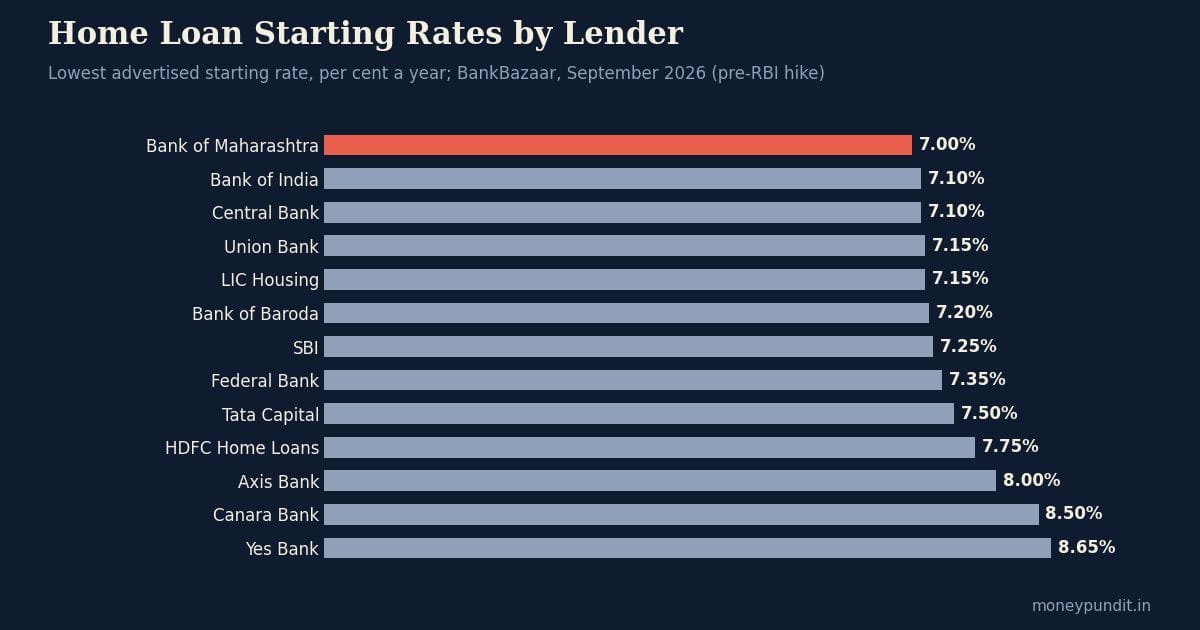
Home loan interest rates in India start at about 7.00% a year at the lowest public sector bank and climb past 13% at some NBFCs for weaker credit profiles. The table lists 32 lenders, including all public sector banks that publish a home loan rate in this source, major private banks and housing finance companies, with the starting rate and processing fee.
| Lender | Interest rate (p.a.) | Processing fee |
|---|---|---|
| Bank of Maharashtra | 7.00% to 9.65% | Up to 0.25%, max Rs 25,000 |
| Bank of India | 7.10% to 10.00% | 0.25%, Rs 1,500 to Rs 20,000 |
| Central Bank of India | 7.10% to 8.75% | 0.50%, max Rs 20,000 plus taxes |
| Union Bank of India | 7.15% to 9.35% | 0.50%, max Rs 15,000 plus GST |
| LIC Housing Finance | 7.15% onwards | 0.25%, max Rs 15,000 plus GST (loans up to Rs 1 crore) |
| Bank of Baroda | Floating 7.20% to 8.95%; fixed 8.90% to 9.95% | Rs 8,500 to Rs 25,000 |
| State Bank of India | 7.25% onwards | 0.35% plus GST, Rs 3,000 to Rs 12,000 plus GST |
| South Indian Bank | 7.25% onwards | 0.50% plus GST, Rs 10,000 to Rs 50,000 plus GST |
| Punjab and Sind Bank | 7.35% to 10.75% | 0.25% plus taxes (loans above Rs 75 lakh) |
| Federal Bank | 7.35% to 9.25% | 0.50%, Rs 10,000 to Rs 2 lakh |
| Saraswat Bank | 7.35% to 9.10% | Rs 2,500 to Rs 7,500 plus GST onwards |
| IDBI Bank | 7.40% to 11.90% | 0.50% plus taxes |
| HSBC Bank | 7.45% onwards (floating); 12.75% fixed | Contact the bank |
| Karnataka Bank | 7.48% to 11.80% | 0.25% (nil on KBL Xpress loans above Rs 75 lakh) |
| Jammu and Kashmir Bank | 7.50% to 8.20% | 0.25% plus GST, Rs 2,000 to Rs 50,000 plus GST |
| Tata Capital | 7.50% onwards | Rs 999 plus GST initial fee |
| Dhanlaxmi Bank | 7.65% onwards | 1.00%, minimum Rs 10,000 |
| Kotak Mahindra Bank | 7.60% onwards (floating); 12.00% fixed | Up to 2% plus GST (zero for online applications) |
| HDFC Home Loans | 7.75% to 13.20% | Up to 0.50%, minimum Rs 4,000 |
| IDFC FIRST Bank | 7.75% onwards | Up to 3% |
| Aditya Birla Housing Finance | 7.75% onwards | Contact the NBFC |
| Standard Chartered Bank | 7.99% onwards | 1% of sanctioned amount |
| Tamilnad Mercantile Bank | 7.90% to 9.30% | 0.50% plus GST |
| Axis Bank | 8.00% to 9.10% (floating); 14.00% fixed | Up to 1%, minimum Rs 10,000 plus taxes |
| Canara Bank | 8.50% to 10.75% | Contact the bank |
| Karur Vysya Bank | 8.50% to 10.65% | Contact the bank |
| Bandhan Bank | 8.55% to 13.52% | Contact the bank |
| Yes Bank | 8.65% onwards | 1.5% plus GST or Rs 10,000, whichever is higher |
| GIC Housing Finance | 8.80% onwards | Rs 2,500 plus GST |
| HUDCO | 9.10% to 9.60% | Contact the lender |
| Sundaram Home Finance | Contact the lender | Contact the lender |
| India Shelter Finance | Contact the lender | Contact the lender |
Source: BankBazaar home loan interest rate listing, rates updated September 2026, before the RBI repo rate hike to 5.50% on 7 October 2026. Advertised rates are starting rates for the best credit profiles, so your offer may be higher. Canara Bank is listed from 8.50% in this source; check its own page. Verify the final rate on the lender site before you apply. For the RBI effect, see our RBI MPC explainer. Regulator information is on the RBI website.
Estimate your EMI with the home loan EMI calculator, check what you can borrow with the eligibility calculator, and read the full home loan guide and tax benefits page.
Fixed vs Floating Rate: What to Choose
Floating rate loans (linked to RBI repo rate via EBLR/RLLR) adjust when RBI changes rates, currently the dominant choice for 95%+ borrowers. Fixed rate loans lock your rate for the entire tenure but are typically 1-2% higher. In a falling rate environment, floating is advantageous. In a rising rate environment, fixed protects you. Given India’s long-term trend toward lower rates, floating rate is generally recommended. However, if rates are historically low and you want EMI certainty, a fixed-rate loan provides peace of mind.
How to Get the Best Rate
Maintain a CIBIL score above 750 for the lowest rates: the difference between 750+ and 650-700 can be 0.5-1% in interest rate. Women borrowers often get 0.05% concession at most banks. Apply at your salary bank where you have a relationship and salary credit history. Compare across at least 5 lenders including banks, housing finance companies, and NBFCs. Negotiate processing fees, many banks waive them during festive seasons or for premium customers. Consider top-up loans for additional needs rather than separate personal loans at higher rates.
Understanding EMI and Total Interest
For a ₹50 lakh loan at 8.5% for 20 years: EMI is ₹43,391, total payment is ₹1.04 crore, and interest cost is ₹54.1 lakh (108% of principal). At 9% for the same loan: EMI is ₹44,986, total payment is ₹1.08 crore, interest is ₹57.9 lakh. The 0.5% rate difference costs ₹3.8 lakh over the full tenure. For a 30-year tenure, the same 0.5% difference costs ₹7.2 lakh. This illustrates why even small rate differences matter enormously for home loans.
Prepayment Strategy
RBI mandates zero prepayment penalty on floating rate home loans. Even ₹50,000 extra per year on a ₹50 lakh loan can reduce tenure by 3-4 years and save ₹8-12 lakh in interest. Use annual bonuses, tax refunds, and salary increments for lump sum prepayments. Alternatively, increase EMI by 5-10% every year as income grows. Target paying off your home loan at least 5 years before retirement.
Should I transfer my existing home loan to a lower rate?
Balance transfer makes sense if the rate difference is more than 0.5% and remaining tenure is more than 10 years. Factor in processing fees (0.5-1% of outstanding), legal charges, and administrative hassle. Many banks match competing offers to retain you, negotiate with your existing lender first before initiating transfer.
Fixed vs Floating Rate: Which Home Loan Type Saves More
Floating-rate loans are linked to the RBI repo rate via external benchmarks (EBLR/RLLR) and adjust with every policy change. Currently the most common choice since rates have been declining. Fixed-rate loans lock your EMI for the full tenure but typically start 1-2% higher than floating rates. In a falling rate environment, floating rates deliver significant savings; in rising rate cycles, fixed rates protect you from EMI shocks.
Most borrowers benefit from floating rates over long tenures (15-25 years) because interest rate cycles average out. If you’re risk-averse and can budget precisely, consider a “hybrid” option offered by some banks. Fixed for the first 3-5 years, then floating. Use our EMI Calculator to compare monthly payments at different rates and tenures. A useful rule: for every 0.5% increase in rate on a ₹50 lakh loan over 20 years, your total interest cost increases by approximately ₹4-5 lakh.
Tips to Get the Lowest Home Loan Rate
Negotiate aggressively: banks have flexibility, especially for salaried professionals with CIBIL scores above 780. Consider credit unions and smaller banks that may offer 0.1-0.3% lower rates to compete with larger players. Balance transfer your existing loan if another lender offers 0.5% or more savings. The processing fee (0.5-1% of outstanding) is usually recovered within 12-18 months through lower EMIs.
Maximize down payment to reduce LTV ratio: banks offer better rates for lower LTV (below 75%). Women borrowers get a 0.05% rate concession from most banks, plus reduced stamp duty in several states. Pre-payment is your most powerful tool: even ₹5,000-10,000 extra per month towards principal dramatically reduces total interest and tenure. Most floating-rate loans allow unlimited pre-payment without penalties, make this a non-negotiable condition in your loan agreement. Review whether to prepay or invest based on your loan rate versus expected investment returns.
References: Rbi.org.in
Source: rbi.org.in
Home Loan Interest Rates 2026: Frequently Asked Questions
Which bank has the lowest home loan interest rate in 2026?
In the September 2026 listing, Bank of Maharashtra starts lowest at 7.00%, followed by Bank of India and Central Bank of India at 7.10%, and Union Bank of India and LIC Housing Finance at 7.15%. SBI starts at 7.25%. The rate you get depends on your credit score, loan size and employment type.
Will home loan rates go up after the RBI repo hike?
The RBI raised the repo rate by 25 basis points to 5.50% on 7 October 2026. Floating loans linked to the repo rate or another external benchmark reset at the next reset date, usually within three months, so EMIs or tenure may rise.
Is a fixed or floating home loan rate better?
Floating rates are usually lower at the start and follow benchmark changes, while fixed rates are often several points higher at banks such as Bank of Baroda, Kotak and Axis. See the fixed vs floating section above.
What is the processing fee on a home loan?
Fees range from about 0.25% at several public sector banks to 1% to 3% at some private lenders, plus GST. Some banks waive the fee for online applications, so always ask.
Need unsecured credit instead? Compare personal loan India interest rates across 30+ banks and NBFCs.
Buying a vehicle? Compare car loan India interest rates across 25+ banks.
Funding a course? Compare education loan India interest rates across 25+ lenders.
Related guide: Read our guide on how to close a home loan account in India.