

Best debt mutual funds in brief: Debt mutual funds aren’t risk-free just because they avoid the stock market.
Debt mutual funds aren’t risk-free just because they avoid the stock market. Interest rate risk and credit risk can still erode returns, and picking the wrong debt category for your time horizon is a common, avoidable mistake. Here’s how debt fund types differ and which ones currently stand out.
Debt mutual funds invest in fixed-income securities such as government bonds, corporate bonds, treasury bills, and money market instruments. They offer more predictable returns than equity funds with significantly lower volatility, making them essential for portfolio diversification, short-to-medium-term goals, and conservative investors seeking better returns than traditional fixed deposits.
Types of Debt Mutual Funds
SEBI classifies debt funds into 16 categories based on the duration and credit quality of underlying securities. The most commonly used categories for retail investors include liquid funds (overnight to 91-day instruments), ultra-short duration funds (3-6 month Macaulay duration), short duration funds (1-3 year duration), corporate bond funds (minimum 80% in AA+ rated bonds), banking and PSU debt funds, and gilt funds (100% government securities).
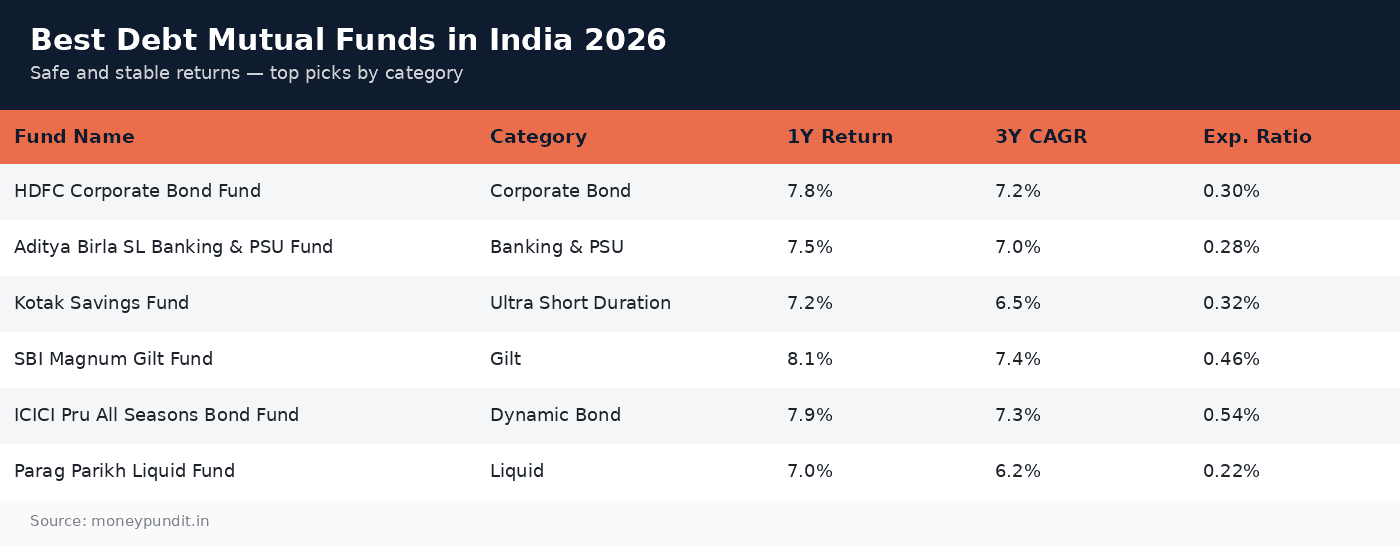
Top Debt Mutual Funds for 2026
| Fund Name | Category | 1-Year Return | 3-Year Return (CAGR) | Expense Ratio |
|---|---|---|---|---|
| HDFC Corporate Bond Fund | Corporate Bond | 7.8% | 7.2% | 0.30% |
| Aditya Birla SL Banking & PSU Fund | Banking & PSU | 7.5% | 7.0% | 0.28% |
| Kotak Savings Fund | Ultra Short Duration | 7.2% | 6.5% | 0.32% |
| SBI Magnum Gilt Fund | Gilt | 8.1% | 7.4% | 0.46% |
| ICICI Pru All Seasons Bond Fund | Dynamic Bond | 7.9% | 7.3% | 0.54% |
| Parag Parikh Liquid Fund | Liquid | 7.0% | 6.2% | 0.22% |
Returns as of April 2026. Past performance does not guarantee future results.
Why Invest in Debt Mutual Funds?
Better Tax Efficiency Than FDs
For investors in the 20% and 30% tax brackets, debt mutual funds can deliver superior post-tax returns compared to bank FDs. While FD interest is fully taxable at your slab rate each year, debt fund gains are taxed only on redemption. This tax deferral allows your money to compound more efficiently. Additionally, if held for more than three years, debt fund gains benefit from indexation, which adjusts the purchase cost for inflation and significantly reduces the taxable gain.
Professional Credit Management
Debt fund managers continuously analyse credit quality, interest rate trends, and economic indicators to optimise the portfolio. They can switch between government securities, high-quality corporate bonds, and money market instruments based on the interest rate cycle. This active management can add 0.5-1% extra return compared to a simple fixed deposit.
Liquidity
Most debt funds offer redemption within T+1 working days. Liquid funds now provide instant redemption up to ₹50,000 through select platforms. This liquidity is far superior to fixed deposits, where premature withdrawal comes with a penalty and reduced interest rate.
Understanding Key Risks
Credit Risk
If a bond issuer defaults on interest payments or principal repayment, the fund’s NAV drops sharply. The Franklin Templeton crisis of 2020, where six debt schemes were wound up due to illiquid holdings, remains a cautionary tale. To minimise credit risk, choose funds that invest predominantly in AAA-rated and government securities. Banking and PSU funds and gilt funds carry virtually zero credit risk.
Interest Rate Risk
Bond prices and interest rates move inversely. When the RBI raises interest rates, existing bond prices fall, causing debt fund NAVs to decline temporarily. Longer-duration funds are more sensitive to interest rate changes. If you expect rates to rise, stick with short-duration funds. If rates are expected to fall, longer-duration or gilt funds can deliver capital appreciation on top of regular coupon income.
Liquidity Risk
Some lower-rated corporate bonds may have limited secondary market liquidity. If a fund holds illiquid bonds and faces large redemption pressure, it may have to sell at distressed prices. This risk is minimal in funds investing in government securities and high-quality corporate bonds with active trading volumes.
Choosing the Right Debt Fund for Your Goal
| Investment Horizon | Recommended Category | Expected Returns |
|---|---|---|
| 1 day to 3 months | Liquid Fund / Overnight Fund | 6.0-7.0% |
| 3 to 6 months | Ultra Short Duration Fund | 6.5-7.5% |
| 6 months to 1 year | Low Duration / Money Market Fund | 6.5-7.5% |
| 1 to 3 years | Short Duration / Corporate Bond Fund | 7.0-8.0% |
| 3+ years (rate fall expected) | Gilt Fund / Dynamic Bond Fund | 7.5-9.0% |
Debt Funds for Emergency Fund
Liquid funds and overnight funds are excellent choices for parking your emergency corpus. They provide near-instant redemption, have negligible credit risk when invested in government securities, and deliver returns 1-2% higher than a savings account. Maintain 3-6 months of expenses in such funds, with instant redemption enabled on your mutual fund app for quick access during emergencies.
Frequently Asked Questions
Are debt funds completely safe?
No investment is completely safe. However, debt funds investing in government securities (gilt funds) carry sovereign guarantee on the underlying bonds. Corporate bond funds carry some credit risk depending on the quality of bonds held. Overall, high-quality debt funds are significantly safer than equity funds, though not as guaranteed as bank FDs insured by DICGC.
How are debt funds taxed in 2026?
Short-term capital gains (held less than 3 years) are taxed at your income tax slab rate. Long-term capital gains (held more than 3 years) are taxed at 20% with indexation benefit, which typically brings the effective tax rate down to 5-10%. This makes debt funds more tax-efficient than FDs for investors in higher tax brackets.
Can I do SIP in debt funds?
Yes, SIPs in debt funds are available, though they are less common than equity fund SIPs. They can be useful for systematically building a debt allocation. However, for parking surplus cash or emergency funds, lumpsum investments in liquid or ultra-short duration funds are more practical.
What happened with Franklin Templeton and is it safe to invest now?
Franklin Templeton wound up six debt schemes in April 2020 due to illiquid holdings in lower-rated bonds. Investors eventually recovered most of their money through a court-supervised process. The key lesson is to avoid debt funds that chase higher yields through lower-quality bonds. Stick to funds with high credit quality portfolios (predominantly AAA/sovereign) and check the fund’s portfolio disclosure before investing.
For most conservative investors, a mix of liquid and short-duration debt funds covers short-term needs safely, while longer-duration debt should only be added if you’re comfortable with the interest-rate risk that comes with it.
References: Amfiindia.com
Best debt mutual funds: Key Takeaways
Key points on best debt mutual funds:
- SEBI classifies debt funds into 16 categories based on the duration and credit quality of underlying securities.
- For investors in the 20% and 30% tax brackets, debt mutual funds can deliver superior post-tax returns compared to bank FDs.
- If a bond issuer defaults on interest payments or principal repayment, the fund’s NAV drops sharply.
Verify the latest best debt mutual funds figures with AMFI before you act.