

Cryptocurrency tax in brief: If you bought Bitcoin at ₹20 lakh and sold at ₹30 lakh, your gain is ₹10 lakh, and tax is ₹3 lakh (30%) plus ₹12,000 (4% cess) = ₹3.12 lakh.
India taxes cryptocurrency gains at a flat 30% with no deduction for losses against other income, plus a 1% TDS on every transaction above a threshold, rules stricter than almost any other asset class in the country. Here’s exactly how crypto tax, TDS, and ITR reporting work.
India introduced a comprehensive cryptocurrency tax framework from April 2022, subjecting all gains from Virtual Digital Assets (VDAs), including Bitcoin, Ethereum, NFTs, and other cryptocurrencies, to a flat 30% tax with 1% TDS on transfers. The taxation is deliberately harsh, designed to discourage speculative crypto trading while acknowledging crypto as a legitimate (if risky) asset class. Understanding these rules is essential for every crypto investor in India.
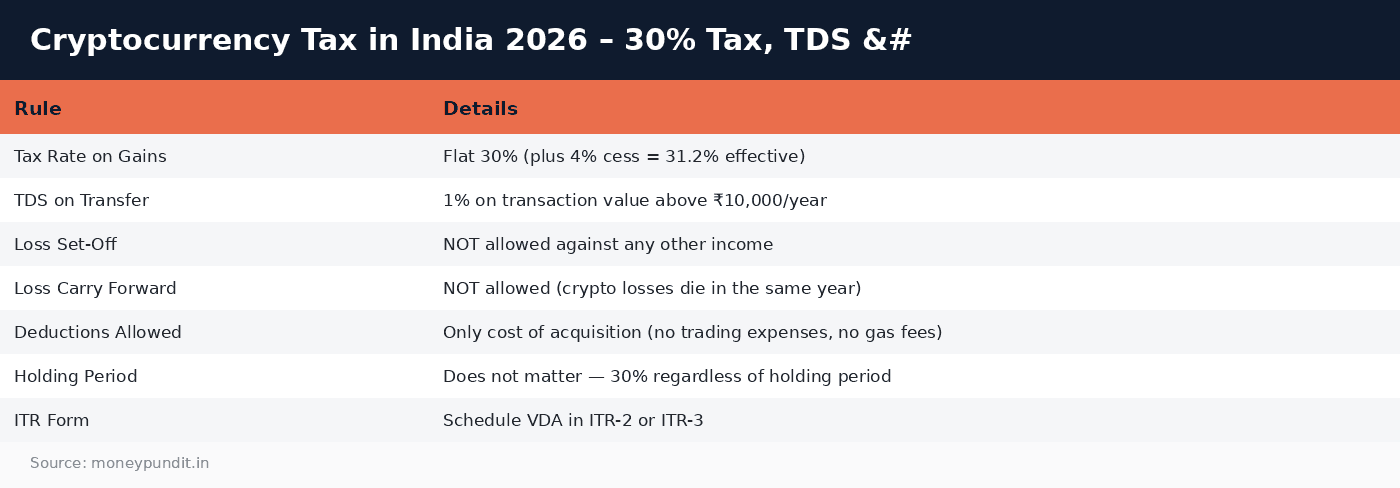
Crypto Tax Rules at a Glance
| Rule | Details |
|---|---|
| Tax Rate on Gains | Flat 30% (plus 4% cess = 31.2% effective) |
| TDS on Transfer | 1% on transaction value above ₹10,000/year |
| Loss Set-Off | NOT allowed against any other income |
| Loss Carry Forward | NOT allowed (crypto losses die in the same year) |
| Deductions Allowed | Only cost of acquisition (no trading expenses, no gas fees) |
| Holding Period | Does not matter: 30% regardless of holding period |
| ITR Form | Schedule VDA in ITR-2 or ITR-3 |
How 30% Crypto Tax Works
The 30% tax applies to any profit from transferring (selling, swapping, or spending) a VDA. If you bought Bitcoin at ₹20 lakh and sold at ₹30 lakh, your gain is ₹10 lakh, and tax is ₹3 lakh (30%) plus ₹12,000 (4% cess) = ₹3.12 lakh. The only deduction allowed is the cost of acquisition, you cannot deduct trading fees, exchange commissions, gas fees, or any other expenses from the gain.
Critically, even swapping one crypto for another (e.g., converting Ethereum to Bitcoin) is a taxable transfer. Each swap triggers a 30% tax on the gain from the crypto you are disposing of. This makes frequent trading extremely expensive from a tax perspective.
Understanding the 1% TDS (Section 194S)
Any person paying for crypto must deduct 1% TDS on the transaction value exceeding ₹10,000 per year (₹50,000 for specified persons, those having business income exceeding ₹1 crore or professional income exceeding ₹50 lakh). Indian crypto exchanges deduct this TDS automatically when you sell. For P2P transactions, the buyer is responsible for deducting and depositing TDS.
TDS is deducted on the sale value, not the profit. If you sell ₹5 lakh worth of Bitcoin, ₹5,000 is deducted as TDS regardless of whether you made a profit or loss. This TDS can be claimed as credit against your actual tax liability when filing your ITR.
No Loss Set-Off: The Biggest Burden
Unlike stocks or mutual funds where you can set off losses against gains, crypto losses cannot be set off against any other income, not even against gains from other crypto transactions in the same year. If you made ₹5 lakh profit on Bitcoin and ₹3 lakh loss on Ethereum, you still pay 30% on ₹5 lakh (₹1.5 lakh tax). The ₹3 lakh Ethereum loss provides zero tax benefit and cannot be carried forward to future years. This asymmetric treatment makes crypto trading extremely punitive from a tax standpoint.
How to Report Crypto in Your ITR
Step 1: Calculate Gains for Each Transaction
Maintain a record of every crypto transaction: date, type of crypto, quantity, purchase price, sale price, and gain/loss. Use the FIFO (First In, First Out) method to determine which units are sold first. Indian exchanges like WazirX, CoinDCX, and CoinSwitch provide annual tax reports that summarise your transactions.
Step 2: Fill Schedule VDA in ITR
ITR-2 and ITR-3 include Schedule VDA (Virtual Digital Assets) where you report: date of transfer, date of acquisition, head of income (capital gains or business income), cost of acquisition, sale consideration, and net gain. Report each significant transaction separately.
Step 3: Claim TDS Credit
The 1% TDS deducted by exchanges appears in your Form 26AS/AIS. Claim this as tax credit against your total tax liability. If the TDS exceeds your actual tax (possible if you had net losses but TDS was deducted on gross sale values), you can claim a refund through your ITR.
Crypto Tax Planning Strategies
HODL Strategy
Since tax is triggered only on transfer, simply holding (not selling) your crypto avoids any tax event. Long-term believers in crypto can accumulate and hold indefinitely. No unrealised gains are taxable. This also avoids the 1% TDS erosion on each transaction.
Avoid Frequent Trading
Each trade triggers 30% tax on gains and 1% TDS on the transaction value. Active crypto traders face a double burden: high tax rates and TDS liquidity drain. A buy-and-hold approach is far more tax-efficient than attempting to time the crypto market through frequent trades.
Invest Through International Routes
Some investors consider investing in crypto through international exchanges or funds. However, Indian tax residents are required to report and pay tax on worldwide income, including crypto gains on foreign exchanges. The 30% tax applies regardless of where the exchange is located. Non-reporting of foreign crypto holdings can attract penalties under the Black Money Act.
Airdrop, Staking, and Mining Tax Treatment
| Activity | Tax Treatment |
|---|---|
| Airdrop received | Taxable as income at slab rate on receipt; 30% on subsequent sale gain |
| Staking rewards | Taxable as income at slab rate on receipt |
| Mining income | Taxable as business income; 30% on subsequent sale gain |
| Gift of crypto | Taxable in recipient’s hands if value > ₹50,000 |
Frequently Asked Questions
Is crypto legal in India?
Crypto is not banned in India: it is legal to buy, sell, and hold. However, it is not recognised as legal tender (you cannot use it to pay for goods/services as a substitute for rupees). The government has chosen to regulate through taxation rather than prohibition. A comprehensive Crypto Bill is still pending, which may bring further regulatory clarity.
What if I do not report my crypto transactions?
With 1% TDS being deducted by exchanges, the tax department has detailed records of your transactions. Non-reporting can lead to notices, penalties (up to 200% of tax evaded), and prosecution. The AIS (Annual Information Statement) now includes crypto transaction data, making it virtually impossible to hide crypto income.
Do I need to pay tax on crypto-to-crypto swaps?
Yes, swapping one cryptocurrency for another is treated as a transfer and triggers the 30% tax on any gain. For example, if you bought Ethereum at ₹1 lakh and swapped it for Bitcoin when its value was ₹1.5 lakh, you have a ₹50,000 gain taxable at 30% (₹15,000 tax). The cost basis of your Bitcoin becomes ₹1.5 lakh.
Can I show crypto as business income instead of capital gains?
Whether crypto income is classified as capital gains or business income depends on your trading frequency and intention. However, it makes no practical difference. The 30% flat rate applies regardless of classification. The only difference is the ITR form used (ITR-2 for capital gains, ITR-3 for business income) and that business classification allows deduction of related expenses, though the tax department may dispute expense claims.
References: Amfiindia.com
Cryptocurrency tax: Key Takeaways
Key points on cryptocurrency tax:
- The 30% tax applies to any profit from transferring (selling, swapping, or spending) a VDA.
- Indian crypto exchanges deduct this TDS automatically when you sell.
- Unlike stocks or mutual funds where you can set off losses against gains, crypto losses cannot be set off against any other income, not even against gains from other crypto transactions in the same year.
Verify the latest cryptocurrency tax figures with Income Tax Department before you act.