

Financial planning women in brief: Financial independence is as important for women as it is for men, yet studies show that only 33% of Indian women actively manage their own investments.
Women in India live longer on average than men but often have shorter, more interrupted careers due to caregiving breaks. A combination that makes retirement planning genuinely different, not just a rebranded version of general financial advice. Here’s a plan built around those specific realities.
Financial independence is as important for women as it is for men, yet studies show that only 33% of Indian women actively manage their own investments. Cultural norms, career breaks for child-rearing, and gender pay gaps make financial planning even more critical for women. The good news is that Indian tax laws and financial products offer several advantages specifically for women, lower stamp duty, tax benefits, and preferential loan rates that can be leveraged for better wealth creation.
Why Women Need a Separate Financial Plan
Longer Life Expectancy
Indian women live an average of 3-5 years longer than men. This means a woman’s retirement corpus needs to last longer. If retirement is planned for age 60 and life expectancy is 85 (vs 80 for men), a woman needs 5 additional years of expenses, approximately 20-25% more in her retirement corpus.
Career Breaks
Many women take career breaks for maternity and child-rearing, typically 1-5 years. During this period, there’s no active income or employer-contributed EPF. This gap must be compensated through higher savings before and after the break, or through continued SIPs funded by the spouse or savings.
Gender Pay Gap
Women in India earn approximately 19-27% less than men in comparable roles. Lower income means a smaller absolute amount available for savings and investment, making it even more important to start investing early and choose high-growth instruments.
Financial Advantages Available to Women
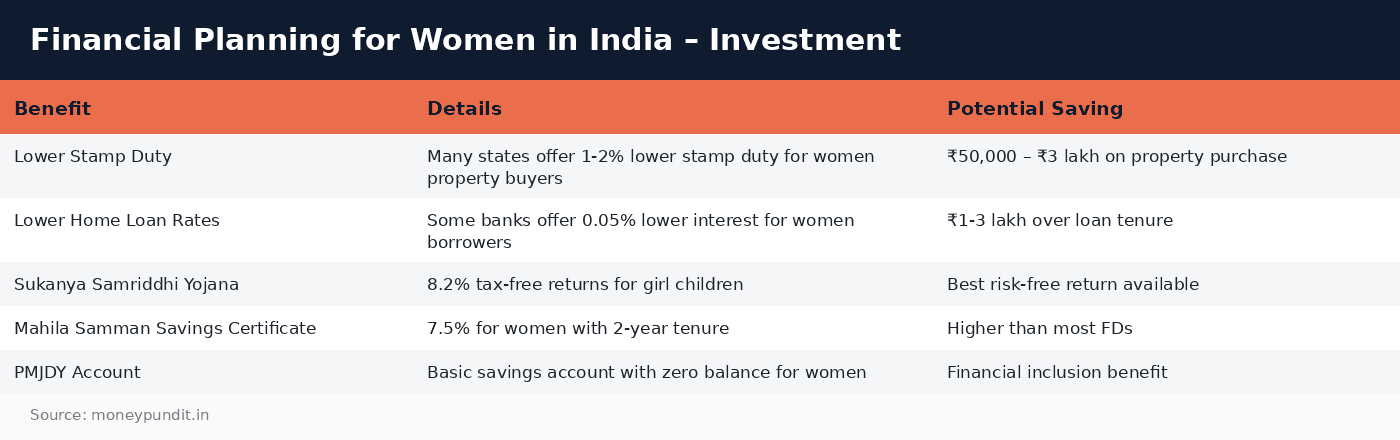
| Benefit | Details | Potential Saving |
|---|---|---|
| Lower Stamp Duty | Many states offer 1-2% lower stamp duty for women property buyers | ₹50,000 – ₹3 lakh on property purchase |
| Lower Home Loan Rates | Some banks offer 0.05% lower interest for women borrowers | ₹1-3 lakh over loan tenure |
| Sukanya Samriddhi Yojana | 8.2% tax-free returns for girl children | Best risk-free return available |
| Mahila Samman Savings Certificate | 7.5% for women with 2-year tenure | Higher than most FDs |
| PMJDY Account | Basic savings account with zero balance for women | Financial inclusion benefit |
Investment Strategy by Life Stage
Early Career (22-30 years)
Start SIPs immediately: even ₹2,000-₹5,000 per month matters immensely when compounded over 30+ years. Focus 80% on equity (index funds and flexi cap funds) and 20% on PPF. Build an emergency fund covering 6 months of expenses. Get term insurance if you have financial dependents, and health insurance independent of your employer’s group cover.
Marriage & Family Planning (28-35 years)
Maintain your financial identity even after marriage: keep your own bank accounts, investments, and credit history active. If planning a career break, increase SIP amounts before the break and ensure existing SIPs continue from joint or personal savings during the break. Open a Sukanya Samriddhi account immediately if you have a daughter.
Career Break Period
Do not stop SIPs during a career break: even reducing them is better than stopping completely. If your spouse’s income supports the household, redirect your existing savings and investments to continue growing. Use this period to enhance skills through online courses and certifications that increase your earning potential when you return to work.
Post-Break Career Restart (35-45 years)
When you resume working, aggressively increase SIP amounts by 15-20% annually to compensate for the break years. Maximise all tax benefits, 80C, 80D, NPS 80CCD(1B). This decade is crucial for catching up on retirement savings that were affected by the career break.
Pre-Retirement (50-60 years)
Gradually shift to a 50% equity / 50% debt allocation. Ensure health insurance coverage is robust. Premiums increase significantly with age, and getting new coverage after 55 is expensive. Create a clear estate plan including a will, nomination updates on all accounts and investments, and consolidation of multiple accounts.
Property in Women’s Name: Financial Benefits
Buying property in a woman’s name is financially advantageous in most Indian states. Delhi offers 2% lower stamp duty (4% vs 6% for men), Haryana offers 3% lower (3% vs 6%), and several other states provide similar concessions. On a ₹1 crore property, this translates to savings of ₹2-3 lakh. Additionally, some banks offer marginally lower home loan interest rates (0.05%) for women borrowers. If both spouses are co-borrowers, list the woman as the primary borrower to avail these benefits.
Building Financial Independence
Maintain Separate Finances
Have your own savings account, investment portfolio, and credit card regardless of marital status. Joint accounts and investments with your spouse are fine for shared goals, but having independent finances ensures you always have financial agency. This is not about mistrust. It is about practical financial security.
Understand Your Household Finances
Know where all the money goes: household income, expenses, investments, insurance policies, loans, and nominations. If you are not the primary financial manager in the household, participate actively in financial decisions and maintain access to all financial information. Many women discover financial gaps only after a spouse’s death or divorce.
Frequently Asked Questions
Should married women invest in their own name or husband’s name?
Always invest in your own name. This maintains your financial identity, ensures the investments remain yours legally, and provides security in case of any life changes. For joint investments towards common goals, use joint accounts where both have equal access.
Are there special mutual funds or SIPs for women?
There are no gender-specific mutual funds. All funds are equally available to men and women. However, some AMCs and platforms run promotional campaigns with reduced or waived SIP charges for women investors. The investment strategy should be based on your risk profile and goals, not gender.
How should a homemaker plan financially?
Homemakers should have a personal savings account, contribute to PPF or SSY (for daughters), maintain health insurance in their own name, and be co-owners of family property. If the earning spouse creates a monthly budget, ensure a portion is allocated for the homemaker’s personal savings. These savings, invested in SIPs, build a corpus that provides financial security and independence.
What is Mahila Samman Savings Certificate?
Launched in Budget 2023, this scheme offers 7.5% interest for a 2-year deposit, available exclusively to women and girls. The maximum investment is ₹2 lakh. Partial withdrawal of up to 40% is allowed after 1 year. It is available at post offices and authorised banks. While the interest is taxable at slab rate, the 7.5% rate is higher than most comparable-tenure FDs.
References: Amfiindia.com
Financial planning women: Key Takeaways
Key points on financial planning women:
- If retirement is planned for age 60 and life expectancy is 85 (vs 80 for men), a woman needs 5 additional years of expenses, approximately 20-25% more in her retirement corpus.
- Start SIPs immediately: even ₹2,000-₹5,000 per month matters immensely when compounded over 30+ years.
- Buying property in a woman’s name is financially advantageous in most Indian states.
Verify the latest financial planning women figures with Income Tax Department before you act.