

How to apply ipo in brief: IPOs have generated immense excitement among Indian retail investors, with blockbuster listings like Tata Technologies (140% listing gain) and several others delivering stellar returns.
IPO allotment in India runs on a lottery system when an issue is oversubscribed, applying for the maximum lot doesn’t guarantee anything, but a specific bidding strategy can meaningfully improve your odds. Here’s the complete process for applying, from demat account to allotment.
An Initial Public Offering (IPO) is when a private company offers its shares to the public for the first time on a stock exchange. IPOs have generated immense excitement among Indian retail investors, with blockbuster listings like Tata Technologies (140% listing gain) and several others delivering stellar returns. However, not all IPOs are winners. Understanding how to evaluate and apply for IPOs is crucial to making money rather than losing it.
How IPO Allotment Works
SEBI mandates that IPOs reserve at least 35% of shares for retail individual investors (investment up to ₹2 lakh). If the retail category is oversubscribed (more applications than available shares), allotment is done through a computerised lottery. Each valid application has an equal chance of getting allotment. Applying for the maximum amount does not improve your odds. In heavily oversubscribed IPOs (20-100x), the probability of allotment can be as low as 1-5%.
How to Apply for an IPO
Through UPI (ASBA)
The most common method for retail investors. Log into your broker’s app (Zerodha, Groww, Angel One, etc.), navigate to the IPO section, select the IPO, enter your bid details (price and lot size), and approve the UPI mandate on your UPI app. The money is blocked in your bank account (not debited) until allotment. If you don’t get allotment, the block is released within 1-2 working days after the basis of allotment is finalised.
Through Net Banking (ASBA)
Some banks offer IPO application through their net banking portal. Login to your bank’s net banking, find the IPO section, fill the application details, and submit. The bank blocks the amount in your account similar to UPI ASBA. This method is useful if you have issues with UPI mandates.
IPO Bid Strategy
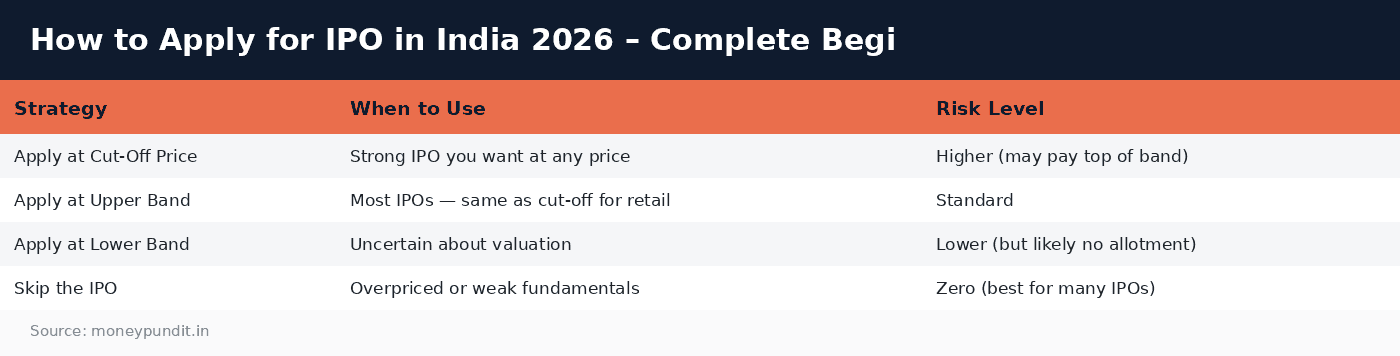
| Strategy | When to Use | Risk Level |
|---|---|---|
| Apply at Cut-Off Price | Strong IPO you want at any price | Higher (may pay top of band) |
| Apply at Upper Band | Most IPOs: same as cut-off for retail | Standard |
| Apply at Lower Band | Uncertain about valuation | Lower (but likely no allotment) |
| Skip the IPO | Overpriced or weak fundamentals | Zero (best for many IPOs) |
For retail investors, applying at the cut-off price is the standard approach for IPOs you want. Since allotment is lottery-based (not price-based), bidding at a lower price simply reduces your chance of getting shares without any cost benefit.
How to Evaluate an IPO
Key Financial Metrics
Check the company’s revenue growth (consistent 15%+ growth is positive), profitability (net profit margins and trends), return on equity (above 15% indicates efficient capital use), debt levels (lower is better), and operating cash flow (should be positive and growing). These metrics are available in the Draft Red Herring Prospectus (DRHP) and summarised by financial portals.
Valuation Comparison
Compare the IPO’s Price-to-Earnings (P/E) ratio with listed peers in the same industry. If the IPO is priced at 40x P/E while listed competitors trade at 25x, the IPO is expensive relative to alternatives. Premium pricing is justified only if the company has significantly better growth prospects, market leadership, or competitive advantages.
Grey Market Premium (GMP)
GMP is the unofficial premium at which IPO shares trade before listing. A GMP of ₹200 on a ₹500 IPO suggests the market expects a 40% listing gain. While GMP is not officially sanctioned and can be manipulated, it provides a rough sentiment indicator. Very high GMP (50%+) usually indicates a strong listing, while zero or negative GMP suggests weak demand.
Promoter and Management Quality
Research the promoters’ track record, the purpose of the IPO (fresh issue for business growth is better than Offer for Sale where existing investors are exiting), and the post-IPO promoter holding. If promoters are selling a large portion of their stake, it raises questions about their confidence in the company’s future growth.
IPO vs Buying After Listing
Many successful companies list at a significant premium but then correct 20-40% over the following weeks as initial euphoria fades. Buying after listing at a lower price can be more profitable than getting IPO allotment at issue price. For companies with strong long-term potential, waiting 3-6 months post-listing allows you to evaluate actual quarterly results and buy at a more rational valuation.
IPO Tax Implications
| Scenario | Holding Period | Tax Treatment |
|---|---|---|
| Sell on listing day | Less than 12 months | 15% STCG (speculative income if intraday) |
| Sell within 12 months | Less than 12 months | 20% STCG |
| Sell after 12 months | More than 12 months | 12.5% LTCG above ₹1.25 lakh |
Most retail IPO investors sell on listing day to book quick gains. This attracts 20% short-term capital gains tax. If you believe in the company’s long-term story, holding for over 12 months qualifies for the more favourable 12.5% LTCG rate with ₹1.25 lakh annual exemption.
Common IPO Mistakes
Applying to Every IPO
Not every IPO is worth investing in. Many companies go public at inflated valuations to benefit existing investors and promoters. Only apply to IPOs where the business fundamentals are strong, the valuation is reasonable, and you would be comfortable holding the shares even if the listing is flat or negative.
Using Multiple Demat Accounts for More Chances
Some investors apply through multiple family members’ accounts to increase allotment probability. While this is legal (each person applies independently), it requires blocking ₹14,000-₹2,00,000 per application across multiple bank accounts. Ensure you have sufficient funds and that all accounts have valid KYC and linked bank accounts.
Frequently Asked Questions
What is the minimum amount needed to apply for an IPO?
You apply in lots: each lot has a fixed number of shares. The minimum application is one lot, typically priced between ₹14,000 and ₹15,000 (SEBI mandates the minimum lot value should be between ₹13,000-₹15,000). The exact lot size and price vary by IPO.
Can I withdraw my IPO application after submitting?
Yes, you can withdraw or modify your bid until the IPO closing date (last day of the subscription period). After the IPO closes, applications cannot be modified or cancelled. If you change your mind, ensure you revise before the deadline.
What happens if I do not get allotment?
If allotment is not received, the blocked amount in your bank account is released within 1-2 working days after the basis of allotment is announced. No charges or deductions are made. You get back the exact amount that was blocked.
How do I check my IPO allotment status?
Check allotment status on the registrar’s website (KFin Technologies or Link Intime, specified in the IPO details), BSE IPO platform, or your broker’s app. Enter your PAN or application number to see if shares are allotted. Allotment is typically announced 5-6 days after the IPO closes, with shares credited to your demat account 1 day before listing.
References: Sebi.gov.in
How to apply IPO: Key Takeaways
Key points on how to apply ipo:
- SEBI mandates that IPOs reserve at least 35% of shares for retail individual investors (investment up to ₹2 lakh).
- Log into your broker’s app (Zerodha, Groww, Angel One, etc.), navigate to the IPO section, select the IPO, enter your bid details (price and lot size), and approve the UPI mandate on your UPI app.
- For retail investors, applying at the cut-off price is the standard approach for IPOs you want.
Verify the latest how to apply ipo figures with SEBI before you act.