

Dividend investing in brief: Since April 2020, dividends are taxed in the hands of investors at their income tax slab rate.
A stock paying a 6% dividend yield isn’t automatically a better income investment than one paying 2%, payout ratio and earnings stability matter more than the headline number, and ignoring them is how dividend portfolios get blindsided by a cut. Here’s how to build one properly.
Dividend investing focuses on building a portfolio of companies that regularly pay dividends, creating a stream of passive income alongside potential capital appreciation. In India, several blue-chip companies have decades-long track records of consistent and growing dividend payments, making this strategy attractive for income-seeking investors.
How Dividends Work in India
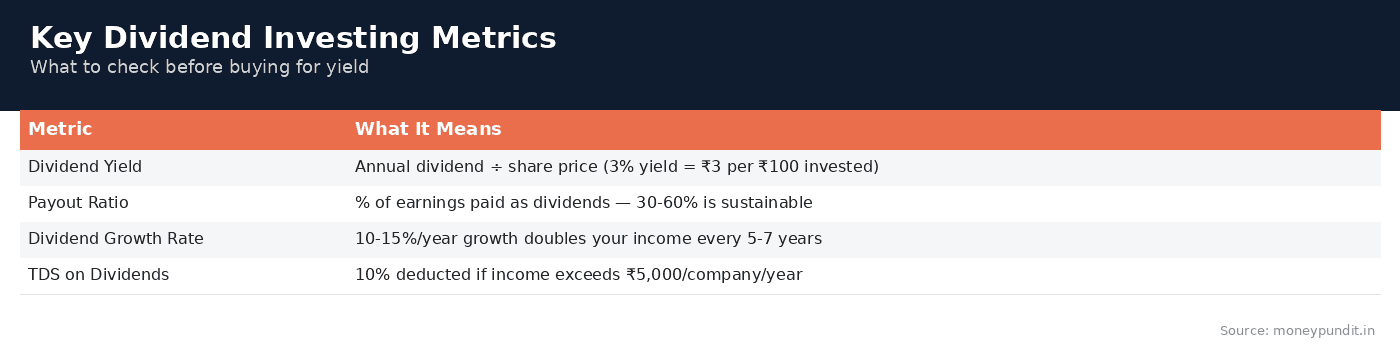
Companies declare dividends from their profits, typically as a percentage of face value or as a fixed amount per share. Interim dividends are paid during the financial year, while final dividends are declared at the AGM. Dividends are paid to shareholders registered on the record date. Since April 2020, dividends are taxed in the hands of investors at their income tax slab rate. TDS of 10% is deducted on dividend income exceeding ₹5,000 per company per year.
Key Metrics for Dividend Investors
Dividend yield is the annual dividend per share divided by the share price. Expressed as a percentage. A 3% yield means ₹3 income per ₹100 invested. Dividend payout ratio is the percentage of earnings paid as dividends, 30-60% is sustainable for most companies. Dividend growth rate shows how fast dividends are increasing, companies growing dividends by 10-15% annually double your income every 5-7 years. Look for consistent dividend payment history over 10+ years with no cuts or omissions.
Top Dividend Stocks in India
Coal India has historically offered 7-10% yields but faces long-term industry challenges. ITC offers 3-4% yield with steady dividend growth and strong FMCG business. Power Grid Corporation provides 4-5% yield backed by stable regulated utility income. Hindustan Zinc offers 5-8% yields. HDFC Bank, Infosys, and TCS offer lower yields (1-2%) but consistent growth in both dividends and share price. State-owned companies like Oil India, NMDC, and REC often have high yields but variable payout policies.
Building a Dividend Portfolio
Diversify across 15-20 dividend stocks in different sectors. Mix high-yield stocks (4-6%) for current income with dividend growth stocks (1-3% yield but 15%+ annual growth) for future income. Reinvest dividends through additional share purchases during the accumulation phase. Target a portfolio yield of 3-4% with 10-12% annual dividend growth. At this rate, a ₹50 lakh dividend portfolio generates ₹1.5-2 lakh annual income that grows to ₹4-5 lakh within 10 years without adding new capital.
Dividend Investing vs Growth Investing
Dividend stocks tend to be mature companies with stable cash flows, they offer lower volatility but also lower growth potential. Growth stocks reinvest all profits back into the business for expansion, offering higher capital appreciation but no income. For retirees and those seeking passive income, dividend investing is valuable. For younger investors with long horizons, growth investing typically builds more wealth. A balanced approach combining both styles works well for most investors.
Are high dividend yields always good?
Not necessarily: very high yields (above 7-8%) may signal that the market expects dividend cuts or the company faces financial distress. The share price may have dropped dramatically (raising the yield) for valid fundamental reasons. Always verify that the dividend is sustainable by checking the payout ratio and free cash flow coverage.
Building a Dividend Portfolio in India
Dividend stocks provide regular income while your capital remains invested and potentially appreciating. In India, look for companies with: consistent dividend payment history (10+ years), dividend yield above 2-3% (significantly above FD rates when combined with capital appreciation), low payout ratio (below 50%, ensuring the company retains enough for growth), and strong free cash flow generation. Sectors known for reliable dividends include IT (TCS, Infosys, 2-3% yield), FMCG (ITC, 3-4% yield), PSU banks (Coal India, 5-8% yield), and utilities (Power Grid, NTPC).
The total return from dividend stocks combines two components: dividend yield (2-5% annually) plus capital appreciation (8-12% for quality companies). Together, this can deliver 12-17% total returns, competitive with growth stocks but with the added benefit of regular cash flow. Reinvesting dividends through a DRIP (Dividend Reinvestment Plan) or manually buying more shares accelerates compounding significantly.
Dividend Taxation and Strategy
Since April 2020, dividends are taxable in the hands of the investor at their income tax slab rate (plus TDS of 10% on dividends exceeding ₹5,000/year from a single company). For someone in the 30% bracket, a 4% dividend yield effectively becomes 2.8% post-tax. This tax treatment has made dividends less attractive compared to the earlier DDT (Dividend Distribution Tax) regime for high-income investors.
Tax-efficient dividend strategy: hold dividend stocks in your spouse’s name if they’re in a lower tax bracket (ensure compliance with clubbing provisions), time dividend income across financial years to stay within lower tax slabs, and consider growth-oriented mutual funds with SWP (Systematic Withdrawal Plan) as a tax-efficient alternative to dividend income. Use our Capital Gains Tax Calculator to compare the after-tax returns of dividend versus growth investing strategies for your specific tax situation.
Key Insight: Dividend investing works best as a long-term compounding strategy. Reinvest dividends through SIPs or DRIPs to buy more shares, which generate more dividends, creating a virtuous cycle. Focus on companies with a track record of increasing dividends annually. For a broader wealth-building approach, combine dividend stocks with growth-oriented SIP investments.
References: Amfiindia.com
Source: amfiindia.com
Dividend investing: Key Takeaways
Key points on dividend investing:
- Companies declare dividends from their profits, typically as a percentage of face value or as a fixed amount per share.
- Dividend yield is the annual dividend per share divided by the share price.
- Coal India has historically offered 7-10% yields but faces long-term industry challenges.
Verify the latest dividend investing figures with RBI before you act.